


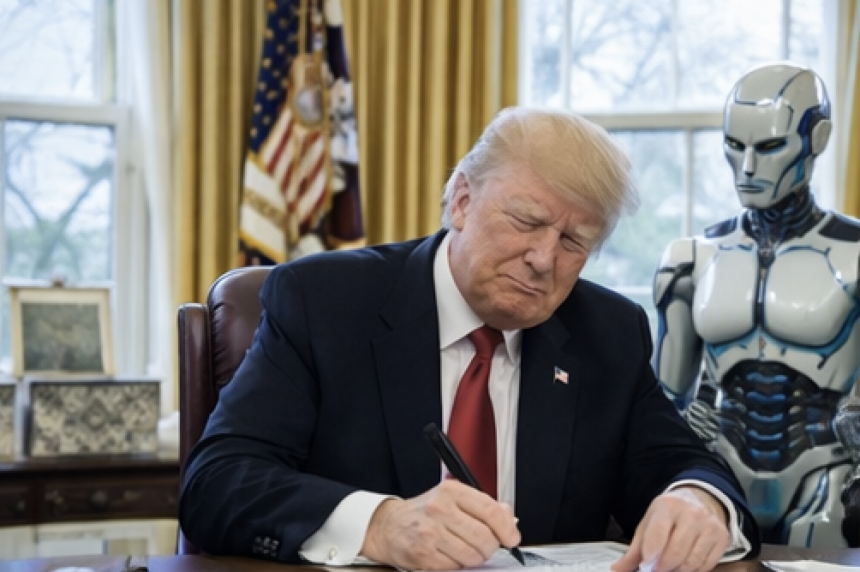
The White House wants one AI rulebook, fewer state obstacles, and a faster race toward American AI dominance.
The Trump White House just drew a harder line on AI regulation. On March 20, the administration released a national legislative framework for artificial intelligence and told Congress to build one federal standard instead of letting states write their own rules. The plan ties AI policy to child safety, energy costs, free speech, copyright, workforce training, and America’s race with China.
That makes this more than a routine policy memo. The framework shows how President Donald Trump wants Washington to treat AI: cut friction, curb state-level barriers, protect children, and speed infrastructure. Supporters see clarity. Critics see a light-touch federal blueprint that leaves hard safety questions in the hallway.
What’s Happening & Why This Matters
The White House Wants One National AI Standard
The administration’s core message is simple. Congress should pass a national AI framework and stop a patchwork of state laws from shaping the market. The White House said the federal government must “protect American rights, support innovation, and prevent a fragmented patchwork of state regulations.” That line is the centre of the whole document.
The framework argues that state laws can slow AI development, burden users, and weaken U.S. competitiveness. It says Congress should preempt state AI laws that impose “undue burdens” and create one “minimally burdensome national standard.” The document carves out room for states to enforce general laws on child protection, fraud, consumer protection, zoning, and their own government use of AI.
That split matters. The White House is not asking states to vanish from the picture. It is trying to stop states from becoming primary AI regulators. That approach fits Trump’s broader push for national control over AI policy and stronger federal leverage over infrastructure and technology competition.
Trump’s AI Policy Favours Speed Over Restrictions
The framework does not read like a safety-first crackdown. It reads like a growth plan with guardrails. The White House says the goal is “winning the AI race” while building public trust. Reuters reported that the plan urges lawmakers to remove barriers to innovation, accelerate AI deployment across business sectors, and make it easier to build advanced AI systems.

That tone will please many large tech firms. A single federal rulebook is easier to manage than dozens of state laws. Industry groups have pushed for that outcome for months. Investors like clarity, too. So do companies build models, chips, tools, and data centre capacity?
Still, the tradeoff is obvious. A lighter rule set can speed product releases and infrastructure buildout. The same approach can leave unresolved questions around liability, safety testing, privacy, and national security. That is why the policy will attract support from innovation hawks and scepticism from lawmakers who want stronger accountability.
Child Safety at the Forefront
The administration placed child safety at the top of the framework. The White House said parents need more tools to manage children’s digital lives, including account controls that protect privacy and help manage device use. The document adds that AI platforms likely to be accessed by minors should include features that reduce sexual exploitation risks and self-harm encouragement.
Reuters reported that Michael Kratsios, Trump’s science and technology adviser, described child protection as one of the key pieces that could help build bipartisan support. He said, “We need one national AI framework, not a 50-state patchwork.” He added that the plan could come together by focusing on protecting America’s children.
That emphasis is politically smart. Child safety carries wider support than abstract debates over model governance. It gives the White House a more public-facing reason for federal action while preserving the lighter-touch structure favoured by many in the tech sector.
Data Centres, Energy Policy Are Critical
This framework is not only about software. It is about power. The White House says communities should not bear rising electricity costs caused by AI infrastructure. It calls on Congress to streamline permitting so data centres can generate power on-site. The stated aim is better grid reliability and less pressure on ratepayers.

That section matters because AI policy is quickly turning into energy policy. Data centres need land, permits, water, chips, transmission, and huge power loads. The administration wants to remove bottlenecks. In plain terms, Washington is saying: if America wants AI dominance, America needs faster infrastructure.
This fits Trump’s wider pitch around industrial speed. It treats data centres as strategic assets, not just private facilities. Critics will likely argue that faster permitting can weaken oversight. Supporters will argue that delay helps rivals abroad. Either way, the administration is making energy and AI part of the same political sentence.
The Light Touch: Copyright, Free Speech, and Censorship
The framework says America should respect intellectual property rights and support creators. At the same time, it argues that AI needs enough room to learn from the world around it. That language points toward a looser posture than some creators want. The White House is trying to balance creator protection with continued model development.
The document takes a similar line on speech. One section focuses on preventing censorship and protecting free speech. Rather than calling for a new central AI regulator, the framework leans toward sector-specific oversight and non-regulatory tools in several areas. The overall tone is clear: regulate with a scalpel, not a shovel.
That will draw applause from some policy conservatives and tech backers. Others will say the framework understates the scale of harm that AI can cause in labour markets, public discourse, security, and personal privacy. The fights over copyright lawsuits and AI-generated content rights are nowhere near finished.
National Security Not Detailed
One of the biggest critiques will focus on what the framework leaves thin. Reuters noted that the four-page document barely touches on national security, despite concerns in Washington over China, chip exports, and the military value of advanced AI systems. That omission stands out because the White House repeatedly frames AI as a national race tied to strategic dominance.
The contradiction is hard to miss. The plan says AI leadership matters for national security. Yet the framework gives more concrete details on children, energy, and regulatory structure than on defence or export risk. For critics, that gap will feel too large. For supporters, the answer will be that this document is a legislative blueprint, not a full national security doctrine.
Either way, lawmakers will notice. AI policy is no longer a side issue in Washington. It sits inside trade, defence, infrastructure, labour, speech, and industrial competition. A four-page framework can start that discussion. Congress still has to turn the broad strokes into real law.
Congress Still Holds the Pen
This is the key political fact. The White House has released a framework. Congress must still write, debate, amend, and pass legislation. That process will not be smooth. State officials will resist broad preemption. Some Republicans will object on federalism grounds. Democrats will likely demand tougher consumer, privacy, labor, and safety protections.
Reuters reported that House Republican leaders, including Speaker Mike Johnson and Steve Scalise, praised the framework as a roadmap that can offer innovators certainty while protecting consumers and children. That support gives the administration momentum in the House. The Senate will be harder terrain.
The coming fight will shape more than AI policy. It will test whether Washington can build a federal technology framework before the states fill the gap themselves. If Congress stalls, state rulemaking will keep moving. If Congress acts, the White House wants a standard that favors innovation, speed, and national scale over fifty competing systems.
TF Summary: What’s Next
The Trump administration has made its position clear. AI regulation should live mainly at the federal level, move with a lighter touch, and support faster infrastructure, stronger child protections, and American AI dominance. The framework gives Congress a political map, but not the finished road. The real contest starts on Capitol Hill, where lawmakers will decide how much freedom, accountability, and preemption this industry gets.
MY FORECAST: Washington will keep moving toward a national AI standard, but the path will turn rough fast. Child safety and data centre policy will pull bipartisan interest. State preemption and lighter liability rules will spark tougher resistance. The final law, if one arrives, will likely keep Trump’s pro-growth core while adding more limits than the White House wants. That is where the real definition of U.S. AI regulation will take shape.
— Text-to-Speech (TTS) provided by gspeech | TechFyle