


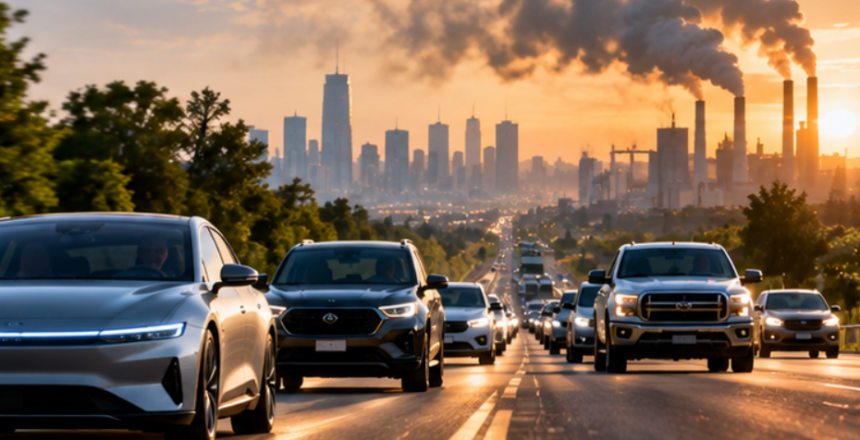
The penalty for missing the target was already zero. The target drops from 50.4 mpg to 34.9 mpg, and the administration says a new car costs $1,300 less. Nobody’s shown the maths.
The Department of Transportation finalised a rewrite of federal fuel economy rules on 28 September, cutting the Corporate Average Fuel Economy target for model year 2031 from 50.4 mpg, set under the Biden administration, to 34.9 mpg, a figure close to where the standard sat in 2014. Transportation Secretary Sean Duffy called the new rule, SAFE Vehicles Rule III, a set of “common-sense” guidelines. President Trump posted that the change would “take the waste out of building cars in America” and lead to “LOWER PRICES.”
What’s Happening & Why It Matters
A Penalty of Zero
CAFE standards have set fleet-wide fuel economy targets for automakers since 1975. The One Big Beautiful Bill Act, passed in July, had already reduced the financial penalty for missing those targets to $0, a change the industry itself called defanging. Monday’s rule goes further, lowering the target automakers must meet in the first place, even though missing it carries no cost.
NHTSA, which administers CAFE, projects the rule will cut annual oil consumption by 1.3 billion barrels by 2050 compared with 2024 levels. That projection is next to the rule’s direction: a lower fuel economy target should, on its face, increase fuel consumption per vehicle, not reduce it. NHTSA hasn’t published the full modelling behind its oil-consumption claim.
A $1300 Price Reduction
The administration says the change will make new vehicles $1,300 cheaper on average and save Americans $138 billion over five years. Patricia Hughes-Cromwick, an economist who studies the auto industry, told NPR the long-term risk cuts the other way: weaker standards could leave American manufacturers behind in a global market where other regions keep tightening their rules. Sue Helper of Case Western Reserve University made a similar point, arguing the rollback will slow the industry’s shift toward more efficient and electric vehicles at a time when global competitors are accelerating theirs.
The rule also eliminates CAFE credit trading starting with the 2028 model year. That system let automakers who exceeded fuel economy requirements sell compliance credits to companies that fell short, a mechanism that benefited EV-focused manufacturers with surplus credits to sell. Removing it cuts off a revenue stream those companies had built into their business models.
Automakers Want Stability
The Alliance for Automotive Innovation, the trade group representing major manufacturers, responded to the rule with measured caution rather than celebration. “NHTSA made the right call to better align fuel economy standards with the law and current market conditions,” the group said, while adding: “What the industry needs is long-term regulatory stability that includes balanced, durable and achievable fuel economy standards that continue to reduce emissions and improve fuel economy.”
That’s a trade group thanking the administration for flexibility while asking, in the same breath, for the opposite of what a third major CAFE rewrite in a decade delivers. Katherine García of the Sierra Club stated the trade-off more bluntly: “Less fuel-efficient cars mean more gas burned, spending more at the pump, and dirtier air in our communities.”
TF Summary: What’s Next
SAFE Vehicles Rule III applies to model years 2022 through 2031, with CAFE credit trading ending for the 2028 model year onward. No legal challenge has been filed against the rule as of this writing, though environmental groups have signalled litigation. NHTSA hasn’t published detailed modelling supporting either the oil consumption or the $1,300 price claims.
MY FORECAST: Expect a legal challenge from Democratic-led states within months, following the same pattern that met the first Trump administration’s 2019 CAFE rollback. The $1,300 savings claim will draw the sharpest scrutiny once independent analysts publish their modelling, since removing a compliance requirement doesn’t mean manufacturers pass savings to buyers rather than absorbing them as margin. Watch whether automakers slow their EV production plans in response, or continue regardless, given how much capital several manufacturers have already committed to electric platforms that don’t depend on CAFE credits to be profitable.
Related Stories
- JCB’s Hydrogen-Powered Car Sets New 406 MPH Speed
- The 2027 Q9: Audi’s Techy, Full-Size Luxury SUV
- Bentley’s First EV Has Live Musicians Instead of an Engine