


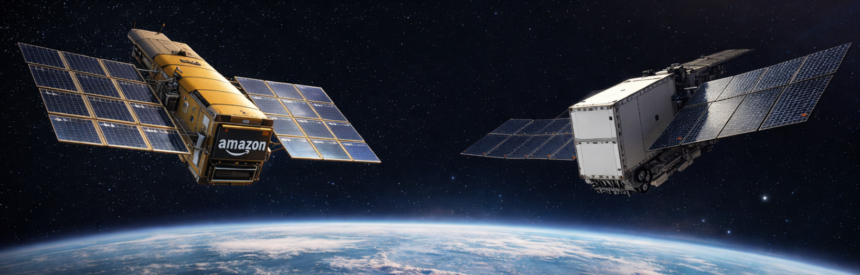
Low-Earth orbit is starting to resemble a boardroom knife fight with rockets attached.
The satellite internet race has entered a nastier phase. SpaceX is accusing Amazon Leo of raising collision risk in low-Earth orbit. Amazon is reportedly trying to buy Globalstar for about $9 billion (€8.3 billion) to strengthen its hand against Starlink. Delta Air Lines has chosen Amazon Leo for future in-flight Wi-Fi on 500 aircraft starting in 2028. Amazon is even testing a smaller custom satellite dish with an Israeli firm as the company sharpens its hardware stack.
None of that reads like a calm infrastructure rollout. Every move points to a larger truth: satellite broadband is no longer a quirky side market for remote cabins and cruise ships. The sector has turned into a fight over orbital access, hardware, airline contracts, regulatory patience, and plain-old market dominance. SpaceX has the lead. Amazon has the money. Everyone else gets a front-row seat to the shoving match.
What’s Happening & Why This Matters
Playing Safely in Orbit
The loudest clash of the week came from the Federal Communications Commission, where SpaceX accused Amazon and launch partner Arianespace of creating unnecessary collision risk by placing Amazon Leo satellites into insertion orbits higher than expected. SpaceX argued that the 12 February 2026 Ariane 6 launch inserted satellites roughly 50 to 90 km (31 to 56 miles) above the altitude Amazon had led regulators and rivals to expect. According to SpaceX, that created “unmitigable collision risks” and forced about 30 collision-avoidance maneuvers by Starlink satellites within hours of launch.
Amazon fired back. The company said the launch altitudes still fit inside the language of its license, that it had disclosed the altitudes to the FCC, and that SpaceX only started complaining after moving parts of the Starlink constellation into the same orbital neighborhood. Amazon added that SpaceX itself had launched Amazon satellites into similar insertion altitudes in 2025.
That exchange says plenty about the market’s stage. Both firms are past the polite period. Each side is accusing the other of using regulators as a cudgel. The competitors claim the mantle of space safety. Each side wants the FCC to notice who is allegedly a grown-up and who is a maverick.
The point is here: once constellations grow into the thousands, orbital etiquette stops sounding academic. A few dozen emergency maneuvers are not PR fluff. They are a preview of what happens when two giant systems start crowding the same roads.
Buying Globalstar Is A Winning Shortcut
Orbit fights are only one part of the war. Amazon is reportedly in talks to buy Globalstar in a deal valued at around $9 billion (€8.3 billion). The acquisition would help Amazon accelerate the satellite ambitions wrapped into its rebranded Leo business and give the company a stronger existing communications footprint while trying to catch Starlink.

That rumored deal carries more bite than a routine acquisition. Globalstar already owns spectrum, runs a live satellite business, and has valuable ties in enterprise, government, and consumer communications. Apple complicates the picture because the company owns about 20% of Globalstar and uses much of its network capacity for emergency SOS and satellite messaging on iPhones. Any Amazon deal would therefore require more than a simple handshake between buyer and target.
The logic still looks obvious. Amazon Leo trails Starlink badly in deployed scale. Amazon has roughly 180 satellites in orbit under the Leo effort, while Starlink has more than 9,500 and over 9 million users worldwide. Buying Globalstar would not erase that gap overnight. A deal would still give Amazon assets, relationships, and operational muscle far faster than building everything from scratch.
The rumor is important. Amazon is not only racing to launch more satellites. The online retailer may be trying to buy a shortcut through a market where SpaceX already owns the loudest head start.
Amazon Leo Gets a Viable Commercial Win
A constellation can sound exciting in investor decks and still struggle to win meaningful customer commitments. Amazon Leo just picked up one. Delta Air Lines has chosen Amazon Leo for future in-flight Wi-Fi, with an initial rollout planned across 500 aircraft beginning in 2028. Delta CEO Ed Bastian said the agreement offers “the fastest and most cost-effective technology available” for better global connectivity.
Airlines do not buy satellite connectivity for the vibes. They buy performance, coverage, cost control, and reliability. In-flight Wi-Fi contracts carry prestige because they turn a constellation into a visible everyday service rather than a technical promise floating above the atmosphere.
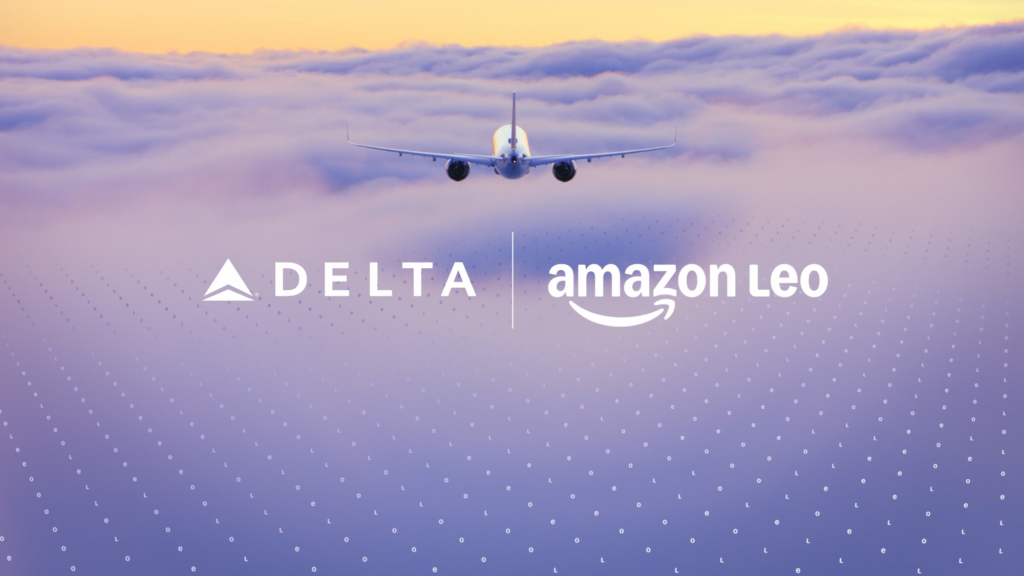
The Delta win gives Amazon Leo something valuable beyond revenue. The deal gives the company a proof point. SpaceX already has a dominant public story around Starlink’s scale. Amazon needs commercial landmarks to show the market that Leo is not only a very expensive catch-up exercise.
And yes, the choice stings for Starlink fans. An airline picking Amazon’s future network over the loudest name in the category tells everyone that incumbency is not everything. Contracts can still be won on timing, pricing, and long-game confidence.
The columnist version is simpler: Delta just handed Amazon a respectable trophy in a race where SpaceX had been collecting most of the shiny objects.
Who Wins the Ground Game?
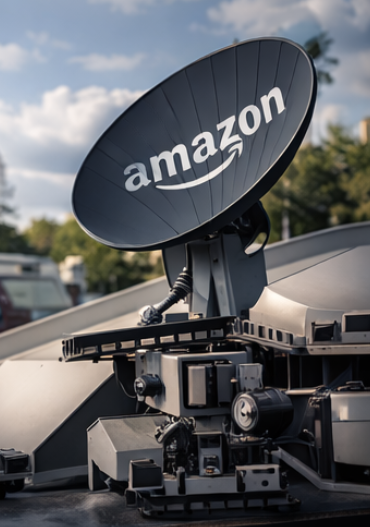
Satellites grab the glamour. Terminals often decide the business. Amazon is testing a custom user terminal with Israeli firm Get SAT, according to reporting tied to an FCC experimental filing. The tests would take place north of Los Angeles. The aim is to evaluate a smaller satellite communications antenna that could help Amazon Leo compete more effectively on the customer-equipment side.
The details are more critical than many people realise. Satellite internet is never only about what is in orbit. Ground equipment shapes installation cost, portability, customer experience, and where the service can realistically go. A more compact dish can widen the addressable market for airlines, vehicles, enterprise users, government customers, and mobile scenarios where bulkier hardware is a pain.
Starlink has already scored well. SpaceX did not merely launch satellites. The company turned user terminals into a recognizable consumer object. Amazon needs a good orbital story, but Amazon needs a cleaner hardware story, too.
That is why the Get SAT test sounds smart. No one wins a satellite broadband war by pretending the dish does not count.
More Strategic, Political, and Crowded
Put the week’s developments together, and a rougher picture appears. SpaceX is policing orbital patterns aggressively. Amazon is flexing its acquisition muscle. Airlines are picking sides. Smaller hardware prototypes are heading toward field tests. None of that looks accidental. The market is more strategic by the month.
Satellite broadband already touches defense, aviation, maritime connectivity, disaster response, remote industry, and ordinary consumer internet. That means regulators, governments, airlines, and enterprise buyers all have skin in the game. Once that happens, a satellite war stops looking like a nerdy launch-count competition and starts resembling a bigger struggle over infrastructure power.
SpaceX still holds the upper hand. Starlink has the scale advantage, the user lead, the satellite count, and a far more mature public footprint. Amazon, however, has money, distribution muscle, cloud relationships, and enough patience to turn a late start into a slower, heavier punch.
The real danger for both companies is the same. The more crowded the orbital highways get, the harder the operational mistakes bite. Space safety disputes will intensify. Hardware economics will factor in more. Commercial contracts will carry more symbolic weight. Regulatory filings will keep doubling as competitive weapons.
That is not a gentle market. That is a market that has stopped pretending everybody can simply coexist while building giant constellations in peace.
TF Summary: What’s Next
Satellite wars are entering a sharper chapter. SpaceX says Amazon Leo’s launch choices have raised collision risk and triggered dozens of avoidance maneuvers. Amazon is reportedly pursuing a $9 billion (€8.3 billion) acquisition of Globalstar to strengthen its satellite position. Delta has selected Amazon Leo for future in-flight Wi-Fi on 500 aircraft beginning in 2028. Amazon is even testing a smaller custom antenna with Get SAT to strengthen the ground hardware story.
MY FORECAST: SpaceX will keep the scale crown for a while, but Amazon will keep building pressure through contracts, hardware, and acquisitions. The nastiest fights will not come from rocket launches alone. The real bruises will come from spectrum, terminals, airline deals, and orbital safety complaints filed with regulators. Low-Earth orbit is getting crowded. The diplomacy is already getting ugly.
— Text-to-Speech (TTS) provided by gspeech | TechFyle