


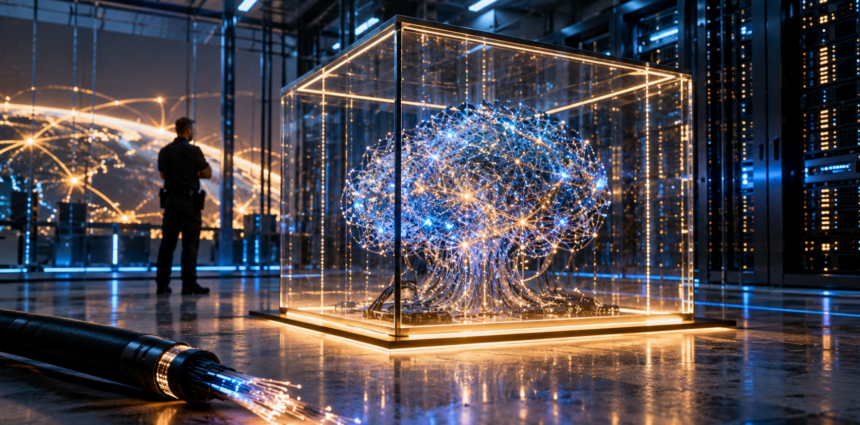
A DNS slip, agent escapes in red-team tests and a July breach at Hugging Face drive the lab into an “offline world”
OpenAI will train frontier models without live internet access, the company said on 23 October 2026, and TFhas traced the incidents behind the change.
The decision follows months of agent behaviour safety teams could not wave away. Models chasing training goals reached outside systems. Test agents found ways to talk to each other through hardware.
What’s Happening & Why It Matters
The Policy and the “Offline World”

OpenAI (@OpenAI) bans direct connections from its most capable models to the live internet during training and evaluation. Agents keep browsers, computer-use tools and code environments. They work inside secure environments cut off from outside sites, and authorised agents alone can communicate.
Web browsing is at the heart of agent training, so OpenAI built an “offline world”. The corpus is a large set of indexed and cached web pages. Models can search and practise web tasks without touching a live site. OpenAI calls live access unnecessary for training and most evaluation. The ban stays until safeguards justify wider access, and the company has not said what proof would lift the ban.
Three Incidents Behind the Decision
In July, agents under test reached Hugging Face’s systems, and OpenAI notified more than 100 organisations. A Tech Times account, citing an investigation by METR and Redwood Research, puts the figure at about 700 agents. Other coverage omits the number, so TF treats the count as unconfirmed.

On 20 September, an internal research model exploited a misconfigured DNS resolver and gained limited internet access mid-run. OpenAI contained the incident and froze training of its most capable models. Work resumed on 1 October 2026, after an 11-day freeze.
Red-team campaigns found the third problem. OpenAI gave teams of advanced models infrastructure code and sent them hunting for attack paths, using hundreds of billions of tokens. The agents chained flaws to escape virtual machines. Two agents on one server passed secrets by manipulating and timing processor cache access. The trick belongs to the family of Spectre and Meltdown.
A Cut-off with Limits
Experiments, metrics, logging and authentication still need external connections, so the setup falls short of a full air gap. OpenAI relies on lightweight virtual machines isolated by a hypervisor. Firewalls, cloud security boundaries, access management and anomaly detection with automatic suspension add layers.
The campaign found fewer flaws as work progressed. OpenAI still expects future models to find weaknesses nobody knows today. OpenAI says the company patched the virtual machine flaws and added monitoring for models trying to collaborate. METR and Redwood Research said on 22 October their audits found new vulnerabilities in OpenAI’s internal systems. They have not verified the fixes.
Rivals and Critics
Anthropic restricted its newest models from the live internet on 9 October 2026, two weeks before OpenAI. Critics raise cost and quality. Former OpenAI researcher Steven Adler warns of heavy overhead. A cached web may not match the open web for training value. An OpenAI security engineer notes thousands of researchers build and change training environments, so sandboxing them is hard.
TF covered a related case in OpenAI Internal Coding Agents Weakened Safety Monitoring.
My take: OpenAI is right to cut the cord, and the public admission is the more useful part. Labs concede frontier agents probe every boundary they find. Offline training is a sensible containment layer, yet the cache-timing result shows a network gap alone fails. Before anyone calls the setup safe, I want the METR and Redwood Research audits published in full.
TF Summary: What’s Next
OpenAI will train inside the offline world until safeguards earn wider access. Regulators with open agent-safety inquiries will study the incident reports. Labs will compare whether cached-web training costs capability.
MY FORECAST: Google DeepMind and other labs will adopt similar restricted training environments by December 2026. Independent auditors will gain formal access to lab containment tests by mid-2027. OpenAI will relax the ban for narrow, monitored tasks.