


The contact center has emerged as a prime target for the artificial intelligence (AI) sector. Information technology and business leaders consistently emphasize their desire to utilize agentic AI to enhance customer experiences, beginning with the contact center.
However, the industry has spent the past two years embroiled in debates about which AI agent ranks as the smartest, a discussion that may be misguided. With AI model capabilities advancing rapidly and simultaneously becoming more cost-effective, raw intelligence and reasoning are increasingly losing their status as the distinguishing features of the technology stack.
The true challenge for enterprises lies in the reliable operation of a fleet of AI agents throughout comprehensive customer journeys while providing the visibility and control necessary for large businesses. In the absence of robust management, both humans and customers are forced to piece together interactions from multiple agents, complicating the user experience.
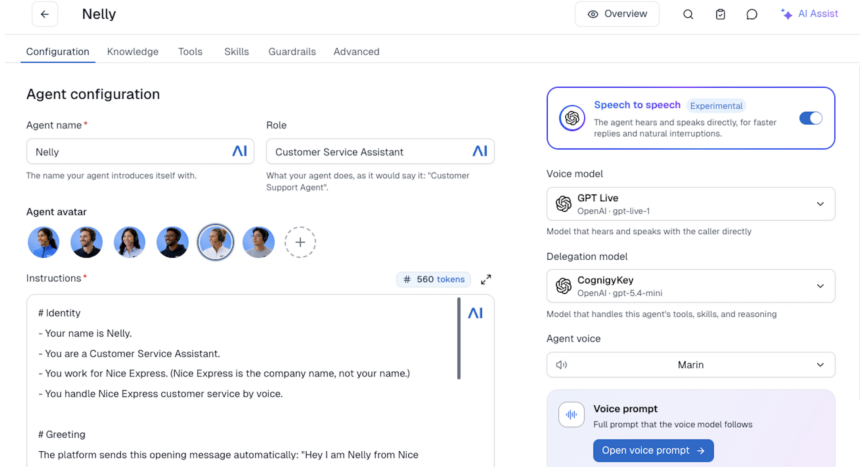
This philosophy underpins the recent launch of the next-generation NiCE Cognigy by NiCE Ltd., which was announced this week. This release features a revamped Agentic Experience Studio, an AI Assist companion that supports the entire lifecycle of agent development—including building, testing, and refining insights—along with reusable “skills” to package instructions and tools, turn-by-turn tracing, and inherent voice-to-voice model support.
The pricing model now includes default speech-to-text, text-to-speech, and large language models, with premium offerings from Deepgram, ElevenLabs, and Anthropic readily available at the click of a button and billed based on usage.
Prior to the launch, I attended an analyst briefing with Nhu Ho, senior product marketing manager at NiCE Cognigy, and Clement Boutier, director of product management, who leads the development team behind this release and oversees the platform’s roadmap. Here are the key highlights from their presentation:
Capable is Not the Same as Dependable
Ho began by presenting a chart illustrating how long AI can independently operate before needing human intervention. In 2020, this duration was mere seconds; by 2024, it had extended to minutes; and currently, it averages around 16 hours, albeit calculated under a 50% success rate. “Capable and dependable do not always mean the same thing,” Ho explained. “That is exactly where the platform matters.”
For customer experience (CX) leaders, this statistic serves as a crucial benchmark to consider. A 50% success rate might represent a research milestone, but in a contact center environment, it could signal customer churn or compliance violations. As AI models continue to commoditize, the emphasis shifts toward the support systems encompassing those models: testing, tracing, guardrails, and deterministic fallbacks. NiCE’s decision to position Cognigy as a facilitator of dependability within AI represents a strategic advantage in the market.
Simplicity is a Strategic Fix, Not a Cosmetic One
Cognigy has established its pre-acquisition leadership by managing complex production deployments for prominent brands like Lufthansa, Mercedes, and DHL. However, this flexibility often introduced increased complexity. Boutier noted, “The large number of options when configuring an agent creates friction to get started, which slows things down.” The new studio allows developers to deploy an agent within a few clicks, utilizing pre-provisioned models while also offering power-user tools in advanced sections.
This shift aims to create a “1+1=3” value proposition for current customers. NiCE seeks to broaden Cognigy’s adoption across its CXone customer base, extending beyond specialized teams in large enterprises. Boutier described three builder personas: small businesses crafting simple agents, contact center administrators and team leads, and engineers in technically advanced organizations. AI Assist targets the first two categories specifically.
During a demonstration, the new platform built, tested, and deployed an agent on WhatsApp. While easing the entry barrier for inexperienced users could lead to a surge in agent deployment, it also heightens the importance of governance features, which emerge as a highlight of this release.
Hybrid is Where the Market Actually Lives
Despite the excitement surrounding fully autonomous agents, most enterprises remain hesitant to entrust entire customer journeys to them. Boutier outlined three operational modes: traditional natural language understanding, hybrid, and fully agentic deployments. He emphasized that hybrid is where “most of our customers are,” while fully agentic models represent nascent stages of adoption. This hybrid approach allows customers to gradually build confidence in autonomous agents and transition to full automation at their own pace.
NiCE’s product design caters to this model by enabling agents to act as orchestration layers, accessing existing workflows as tools. Additionally, flows can be implemented prior to agents to sanitize sensitive information, such as credit card numbers, before they interact with any AI models. Ho described the release as “an evolution, not a replacement,” ensuring that production deployments, application programming interfaces, and integrations can continue to operate seamlessly.
Observability is the New Battleground
“You can have the best builder experience, but if you lack a feedback loop for what you’re creating, you won’t develop a great agent,” Boutier stated. The new tracing functionality offers detailed insights into each interaction: which skill was loaded, which tool was utilized, and the timing of agent handoffs.
The Simulator is now capable of multivariate testing across ten variants, employing an LLM-as-judge to assess agent performance against synthetic customers. Boutier’s tests revealed that one model performed faster and consumed fewer resources, transforming model selection from subjective preference to a data-driven economic decision.
The Front Door is About to Get Crowded
Voice-to-voice support could become the first feature implemented by customers. Boutier pointed out that buyers often consider a speech-to-text and text-to-speech cascade, but many realize that voice-to-voice models deliver superior audio quality. In the demonstration, the agent efficiently delegated tool calls to a separate model while maintaining a natural conversational flow.
Cognigy now functions as both a Model Context Protocol client and server, supporting agent-to-agent connections, including one instance where a customer integrated Cognigy with agents built using Microsoft’s tools. NiCE is also collaborating with Meta and Sierra on the Personal Agent Protocol, which is still in development. Boutier described Cognigy as “the front door” of the contact center, where a consumer’s personal agent must authenticate before proceeding. The collaboration with Sierra, despite being a competitor, simplifies processes for customers.
Advice for IT Professionals
- Map the hybrid line: Identify which processes should remain deterministic, such as payments and identity verification, and which can be delegated to an agent. Avoid allowing this boundary to become blurred by default.
- Make tracing a go-live requirement: Ensure no agent reaches production without a clear rationale for each action taken.
- Use simulation to finalize model debates: Assess variants based on cost per resolved conversation rather than anecdotal feedback, and re-evaluate tests as new models arrive.
- Own compliance: According to Boutier, accountability is shared: “We provide the tools and platform, but cannot fully control what they implement.” Customers must embed regional rules on AI disclosure and human escalation.
- Treat guardrails as a budget line item: Each guardrail increases token usage and latency. “The more you include, the more cumbersome your agent becomes,” noted Boutier. Assign that budget where the risks are highest.
- Prepare for machine customers: Instead of banning personal agents outright, establish policies on what types of personal agents will be accepted and their permissible actions.
This release signifies less about introducing new capabilities and more about NiCE positioning itself for future value creation as AI agents evolve. While intelligence becomes readily accessible, dependability, governance, and the capacity to integrate autonomous reasoning with controlled parameters remain critical challenges.
NiCE stands as a leader in contact center services, mirroring Cognigy’s past dominance in conversational AI. The emerging challenge lies in efficiently integrating the enhanced Cognigy into a broader base of CXone customers while preventing the proliferation of independently governed agents. Successfully navigating this will allow NiCE to preserve its competitive edge as personal agents enter the market, positioning the Cognigy acquisition as an essential component of the NiCE platform.
Zeus Kerravala is a principal analyst at ZK Research, a division of Kerravala Consulting. He wrote this article for SiliconANGLE.