


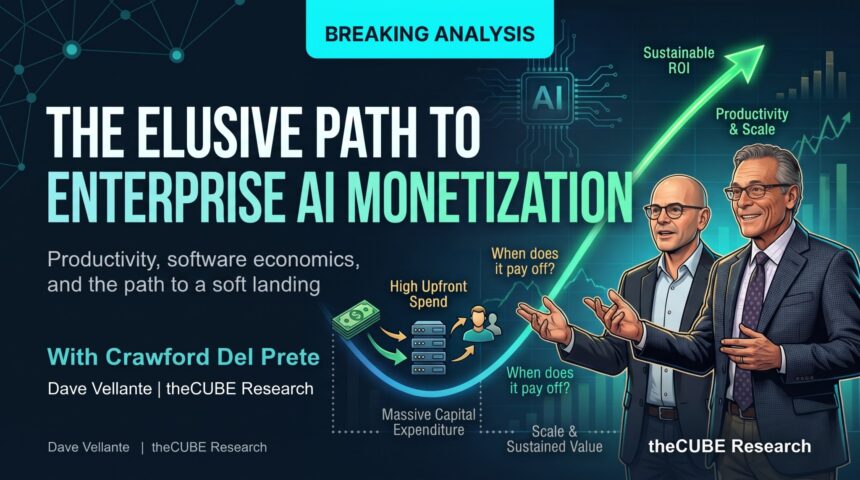
The AI Buildout: Examining Economic Viability and Enterprise Investment in AI Technologies
The artificial intelligence (AI) buildout is making a significant wager on what businesses are ultimately prepared to invest in intelligent solutions. According to our summer analysis, which focused on forecasting the AI bubble, we underscored that a crucial metric to monitor is the productive utilization by enterprise customers.
At that time, we noted that if the supply of infrastructure catches up with demand before meaningful monetization occurs, the risk of an economic bubble bursting would escalate to concerning levels. We speculated that existing supply constraints, coupled with strong capital funding appetites, might create conditions conducive to a soft landing, forecasting 2029 as a particularly high-risk year.
This raises a pivotal query: What transformations must occur within mainstream enterprises for their investments in AI to generate sufficient economic returns? Notably, Michael Burry’s analysis of Anthropic PBC emphasizes the scale and interconnectedness of Anthropic’s commitments, while Apollo’s research led by Torsten Slok questions the breadth of financial benefits currently being realized. Historical precedents set during the personal computer and internet revolutions serve as a reminder that productivity gains may not be immediate, and influential technologies can coexist with initially lackluster investment returns that require time to surface.
We believe the route to a soft landing is contingent upon fundamental changes in how businesses operate, specifically regarding their workflows, workforce requirements, scalability, and the ultimate value they deliver to customers. Welcome to Breaking Analysis, episode 332: Can enterprise AI fuel a financial boom?
Today, we are joined by Crawford Del Prete, the former president of IDC and now a senior advisor at PSG Equity. With decades of experience observing technology transitions, Crawford provides current insights into how software companies are evolving with AI, the emergence of new AI-native firms, and what the emerging operational models appear to be. It’s great to have you with us, Crawford.
Crawford Del Prete: Hey, great to see you, Dave.
Shifting Economics Through AI Adoption
Dave Vellante: As we record this, the Nasdaq has dropped nearly 1,000 points, currently down 937. The drivers of this decline include disappointing earnings reports from major hyperscalers. Google faced challenges in its advertising revenue, while AWS’s capital expenditures and negative cash flow played a significant role. Nonetheless, cloud services continue to expand. Let’s kick things off with your perspective on where AI is shifting economic paradigms within businesses.
Crawford Del Prete: AI is affecting various economic facets across industries. Early indicators of productivity gains are emerging, although they haven’t yet reflected in overall numbers. Companies are beginning to automate workflows more extensively and apply AI in traditional avenues—such as coding and customer service—while now also venturing into other operational areas to automate specific tasks.
The outcomes are uneven as AI’s impact varies widely within organizations. Job roles typically comprise numerous tasks, which are now being automated without significant restructuring of work processes, resulting in inconsistent productivity metrics.
Investment and Commitment to AI Infrastructure
Dave Vellante: Reflecting on our past experiences, we’ve seen that technology historically drove deflationary trends, but now technology appears to be inflationary. In light of Anthropic’s recent S-1 release showcasing staggering revenue growth predictions, the focus has shifted to understanding economic returns on extensive infrastructure commitments. The company reported $132 billion in liquid assets—cash and equivalents—making it one of the top capital-holding non-banks in the U.S., second only to Alphabet and Berkshire. With significant capital involved, what are your thoughts on the sustainability of these economic returns?
Crawford Del Prete: The financial intertwining of AI investments is complex. There’s a vast mesh of funding, commitments, and commercial agreements surrounding Anthropic, demonstrating the depth of these interconnections. For instance, Michael Burry’s analysis revealed $537 billion in multiyear compute commitments tied to various arrangements. While this figure marks substantial investment, the fundamental question remains: how effectively will AI monetize this capacity?
Furthermore, while some enterprises express insatiable demand for compute capacity, others are cautious, contemplating budget efficiencies through optimizing workloads and exploring usage of different AI models. The journey to harness AI’s full potential is in its infancy, reminiscent of earlier tech adoption cycles, where initial enthusiasm differed markedly from eventual market evolution.
Emerging Workflows and Automation Trends
Dave Vellante: With the rapid evolution of AI technologies, how are organizations approaching the complexity of integrating AI with existing workflows and processes?
Crawford Del Prete: The approach varies greatly; however, leading organizations are beginning to decentralize and democratize AI capabilities. Instead of merely automating existing processes—what I term “paving the cow path”—these companies are actively rethinking workflows, understanding pain points, and leveraging AI in innovative ways. This involves grassroots initiatives such as AI hackathons that foster creativity and collaboration, leading to transformative ideas on how to structure work processes moving forward.
Such efforts signal a shift toward a more seamless integration of AI that enables not just effectiveness in automation, but a complete re-envisioning of how work gets done. This paradigm encourages flexibility, adaptability, and the development of replicable skills across organizations.
The Productivity J-Curve: Timeline for Impact
Dave Vellante: Discussing productivity patterns, let’s consider the productivity J-curve, which illustrates that gains from emerging technologies often take time to manifest at the macro level. Businesses invest in significant process improvements; however, the realization of benefits can be staggered, leading to negative cash flow for a period before transformative efficiency comes to light.
The complexities surrounding technological investments challenge traditional metrics of success and output. True productivity increases may become evident as companies begin to fully integrate advancements into their operations and reshape their approach to counting benefits.
Creating Accountability in AI Deployments
Dave Vellante: It appears that a prominent theme in our conversation is the rethinking of operational governance and accountability as AI ramps up. Sam Altman, in a recent appearance at Oracle OpenWorld, advised customers to prioritize securing their infrastructures over immediate productivity gains. How do you see this evolving within organizations?
Crawford Del Prete: We are witnessing an urgent need for organizations to reconsider their security postures as AI’s application increases. The overwhelming amount of generated code and technical debt leaves significant vulnerabilities. Companies must ensure robust security measures while simultaneously promoting a culture of accountability. This evolving infrastructure must allow for human oversight, particularly within high-stakes AI operations, to uphold accountability while harnessing the agility and efficiency that AI technologies offer.
Challenges in the B2B AI Market
Dave Vellante: Our recent survey with Qualitate has unearthed a variety of buyer scenarios. Some organizations are transitioning to more permanent AI solutions; however, technical issues persist that inhibit scaling effectively. Could you elaborate on the key challenges customers face during AI deployments and the potential pathways forward?
Crawford Del Prete: Many enterprises grapple with scalability and validation of demand, leading to cautious AI adoption. Others prefer to maintain on-prem solutions to manage sovereignty concerns, only to find that many can’t achieve necessary utilization rates for profitability. The balance between cloud advantages and on-prem demands creates a dynamic that requires innovative solutions, including hybrid cloud strategies and shared utilization models that enable scalable deployments without incurring prohibitive costs.
Redesigning Economic Models in AI Software
Dave Vellante: As businesses navigate transitions into AI-enhanced models, how do you see software companies adapting their pricing and operating models to accommodate new realities?
Crawford Del Prete: The evolution from traditional pricing methods is imperative. Many organizations are beginning to adopt usage-based pricing as opposed to fixed contracts, reflecting the dynamic nature of AI deployment and its capabilities. Understanding how to monetize AI features alongside core products remains a challenge, yet could provide substantial benefits as software increasingly embeds intelligent functionality. Companies not adapting to these trends risk losing competitive advantages as the market demands agility and flexibility.
Anticipating a Soft Landing
Dave Vellante: The unfolding narrative around AI technologies presents both opportunities and uncertainties. Monitoring core metrics, such as customer retention and effective monetization of AI investments, will be crucial for identifying whether enterprises successfully translate productivity gains into tangible financial outcomes. What critical indicators should we keep our eyes on over the coming months?
Crawford Del Prete: Retention metrics, win-loss analysis, and market responsiveness to AI-driven offerings will be indispensable in informing predictions about the trajectory of enterprise AI adoption. Furthermore, looking ahead, any advancements linked to improving next-action insights will be telling indicators of success as organizations leverage AI to enhance customer experiences through smarter operational strategies.