



Amazon spent more than a decade teaching Alexa to live inside speakers, screens, and kitchens. That phase now closes. Amazon recently released Alexa+ as a full web-based service, untethering its AI assistant from physical hardware and placing it directly in the browser. This move marks a quiet but meaningful change in how Amazon wants people to use Alexa—less as a novelty device and more as a daily, persistent digital companion.
For years, Alexa remained boxed into Echo devices. That limitation changed how people interacted with it. Short commands. Quick questions. Timers. Music. The web release opens up that behaviour. Alexa+ exists alongside ChatGPT, Gemini, and Claude as a general-purpose conversational AI — that carries Amazon’s commerce DNA at its core.
What’s Happening & Why This Matters
Alexa Beyond the Living Room

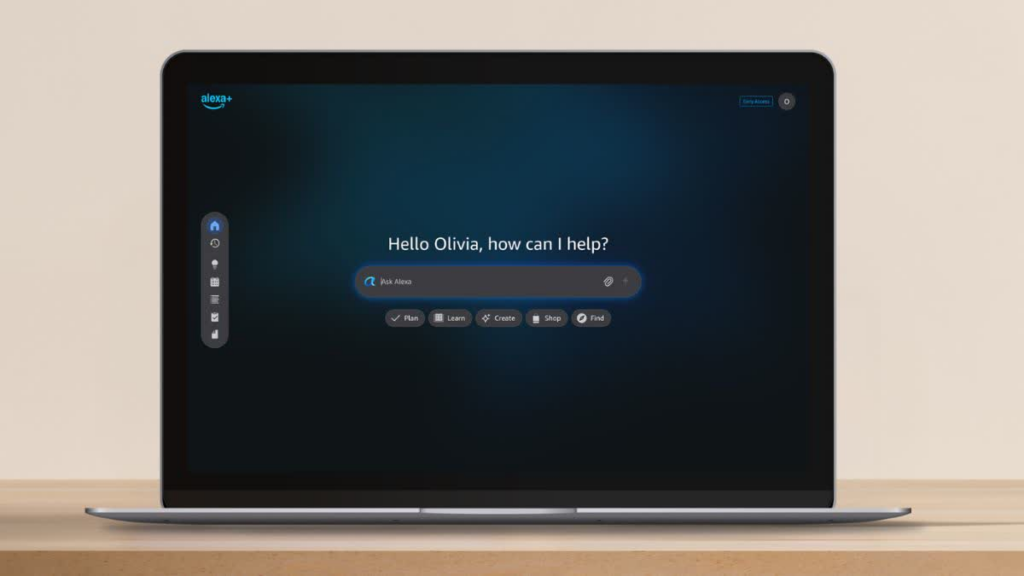
Amazon offers Alexa+ through Alexa.com and Alexa.Amazon.com, allowing anyone to access the assistant through a standard web browser. Early access removes the requirement for an Echo device, which previously acted as a gatekeeper. The decision places Alexa+ where people already work, plan, and browse.
Amazon stated that its choice is an expansion of access rather than a reinvention. In its announcement, the company said the web experience creates “a new interaction model” that lets users collaborate with Alexa across devices without losing context. Conversations persist. Preferences remain intact. Tasks continue without reset.
Continuity matters. Browser-based access allows longer sessions and deeper planning. Users now manage calendars, shopping lists, meals, travel ideas, and smart home settings from a keyboard instead of voice alone. This format suits workdays more than kitchens.
Pushing Prime

Alexa+ operates under an early access program. Once that period ends, Amazon plans to bundle the service with Amazon Prime, priced at $15/month, or sell Alexa+ separately for $20/month. This pricing presents intent. Alexa+ acts as a retention engine for Prime rather than a standalone AI product.
Amazon integrates Alexa+ directly into its retail ecosystem. The assistant connects to Amazon shopping, grocery delivery, and Whole Foods. That integration transforms AI assistance into a commercial workflow. Meal planning links to grocery orders. Event planning links to purchases. The assistant becomes transactional by design.
The structure separates Alexa+ from rivals. ChatGPT and Gemini operate as neutral tools. Alexa+ operates as a guided interface into Amazon’s economy.
Generative AI Competition
Amazon faced mounting pressure to respond to advancement from OpenAI and Google. While Alexa sold hundreds of millions of devices, it struggled to generate direct revenue. Reports long described Alexa as a costly experiment without a clear payoff.
Alexa+ represents Amazon’s attempt to reset that narrative. The assistant now uses generative AI to handle multi-step tasks, maintain context, and respond conversationally. Amazon positions Alexa+ as an “agent-forward” system capable of booking travel, organising schedules, and managing households.
The web release accelerates that effort. It places Alexa+ in direct competition with browser-based AI tools, where users already expect depth and reliability.
Limits Still Exist
Early users report mixed results. Alexa+ sometimes responds slowly. Accuracy varies. Certain features once teased — such as seamless takeout ordering—remain absent. Amazon acknowledges ongoing refinement.
Even so, the direction stays clear. Amazon no longer treats Alexa as a voice assistant alone. Alexa+ now operates as software first, hardware optional.
Industry analysts view this change as overdue. A browser interface lowers friction and increases usage frequency. It also creates space for future monetisation, including potential advertising inside AI conversations — an idea Amazon continues to explore.
TF Summary: What’s Next
Alexa+ now lives where modern work and planning already happen: the browser. The modification stretches Alexa to a persistent AI assistant rather than a household gadget. Amazon uses this release to connect AI usage directly to Prime value and commerce activity, strengthening its ecosystem lock-in.
MY FORECAST: Amazon turns Alexa+ into a core Prime utility. Usage shifts from casual voice commands toward daily planning and purchasing. Alexa is less visible yet more embedded — quietly influencing decisions through convenience rather than novelty.
— Text-to-Speech (TTS) provided by gspeech