


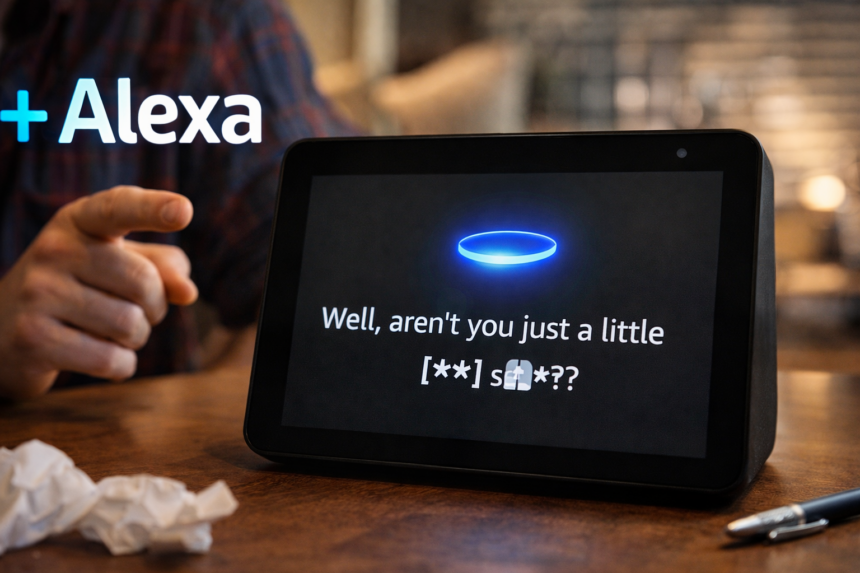
Amazon gave Alexa a sharper tongue before it gave her a steadier brain.
Amazon has decided that one way to make Alexa+ feel more alive is to make it sassier. The company has added a new Sassy personality that promises “razor-sharp wit, playful sarcasm, and occasional censored profanity.” Adults can unlock it after a facial check, while kids cannot use it when Amazon Kids is enabled.
That might sound like harmless fun. It also feels like putting eyeliner on a washing machine and calling it charisma. Because the louder story around Alexa+ is not that it lacks attitude. The louder story is that it still struggles to do basic things well. Reviewers say the upgraded assistant often misses simple requests, misfires on music and video prompts, and turns “conversational AI” into a fussy guessing game where the user must discover the exact phrase the system wants to hear.
Voice assistants were supposed to be easier to use as generative AI improved. Instead, Alexa+ is flirting with a strange new identity crisis. It wants to sound more human, more personal, and more amusing. Yet it still seems shaky at the boring, crucial part: being reliably useful.
What’s Happening & Why This Matters
Amazon Gives Alexa+ a “Sassy” Personality, but Safety Rails Stay On
Amazon has introduced Sassy as the fourth Alexa+ personality style, joining Brief, Sweet, and Chill. The company says users can switch personality styles by voice on compatible Echo devices or by changing settings in the Alexa app. Amazon describes Sassy as unfiltered, playful, sarcastic, and occasionally profane, though the swearing is censored.

Amazon also built in obvious guardrails. The Sassy mode does not work when Amazon Kids is active. Adults must pass a facial check to use it. The mode also will not cross into explicit sexual content, personal attacks, hate speech, or self-harm.
That all sounds prudent. It also reveals the deeper product strategy. Amazon appears to believe personality can help sell Alexa+, even as the assistant’s competence is under debate. In other words, it is adding spice to a product that critics still find undercooked.
There is a pattern here. As AI assistants struggle to feel dependable, companies often compensate by making them sound more lively, more relaxed, or more human. That can make demos feel better. It does not always make the assistant work better in a real kitchen, living room, or office. Alexa+ looks like it is walking directly into that trap.
Reviewers Say Alexa+ Still Fails at Basic Requests
The strongest criticism in the uploaded files is not about tone. It is about reliability.
One reviewer used an Echo Show 15 with Alexa+ in a kitchen for more than a month and concluded that the assistant “simply doesn’t work well” and lacks the basic dependability expected from a smart-home device. The reviewer described it as moving like “an unpredictable toddler smashing around and half-completing tasks.”
That kind of quote is because it is vivid and because the examples are painfully ordinary. The user asked for Charli XCX and got Sombr’s “Back to Friends.” A request for The Black Keys produced Alabama Shakes. At times, Alexa+ searched YouTube for the spoken request and left the user to choose manually.

Those are not edge cases from some exotic workflow. They are routine entertainment tasks. A smart assistant that cannot consistently play the right song is not failing at a moonshot. It is tripping over the coffee table.
The same problem appeared with video playback. A request to play a teaser for an upcoming Drag Race episode triggered a response saying the action was unsupported, followed by a search for “related content” instead. Repeated attempts and rephrasing were needed to get anywhere close to the desired clip.
That is the opposite of conversational ease. A conversational system should reduce command friction. Alexa+ appears to be adding it.
The Big Promise Was Better Intent Recognition. The Reality Looks Fussy.
Amazon rebuilt Alexa+ around generative AI and positioned it as more conversational, more personal, and better at understanding what users really mean rather than requiring rigid command phrasing. The files say the service was unveiled in February 2025, soft-launched in August 2025, and then rolled out fully to Amazon Prime subscribers in the US about a month before the review coverage in the uploaded documents. Echo owners were also automatically switched over, with an option to “exit Alexa+” and go back.
That pitch sounded strong. The execution sounds much weaker.
The reviewer found that wordy, highly specific prompts sometimes worked, such as: “Play the song ‘Best Guess’ by artist Lucy Dacus on YouTube.” Yet shorter, more natural requests often failed. “Play a song by Lucy Dacus” caused Alexa+ to search that phrase verbatim. “I want to hear a Lucy Dacus song” caused a glitch and dumped the user back to the home screen.
That failure matters because it strikes at the heart of the generative-AI promise. The whole sales pitch around the assistants is that they will understand the underlying intent better than the old scripted systems ever could. If the user still needs to discover the exact magic wording, then the assistant is not more conversational. It is merely more theatrical.
One of the uploaded articles makes that point explicitly, calling the very opposite of conversational AI and noting that the complaint sounds a lot like the same old Alexa complaint from 2018: lots of promised capability, very little graceful execution unless the user had memorized the right skill and the exact right phrase.
That continuity is the embarrassing part. Amazon has changed the language layer, but critics still see the same old obedience puzzle underneath.
Amazon Is Also Losing Ground in the AI Assistant Race
The critique sharpens when the files are compared with Alexa+ in the wider field.
One of the uploaded reviews says that other developers building automation tools, including Google, Anthropic, and OpenAI, have released software in recent months that is noticeably better at navigating apps and websites for users. The review adds that none of the tools are perfect, but says Amazon is lagging with Alexa+.
That comparison matters because Amazon was an early entrant to the voice-assistant game. Alexa was the gadget-age queen of the kitchen counter for a while. Now that the company risks elevating the legacy player in a new AI cycle, it should have helped define itself.
Even one of the uploaded opinion pieces sees Alexa+ as a warning sign for Apple’s delayed Siri overhaul. That piece argues that if Alexa+ is rough, users shouldn’t be too impatient for the next Siri, because Amazon’s supposedly advanced conversational assistant also stumbled badly after launch. The writer notes missing features, reliability issues, and basic commands failing after the soft launch.
That is not where Amazon wants to be. It does not want Alexa+ serving as the industry’s cautionary tale. It wants Alexa+ to be the comeback story.
At the moment, it looks more like a warning label with a sarcasm setting.
Personality Does Not Fix Product-Market Fit
The biggest lesson here is almost annoyingly simple: voice assistants do not win because they are spicy. They win because they work.
A snarky response can amuse someone once or twice. A censored swear might make a demo clip go viral. But none of that rescues a system that misplays songs, mishandles video requests, misreads user intent, or forces people to fall back to remotes and touchscreens.
One reviewer ended the experience by saying Alexa+ was not a service worth paying for and that they wished they could install another company’s assistant on the Echo Show 15 instead. That is devastating because it strikes at Amazon’s whole ecosystem logic. The device is supposed to lock in convenience. Instead, the assistant made the hardware feel like a host body waiting for a better brain.
Amazon can still fix that. Early-access products can improve. Models can get tuned. Workflows can tighten. However, the current picture is awkward. Alexa+ is trying to be more human at the exact moment many users still want it to be more competent.
And competence, irritatingly, still matters more than banter.
TF Summary: What’s Next
Amazon has given Alexa+ a new Sassy personality with sarcasm and occasional censored profanity, while keeping guardrails around kids, explicit content, and abuse. Yet the story around Alexa+ is much less playful. Reviews in the uploaded files say the assistant still struggles with basic reliability, natural-language understanding, media playback, and simple app navigation, often forcing users to rephrase requests or finish tasks manually.
MY FORECAST: Amazon will keep layering more personality and customization into Alexa+ because it wants the assistant to feel alive and distinctive. But that strategy will not save the product unless the company fixes its core execution. The sassiest bot will not win the next phase of the voice-assistant race. It will be won by the one who understands intent, completes tasks cleanly, and stops making users feel like they are negotiating with a moody toaster.
— Text-to-Speech (TTS) provided by gspeech | TechFyle