


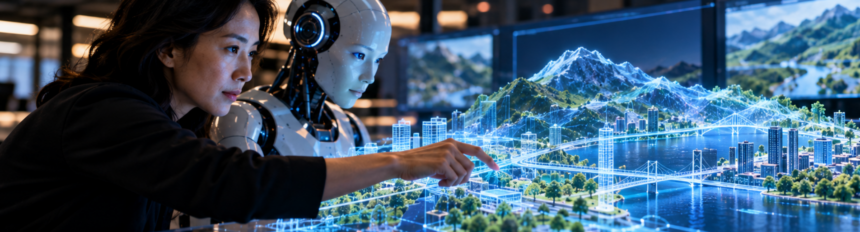
No chatbot. No search engine. Just models trained to understand physical space, going to a chipmaker racing to catch Nvidia. Li keeps her lab and gains a new job title: chief scientist of AMD.
AMD agreed to acquire World Labs for $8.2 billion in an all-stock deal, bringing Stanford researcher Fei-Fei Li and her two-year-old “world model” startup in-house. Li, often called the godmother of AI for creating ImageNet two decades ago, will become AMD’s executive vice president and chief scientist, reporting to CEO Lisa Su. The deal is AMD’s second-largest ever, behind its $50 billion acquisition of FPGA designer Xilinx in 2022. “Together, we’ll combine World Labs’ deep expertise in AI and world models with AMD’s compute leadership to power the future of AI and strengthen the open AI ecosystem,” Su wrote on X.
What’s Happening & Why It Matters
What World Labs Builds
World Labs doesn’t build a chatbot. It builds what the industry calls spatial intelligence: models that generate, reconstruct, and simulate interactive 3D environments from text, image, or video input. Its commercial product, Marble, launched late last year and can turn a handful of photos into a navigable 3D scene. A newer model called Atlas debuted on 1 September and will power future versions of Marble, the company says.

Li founded World Labs in 2024 alongside fellow Stanford professors Justin Johnson and Ben Mildenhall, arguing that general intelligence requires grounding in physics, not just text. That thesis places World Labs in direct competition with Nvidia’s Cosmos world models, which have already passed 2 million downloads. AMD offered text- and video-based models of its own but lacked a dedicated world-model research team until Monday’s deal.
Why a Chip Company Wants Model Researchers
AMD’s stated rationale centres on roadmap visibility, not product revenue. Su said building compute platforms for the next generation of AI requires a deep understanding of where models are heading, and that World Labs’ research expertise will help AMD design the hardware, software, and systems that future world models will run on. That’s a different acquisition logic from buying a product line. AMD is paying $8.2 billion for insight into how AI workloads evolve, insight it can feed into chip design decisions years before those workloads become mainstream.
Li said her motivation centred on resources rather than exit value. Joining AMD, she said, gives her team the engineering depth to scale World Labs’ research beyond what a standalone lab, however well-funded, could support alone. World Labs said in its statement that AI development “requires close collaboration across model research, systems and compute,” language that sees the deal as much a research partnership as an acquisition.
A Trapped Technology, Set Loose

Li’s view of the deal, posted on X, carried a specific note of urgency. She described World Labs’ models as remaining “trapped in the digital world” until paired with the compute and engineering resources a company like AMD can provide. That’s a notable admission from a researcher two years into building a company: the technology worked, but scaling it past demos required infrastructure World Labs couldn’t build alone.
World Labs’ team will continue its research after the deal closes, with the company saying it is committed to “widely accessible open models.” AMD confirmed it invested in World Labs before Monday’s acquisition, meaning the deal converts an existing financial relationship into full ownership rather than opening a new one.
TF Summary: What’s Next
The acquisition is expected to close by the end of 2026, pending regulatory approval. Li’s co-founders, Johnson and Mildenhall, will continue leading World Labs’ research work alongside her after she takes on her new AMD role. Neither company has disclosed specific figures for how many World Labs employees will join AMD. No product roadmap combining World Labs’ research with AMD’s chip lineup has been published.
MY FORECAST: Expect AMD to use World Labs’ research to shape chip architecture decisions over the next two to three years, rather than ship a competing consumer world-model product in the near term, given the stated rationale centres on roadmap insight rather than market entry. The acquisition deepens a pattern TF has tracked throughout 2026: chipmakers buy research talent to stay ahead of workload shifts rather than wait for model companies to reveal their compute needs. Watch whether Nvidia responds with a comparable acquisition of its own, given how the deal narrows the research-talent gap between the two companies in the category; physical and robotic AI have both been identified as the next major growth area.
Related Stories
- TSMC and Sony Are Investing Billions in a New Chip and Sensor Plant
- Nvidia Doubles AI Revenue, Stalks on China Question
- Qualcomm Splits Its Flagship Chip in Two for the First Time