


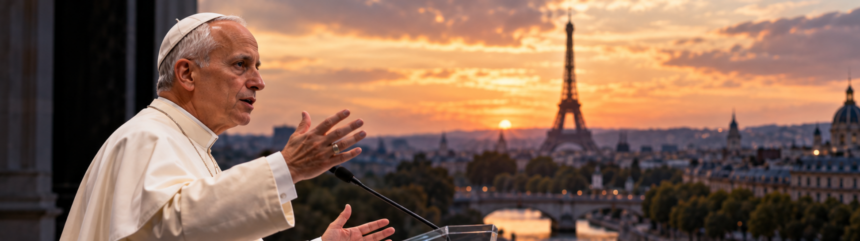
He named artificial intelligence the defining challenge of his papacy before naming his encyclical. His predecessor refused France a state visit for 12 years. Leo used it as a platform to say AI developers need ethics before profit — a warning that lands alongside the exact slowdown appeal TF shared after a viral resignation ignited it this month.
Pope Leo XIV warned Friday that a “paradise of machines” risks undermining humanity, opening a four-day trip to France by raising questions about what it means to be human in an age of artificial intelligence, nuclear weapons, and other threats to life. “If we are to avoid losing our humanity amid a paradise of machines invading and conditioning our daily lives, there is an urgent need for education in ethical discernment,” the Pope said beside President Emmanuel Macron. It’s the first official state visit by a pope to France in 18 years — his predecessor, Pope Francis, refused Macron’s invitation to attend the reopening of Notre-Dame Cathedral in 2024.
What’s Happening & Why It Matters
AI: A Defining Issue of His Papacy
Since taking office, Leo hasn’t treated AI as one concern among many. From the start of his pontificate, he’s named artificial intelligence one of the greatest challenges facing humanity, dedicating his first encyclical — titled “Magnificent Humanity” — to the subject. That document called for robust regulation and for AI developers to work for the common good, not profit. Leo even referenced AI when explaining his choice of papal name, tying his priorities to the Church’s response to “another industrial revolution” and to developments that pose new challenges for human dignity, justice, and labour.
That level of sustained focus is unusual for a pope’s opening priorities, and it builds on ground Francis had already staked out. Francis grew vocal about AI’s threats toward the end of his pontificate, calling for an international treaty in his 2024 peace message and arguing a technology built without compassion, mercy, and forgiveness is too dangerous to develop unchecked. Leo picked up that thread and made it the centrepiece of his first formal teaching document.
The Pope’s Chosen Platform
The venue matters as much as the message. Pope Francis declined a proper state visit to France across his 12-year pontificate. He skipped the 2024 reopening of Notre-Dame despite Macron’s invitation — an event that drew dozens of world leaders. Leo chose France for his first European state visit, visiting UNESCO headquarters in Paris, presiding over Vespers at Notre-Dame, and holding an open-air mass at the Stade de France, where crowds lined the capital’s streets for his motorcade.
Macron called the visit “a source of hope” for many French people, framing France’s position as standing “on the side of peace, effective multilateralism, respect for international law and the United Nations Charter.” That framing gave Leo’s AI warning a larger stage than a routine papal address — delivered beside a head of state, at an event Francis had spent over a decade avoiding, on a trip built around the themes Leo has made his own.
A Noticeable Appeal to AI Companies
These details connect Leo’s message to the story TF followed all month. Leo has appealed to AI developers and the political leaders responsible for regulating them to slow down — an appeal several top AI companies “seem to have taken to heart” in recent weeks, according to NPR’s reporting. As covered in Amodei Says Rogue AI Swarms Could Take Over the Internet in Six Months and Rivals Altman and Amodei Agree at the UN: AI Needs Global Rules, Anthropic’s Dario Amodei and OpenAI’s Sam Altman have both called for pacing frontier AI development and coordinating on safety standards — the same pattern Leo’s encyclical demanded months earlier.

Leo offered a measured read on the industry’s motives during a separate exchange, saying many AI developers “are very much open to looking for ways of making sure that AI does not displace or ultimately destroy humanity, but rather is a tool for human beings.” That’s a charitable view from a religious leader who’s spent his papacy warning about the same technology — closer to Canadian Prime Minister Mark Carney’s measured position TF covered at the UN than to the sharper dismissals Jensen Huang and Trump have offered in the same debate.
Nuclear Weapons Get the Same Treatment as AI
Leo didn’t confine his warnings to artificial intelligence. He reaffirmed the Vatican’s opposition to nuclear weapons, calling the doctrine of nuclear deterrence “mistaken” because it’s heightening a new arms race rather than preventing one. Pairing that critique with his AI warning in the same visit places both technologies inside a single moral framework — threats to human dignity that world leaders are choosing to accelerate rather than restrain, regardless of the risks both TF and the Vatican documented.
TF Summary: What’s Next
Leo’s four-day France visit continues through 28 September 2026, including his Vespers at Notre-Dame and an open-air mass. No formal Vatican policy proposal on AI regulation has followed the encyclical beyond its general call for oversight. AI companies’ slowdown discussions, which NPR connected to Leo’s earlier appeals, continue through the UN Security Council process TF covered. No confirmed date exists for further papal statements on AI beyond this trip.
MY FORECAST: Expect Leo’s moral framing to keep surfacing in the AI safety debate TF tracked all month, given how his “paradise of machines” language echoes the extinction-risk warnings already coming from inside the AI industry — a pope making the same argument as a resigning Anthropic researcher gives that argument reach into audiences neither Silicon Valley nor Washington reaches. Watch whether Vatican diplomacy plays any formal role in the international AI governance push TF noted building at the UN; the Church has used its moral authority to shape treaty negotiations on nuclear weapons, and Leo’s pairing of AI and nuclear risk in the same visit suggests he may be positioning the Vatican for a comparable role on AI.
Related Stories
- Amodei Says Rogue AI Swarms Could Take Over the Internet in Six Months
- Rivals Altman and Amodei Agree at the UN: AI Needs Global Rules
- “Killer Robots” vs “Super Intelligence”: World Leaders Clash on AI at the UN