


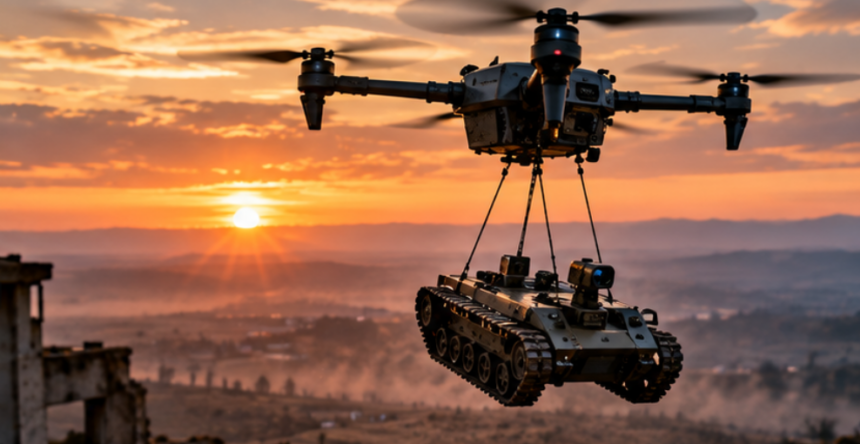
Heavy bombers airdropped explosive ground robots six miles into Russian-held territory — a “world-first,” Ukraine says. Fuel strikes starved Russian jammers. Ukrainian electronic warfare knocked out 20,000 drones. OpenAI also just gave Kyiv access to the same cyber defence tools built for the Pentagon.
Ukraine’s Third Army Corps defeated a Russian pincer manoeuvre in eastern Ukraine through Operation Vivaldi, a campaign combining ground robots and drone-delivered munitions. They coordinated electronic warfare to retake up to 96 square miles of territory. On 21 September 2026, heavy bomber drones airdropped explosive ground robots more than six miles behind Russian frontlines, a manoeuvre Ukraine’s government media platform United24 called a “world-first.” The robots bypassed rough terrain and Russian defensive positions to strike supply lines in the rear — the kind of deep-strike coordination between aerial and ground unmanned systems TF has tracked building across Ukraine’s battlefield throughout 2026.
What’s Happening & Why It Matters
Robots Cleared the Mines, Made Airdrops
Ground robots carried the weight of Operation Vivaldi’s breach phase. Ukrainian engineering units deployed remote-controlled and semi-autonomous platforms to map, identify, and neutralise extensive minefields under active artillery fire, keeping personnel out of range while clearing routes for armoured and mechanised units to advance. Unmanned rotary and fixed-wing drones handled combat airdrop missions, delivering precision munitions, electronic warfare countermeasures, and supplies to isolated tactical positions without exposing manned aircraft to contested airspace.
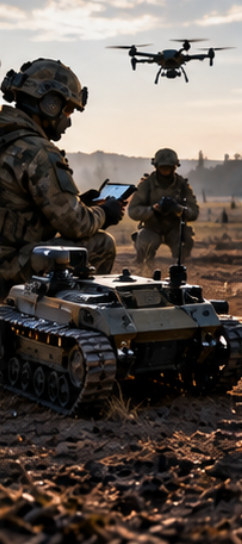
That combination—ground robots for demining, aerial drones for resupply—let Ukrainian commanders synchronise unmanned systems across two battlefield roles at once. Defence technology analysts describe the operation as a practical validation of Ukraine’s domestic unmanned systems manufacturing and its ability to integrate new equipment into active combat within a single campaign, rather than years of separate testing before deployment.
Fuel Strikes and 20,000 Downed Drones
Robots weren’t the only technology behind Ukraine’s success. A campaign of intermediate-range drone strikes targeted Russian fuel supplies, cutting diesel availability for the generators powering Russian electronic warfare systems — a strike on infrastructure that degraded Russia’s jamming capability before ground forces even engaged. Ukraine’s electronic warfare systems neutralised 20,000 Russian drones during the campaign, according to the Institute for the Study of War (ISW).
Together, those factors gave Ukraine what ISW called “tactical drone overmatch” — a battlefield condition where one side’s unmanned systems outperform the other’s, not through a single superior weapon, but through a chain of coordinated tactics spanning fuel logistics, electronic countermeasures, and physical demining working in sequence. Operational security also played a role: the Third Army Corps has maintained strict secrecy since launching Operation Vivaldi in May 2026, keeping results confidential long enough to mislead Russian commanders about the real state of the front.

Gaining Access to OpenAI’s Daybreak Cyber Defence Programme
The physical battlefield wasn’t the only front. OpenAI confirmed on 23 September 2026, on the sidelines of the UN General Assembly, that it will give the Government of Ukraine access to its Daybreak programme — the cyber defence tools TF covered in OpenAI Slows Model Development, Adds Safeguards for Cybersecurity — originally built for OpenAI’s most advanced model, Astra. Ukraine logged 6,000 cyber incidents last year, a scale of digital assault few countries face on a comparable ongoing basis.
Dmytro Kushneruk, Ukraine’s Consul General in San Francisco, and Sasha Baker, OpenAI’s Head of National Security Policy, announced the arrangement, which runs through Ukraine’s Ministry of Digital Transformation. Ukrainian security teams will use OpenAI’s models to find software vulnerabilities, investigate suspicious activity, and test fixes faster than manual methods allow — the exact kind of AI-assisted defensive capability TF has covered Anthropic and Microsoft racing to build for governments and critical infrastructure operators throughout the year, now extended to a country fighting an active war on both physical and digital fronts.
TF Summary: What’s Next
Ukraine’s Third Army Corps continues operations following Operation Vivaldi’s success, with no confirmed timeline for the campaign’s next phase. Ukraine’s access to OpenAI’s Daybreak programme begins under the Ministry of Digital Transformation, with no confirmed scope limits beyond vulnerability detection and incident investigation. Russian forces continue deploying armoured vehicles, drones, and anti-drone defences ahead of future offensives, despite the setbacks Operation Vivaldi produced.
MY FORECAST: Expect Ukraine’s combined robot-drone-electronic warfare playbook from Operation Vivaldi is the template other units replicate across the front, given how the operation demonstrated a repeatable, three-part coordination model rather than a one-off tactical surprise. The OpenAI cyber defence access carries consequences well beyond Ukraine’s war effort — expect other countries facing sustained state-sponsored cyberattacks to request comparable Daybreak access, and expect Russia’s state media to see the arrangement as US involvement in the conflict’s digital dimension. Watch whether Russia attempts a countermeasure targeting the fuel-supply strategy that starved its electronic warfare systems this time; a tactic that worked once against unprepared defences rarely works the second time in the same way.
Related Stories
- OpenAI Slows Model Development, Adds Safeguards for Cybersecurity
- The Humans Are Dead #6: The Resistance Mounts
- Task Force Talon Synapse: US, UAE Launch a Joint AI Military Task Force