


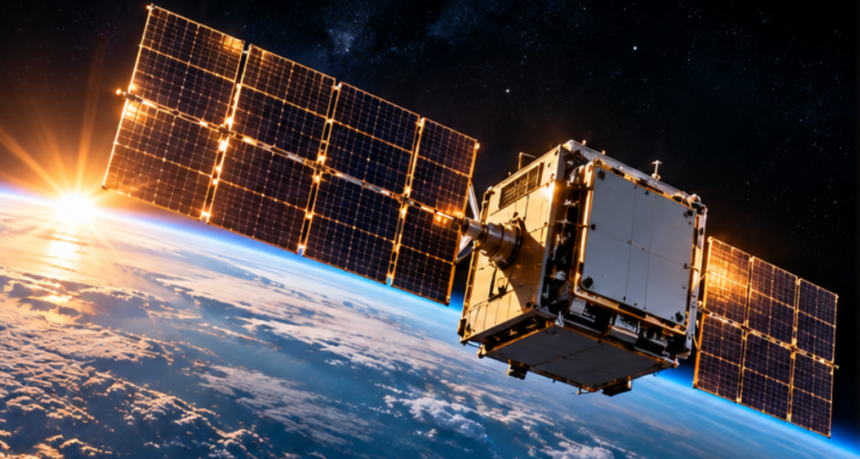
Four TPUs. About one kilowatt of solar power. Enough to answer simple Gemini queries from space, and nothing more. Google moved the launch up months early — accepting real risk to get there before 2027.
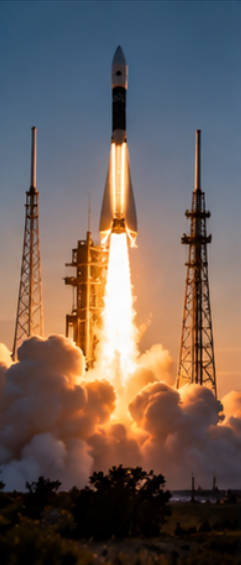
Google confirmed on 24 September 2026 that Project Suncatcher’s first satellite launches on 1 October 2026, aboard a SpaceX Falcon 9 flying from Vandenberg Space Force Base as part of the Transporter-18 rideshare mission. The satellite, named MVP, carries four Google Tensor Processing Units built with satellite partner Planet Labs, marking the first hardware test of whether AI chips can survive and operate in orbit. Google originally planned its launch for early 2027. Eric Stevens, a director of systems engineering at Planet Labs, said Google accepted added risk to reach orbit before year-end.
What’s Happening & Why It Matters
The Bet: Eight Times More Solar Power in Orbit
Google’s argument for building data centres in space comes down to a specific physics advantage. Solar panels in low Earth orbit can collect up to eight times more usable solar power than equivalent panels on the ground, according to reporting on the mission. That gap comes from the absence of atmosphere, weather, and the day-night cycle—three factors that cut into a ground-based solar farm’s output every day.
The advantage matters against a backdrop TF covered throughout 2026. AI data centres are straining power grids from Virginia to Ireland, and hyperscalers have spent the year racing to lock down gigawatts of electricity for GPU and TPU clusters. Google’s pitch is blunt: instead of fighting for grid capacity on the ground, put the compute where the sun never sets.
Fifteen Minutes of Runtime, Then Forced Cooldown
The MVP satellite carries real limits. Its four TPUs deliver about one kilowatt of solar power — enough to answer simple Gemini queries, per Travis Beals, Google’s senior director of product management for Project Suncatcher, but not enough for anything close to commercial workloads. The chips can run for about 15 minutes before shutting down to cool, a constraint that underscores how far this is from a functioning data centre and how close it stays to a lab-grade stress test.
Beals was candid about the scale of ambition attached to the first flight: “If we’re really successful with this in the long run, this will ultimately be boring, and people won’t think anything of the fact that their Gemini query might be getting served in space.” The satellite is designed to operate for about a year before its mission ends.
A Crowded Competitive Field
Google isn’t launching into an empty category. Washington-based startup Starcloud already trained and ran an AI model—Google’s Gemma—on an Nvidia H100 chip in orbit, launching its first satellite in November 2025. Starcloud’s next launch, also scheduled for October 2026, will carry multiple H100 chips and integrate Nvidia’s Blackwell platform. Elon Musk’s SpaceX filed with the FCC to launch up to one million satellites for orbital data centres. Jeff Bezos’s Blue Origin followed with its FCC filing for a comparable programme called Project Sunrise. Lonestar Data Holdings is developing a data centre on the Moon’s surface.

That density of competing bets, from four different companies pursuing four orbital compute strategies, signals the industry treats space-based compute as a real infrastructure category, not a publicity stunt any single company can claim credit for originating.
The Unanswered Warnings
Scepticism runs alongside the enthusiasm. Industry analysts, including those at Gartner, point to high launch costs, severe cooling bottlenecks in the vacuum of space, and data transmission delays as unresolved problems standing between today’s proof-of-concept satellite and any commercial orbital data centre. Some experts warn that massive future constellations could carry ecological costs too — atmospheric pollution and risk to the ozone layer from repeated launches and satellite reentry, concerns that echo the environmental scrutiny TF has covered attached to ground-based data centres throughout the year.
Google itself hasn’t oversold the October test. Senior Vice President for Research James Manyika has said the company doesn’t expect anything operational from the specific mission — a deliberate expectation-setting exercise ahead of a launch that will generate outsized attention regardless of how modest its actual computing output turns out to be.
TF Summary: What’s Next
Google plans a follow-on mission involving two additional prototype satellites, targeted for launch by early 2027, to test high-bandwidth, short-range laser links needed for orbiting chip clusters to communicate with each other. The company has designs for fleets of more than 80 satellites flying in close formation, though no confirmed timeline exists for that constellation. MVP is expected to hold orbit for up to six years before reentering the atmosphere.
MY FORECAST: Expect the October launch to generate outsized coverage relative to its actual technical output — a satellite carrying one kilowatt of solar power and 15 minutes of chip runtime is a genuine proof of concept, not a computing breakthrough, and Google’s senior leadership has already tried to manage those expectations. The real test comes with the 2027 follow-on mission testing inter-satellite laser links, given that communication between orbiting chip clusters, not the chips themselves, is what determines whether a fleet of 80-plus satellites can function as a coherent computing system rather than 80 isolated experiments. Watch Starcloud’s parallel October launch; a smaller company already running a working AI model in orbit gives the orbital-compute category a genuine head start Google will need to match.
Related Stories
- SpaceX Slides on 12M Subscribers, AI Spending and Mobile Plans
- IRIS², EU’s Starlink Alternative, Gets Implementation Partners
- Isar Aerospace: First European Outfit to Reach Orbit