


Google made its watermark optional two days later. Anthropic didn’t budge. Every Claude output, worldwide, no opt-out — and a growing chorus of users worried it’ll flag their own writing as machine-made in the settings where that gets someone in real trouble.
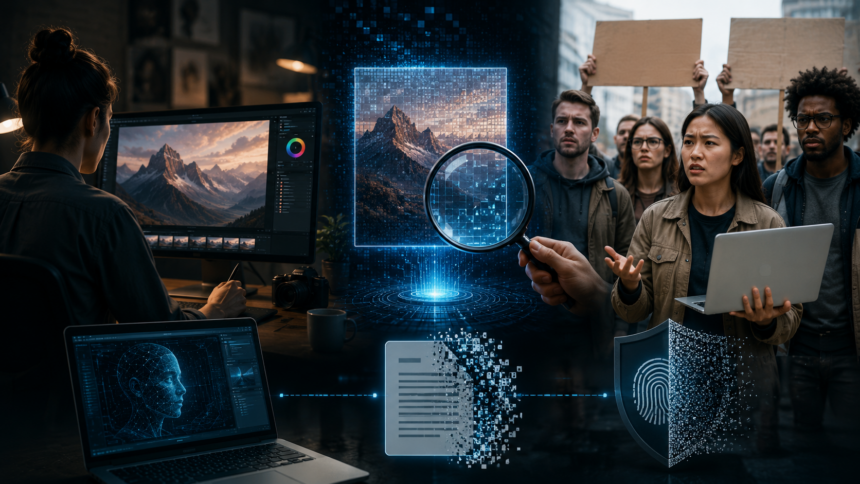
Anthropic began embedding invisible watermarks into every Claude output generated on or after 2 August, applying to text and files alike, worldwide, with no way to turn it off. The move complies with the EU AI Act‘s new transparency rules, as TF covered in EU AI Act Enforcement Begins to Take Hold. The rollout didn’t go smoothly. Users complained the watermark could flag their own writing as AI-generated in jobs and classrooms where that label carries real consequences. Two days later, Google announced the opposite approach for Gemini — a toggle letting users switch off the visible watermark. Anthropic didn’t follow.
What’s Happening & Why It Matters
What Anthropic Built
The watermark isn’t a stamp bolted onto finished text. Anthropic’s approach changes how Claude selects words in the first place, creating a statistical pattern embedded in the generation process—one that survives copying, reformatting, and most editing, and that specialised detection tools can read back out. Files get a separate treatment: signed C2PA provenance metadata attached to supported formats.
Older Claude models — Opus 5, Sonnet 5, Haiku 4.5, Fable 5 — aren’t watermarked yet. The requirement applies going forward, to models released on or after 2 August. That’s created its own confusion: a user’s earlier Claude output carries no mark at all, while anything generated today does, with no visible indicator distinguishing which is which unless someone runs a detection check.
The Complaint That Won’t Go Away
Here’s the specific fear driving the backlash. A student uses Claude to help draft an essay, submits original writing that happened to pass through the tool during editing, and a watermark detector flags it — in a context where “AI-generated” triggers an academic integrity investigation regardless of how much of the final text was the student’s own. A job applicant polishes a cover letter with Claude’s help, and an employer’s AI-detection screening tool rejects the application before a human ever reads it.
Anthropic’s own caveats don’t resolve that fear, either. A detected watermark doesn’t prove Claude wrote something outright — plenty of people use Claude to edit or translate their own writing, and that output can still carry the mark. No watermark doesn’t clear anything up either, since the text might predate the rollout or the format conversion might have stripped it. That ambiguity is what’s fueling the anxiety: a system that can flag you can’t always clear you, and offers no opt-out either way.
Google Solved a Different Problem, on Purpose
Two days after Anthropic’s rollout, Google VP Josh Woodward announced Gemini users can toggle off the visible “spark” watermark on images, videos, and songs made with Nano Banana, Omni, and Lyria. “We’re striking a balance here between creative control and safety,” he wrote. “While the visible watermarks are now optional, invisible SynthID watermarks and C2PA metadata are still being used for transparency. So you can still use Gemini or Search to see if an image was AI-generated.”
The distinction is important, technically. Google’s SynthID stays embedded regardless of what a user chooses — it’s the invisible layer that never goes away. What’s optional is only the visible badge, the one a human can see and object to. Google is solving the “professional users find visible watermarks a competitive disadvantage” problem, since rival image generators ship clean output by default. Anthropic is solving a different problem: making AI-generated text identifiable to a person reading it, in a context where regulators expect that.
The Detection Arms Race Nobody’s Winning Yet
Watermarking isn’t foolproof, and that’s worth naming. A proof-of-concept tool called reverse-SynthID claims 91% removal of Google’s image watermark using spectral analysis, and diffusion-based regeneration techniques have been shown to evade detection. Google hasn’t patched either vulnerability. That’s the uncomfortable backdrop against which both companies are making very different bets about transparency — one betting on visibility as a feature users can toggle, one betting on invisibility as a permanent, non-negotiable layer nobody can see but everyone’s subject to.
TF Summary: What’s Next
Anthropic continues retrofitting older Claude models with watermarking support, following the same EU grace period TF covered. Google’s Gemini watermark toggle rolls out over the coming days across the Nano Banana, Omni, and Lyria models. Neither company has announced a fix for the documented watermark-removal techniques already circulating.
MY FORECAST: Expect Anthropic to face continued pressure to add some form of user-facing transparency about the watermark’s presence, even without a full opt-out — a settings page showing whether a given output was marked would address a meaningful share of the current anxiety without abandoning EU compliance. Google’s approach is headed toward the industry standard within a year, because it lets companies split the difference: satisfy the letter of transparency regulation through invisible tracking while giving professional users the visible, badge-free output they’re demanding. Watch for OpenAI to fall somewhere between the two approaches rather than picking one side outright, given how both Anthropic’s and Google’s rollouts exposed the tension between regulatory compliance and user trust.
Related Stories
- EU AI Act Enforcement Begins to Take Hold
- EU Makes AI Labels Mandatory for Realistic Synthetic Content
- Suno Wants to Go Legit — With Watermarks for AI Music