



Three airlines banned humanoid robots from cabins after one bought its own seat. The FCC just banned foreign humanoid imports outright, aimed at China’s 85% market share. And in upstate New York, the robot teacher TF covered in June — the one built by a company whose sibling firm makes sex dolls — just got paused by the state.
Robot pushback is accelerating on three fronts. Southwest, United, and Delta have all banned humanoid and animal-like robots from flights. The FCC has banned foreign-made humanoid robot imports, targeting China. And a New York school district has paused the exact classroom robot pilot TF profiled with cautious optimism back in June. Three separate institutions, three separate reasons, one shared conclusion: the humanoid robot era is arriving faster than the rules meant to govern it.
What’s Happening & Why It Matters
Sorry, Your Robot Can’t Have An Airline Seat
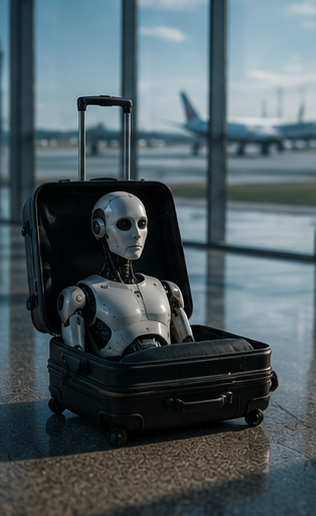
The decision was simple. A humanoid robot named Stewie flew from Las Vegas to Dallas on a Southwest flight — in a purchased seat. Crew members treated it as carry-on luggage. They moved it to a window seat after removing its battery. A second robot, Bebop, delayed an Oakland-to-San Diego departure by more than an hour when crews couldn’t figure out how to handle it.
Southwest banned humanoid and animal-like robots outright in May. United followed on 23 July, prohibiting them “regardless of size or purpose” from cabins, checked bags, and cargo. Delta added a similar rule, calling its version temporary and noting the machines don’t qualify as service animals or assistive devices.
The stated reason across all three carriers is lithium batteries. The robots pack large battery cells, motors, and AI hardware — a fire risk airlines don’t want to gamble on mid-flight. Small robot toys still fly fine if they meet normal battery rules. It’s the human-shaped ones drawing the line.
The FCC Bans Foreign Humanoid Robots — Especially From China
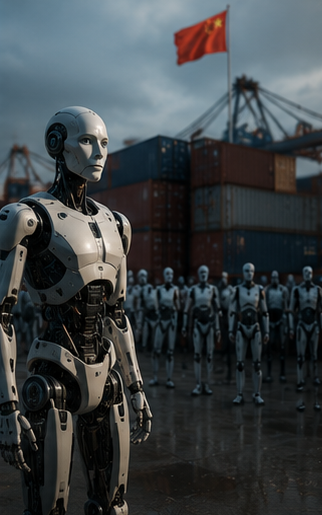
Days later, the fight went federal. The FCC announced a ban on imports of new foreign-made humanoid robots and power inverters on 28 July, citing national security risks. Quadruped robots — the four-legged “robot dogs” — are covered too.
The target is unmistakable. China holds roughly 85% of the global humanoid robot market. FCC Chairman Brendan Carr defined the act as protecting “America’s critical supply chains.” The Pentagon added Chinese robotics firm Unitree to a list of companies it says have ties to the Chinese military — a claim Beijing rejects.
The timing carries real diplomatic weight. President Trump is set to meet Xi Jinping in September, and the ban is in the run-up. Nvidia, notably, unveiled a humanoid robot reference design in June built on Unitree’s own chassis — meaning even American companies are threaded through the Chinese supply chain the ban targets.
New York Pauses the Robot Teacher, Sally
Here’s where the story gets personal for TF readers. In June, we profiled Optio — the AI teaching assistant paired with a Realbotix humanoid robot at Salamanca City Central School District, a small district on the Seneca Nation reservation in western New York. At the time, the pilot appeared promising: curriculum-specific guardrails, no internet access, no data sent back to Realbotix, local storage only.

That robot has a name. Sally. And on 24 July, the district paused the whole program.
The trigger was a letter from State Education Commissioner Betty Rosa, sent hours before the district’s announcement. “The Department remains concerned about the effect that a humanoid robot may have within a high school classroom,” she wrote. Parents, teachers, and the state teachers union raised a specific and uncomfortable detail: Realbotix has a sibling company that manufactures hyper-realistic sex dolls.
Superintendent Mark Beehler had defended the $57,590 contract just weeks earlier, describing Sally as a tool students could ask Arduino-board questions to when stuck. The district maintains Sally collects no personal data and can’t access the open internet. None of that reassurance survived contact with the corporate-parentage detail once it became public.
Is the Backlash Different?
Each of the stories has its own catalyst. But together they describe something TF has been tracking since our earlier coverage of humanoid robots entering classrooms, factories, and public spaces: the physical and cultural friction of putting human-shaped machines into human spaces is proving harder to manage than the technology itself.
Airlines can’t classify a robot as luggage, a passenger, or cargo — so they’re banning the category rather than solving the classification problem. The FCC is treating supply-chain origin as a security question separate from capability. And a school district that did real diligence on data privacy still got tripped up by something no privacy audit would have caught: who else builds products under the same corporate roof.
TF Summary: What’s Next
United’s ban took effect 23 July. The FCC’s import ban is in force, with no timeline for review. Salamanca’s pilot is paused while the district negotiates “enhanced student data privacy agreements” with the state — no date has been set for a decision on the fall expansion to 500 students.
MY FORECAST: Expect at least one more major airline to follow with a formal ban within the next two months — American hasn’t moved yet, and the pressure to standardize policy across carriers is building fast. The FCC’s China-targeted robot ban will draw a retaliatory gesture from Beijing before the Trump-Xi September meeting, given how it is in the middle of that diplomatic calendar. And Salamanca’s pause won’t be permanent, but it won’t survive in its current form either — expect either a contract renegotiation stripping Realbotix’s branding, or a quiet cancellation dressed up as “further review.” The corporate-parentage problem that sank the pilot is the one risk factor no school district screens for before signing an ed-tech contract. That changes.
Related Stories
- New York Public Schools Are Getting a Humanoid Robot AI Tutor — Meet Optio
- New AI Model Gives Humanoid Robots a 90% Success Rate on Complex Tasks
- Europe’s First Fully Autonomous Pharmacy Just Opened in Lisbon