


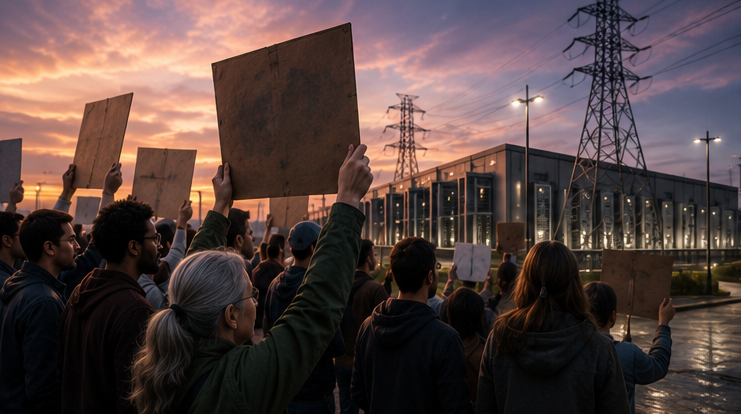
One day. 142 protests. 42 states. The first coordinated nationwide pushback against AI infrastructure — organised by a former Tea Party leader who insists the anger is nonpartisan. Trump’s response: expand a pledge asking tech companies to pay their own power bills. Meanwhile, Bezos wants to skip the whole fight by building data centres in orbit.
The US nationwide data centre backlash reached a fever pitch, when opponents of AI infrastructure held 142 protests across 42 states — the first coordinated nationwide day of action against data centre construction. HumansFirst, a grassroots group co-founded by former Tea Party organiser Amy Kremer, coordinated the rallies. Kremer compared the movement to the Tea Party’s early days in 2009, insisting the anger against data centres is nonpartisan. “They just woke up one day and found out they’re going to have this monstrosity in their community, and they don’t want it,” she said, predicting data centres are a defining issue in November’s midterms and the 2028 presidential race. Texas hosted 18 events, Georgia 11, and California eight — spanning Republican strongholds, battlegrounds, and Democratic states alike. President Trump responded five days later by expanding his Ratepayer Protection Pledge, demanding that tech giants cover their own electricity costs rather than pass them to American households.
What’s Happening & Why It Matters
Blocked Projects Behind the Protests
The nationwide data centre backlash stems from documented, measurable pushback that predates the July protests. Opponents blocked or delayed at least 75 US data centre projects worth roughly $130 billion in Q1 2026 alone, according to a report from Data Center Watch — more than all of 2025 combined. The number of active grassroots opposition organisations more than doubled to 833 across 49 states between the end of 2025 and March 2026. A June Reuters/Ipsos poll found only 14% of Americans would support a data centre being built in their own community, with just a third approving of the current national build rate.
By contrast, more than 300 state bills targeting data centre regulation were introduced in the first half of 2026 — a legislative response tracking alongside the grassroots mobilisation. As TF covered in its New York moratorium article, New York became the first state to halt new construction — a policy Kremer’s own organisers do not endorse, preferring targeted community negotiation over blanket bans.
The Ratepayer Pledge and Uncertain Enforcement
The nationwide data centre backlash produced a direct political response on 23 July, when Trump expanded his Ratepayer Protection Pledge at an event held at EPA headquarters, joined by Energy Secretary Chris Wright and several Republican governors. “We’re insisting that AI data centres and big tech companies pay their own way,” Trump said, revealing that more than 220 utilities, companies, and state governments have signed on since the pledge’s March introduction. Under the agreement, tech firms commit to funding or building the infrastructure needed to power their own data centres, rather than passing those costs to ratepayers.
Trump dismissed data centre opponents as “the radical left” and “communists” who want to “surrender the AI race to China” — a characterisation that is awkwardly against Kremer’s own insistence that HumansFirst spans the political spectrum. John Quigley, senior fellow at the Kleinman Center for Energy Policy, questioned whether the pledge carries real teeth. “The burden of proof is on them,” he said, “to prove this is more than just a stunt.” US Energy Secretary Wright acknowledged the administration is committed to AI leadership “without raising electricity prices for Americans” — while residential electricity prices rose 6% on average in 2025, despite Trump’s earlier campaign pledge to cut energy bills in half.
Building Data Centres in Orbit
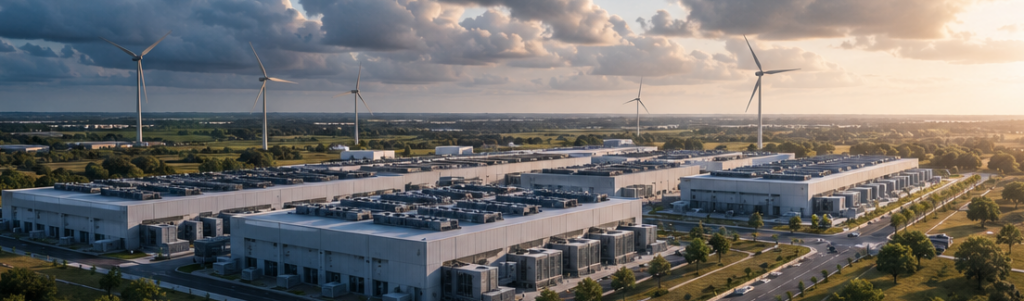
The nationwide data centre backlash has a different response emerging from one of the industry’s most prominent figures. Speaking publicly, Jeff Bezos described a 2-to-3-year timeline for orbital data centres as “a little ambitious,” citing energy costs, chip prices, and launch costs as the barriers. Blue Origin filed plans with the FCC in March under a project called Sunrise, proposing up to 51,600 satellites forming a distributed compute layer in orbit — designed to relocate energy- and water-intensive workloads away from terrestrial communities.
By contrast, consulting firm Bain & Co. published a July report concluding that orbital data centres are a niche share of total compute capacity for the foreseeable future, given high launch and heat-management costs. SpaceX has filed for an even larger orbital network — up to 1 million satellites — while Amazon Leo, as TF covered in its space sector article, has called SpaceX’s plan “wholly unrealistic,” warning it would grant near-total control over launch insertion orbits. Bezos is unbothered by scepticism about the valuation logic. “One thing I can tell you for sure,” he said, “is that space is going to be a gigantic industry.”
TF Summary: What’s Next
HumansFirst plans coordinated protest activity ahead of November’s midterm elections. The Ratepayer Protection Pledge continues adding signatories, with no independent enforcement mechanism yet confirmed. Blue Origin‘s Project Sunrise is under FCC review, with no confirmed launch timeline. State legislatures continue introducing data centre regulation bills at a pace already exceeding all of 2025.
MY FORECAST: The nationwide data centre backlash is a midterm election issue, as Kremer predicts — the combination of rising utility bills, opaque local approval processes, and bipartisan grassroots anger gives the issue unusual cross-party durability. By contrast, Trump’s Ratepayer Pledge will struggle to demonstrate real consumer relief before November, given Quigley’s enforcement concerns and the documented 6% price rise despite the administration’s stated commitments. Expect at least three additional states to pass New York-style moratoriums within 12 months, while Blue Origin and SpaceX continue their orbital ambitions on a longer timeline than either company’s public statements suggest — Bain’s scepticism about near-term viability is better founded than either Bezos’s or Musk’s public optimism.
Related Stories
- New York Becomes the First State to Impose a Data Centre Moratorium
- Meta Plans Its Biggest AI Data Centre Outside the US — in Canada
- Space Racers: Impulse’s Big Raise, Blue Origin’s Timeline, and SpaceX Starfall