


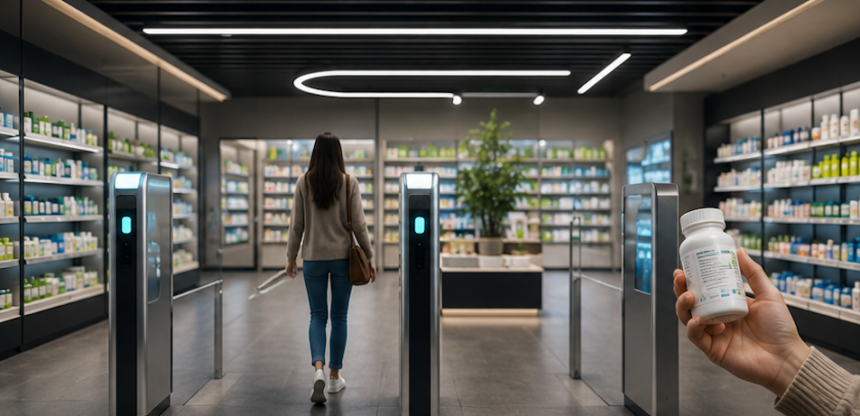
Cameras, motion sensors, and weight controllers replace the checkout counter entirely. Tap your card; the door opens. Take what you need, then walk out. It works flawlessly — except when a man holds the door open for a stranger behind him, and the AI charges both purchases to his account.
Pharma & Go’s unstaffed Lisbon store opened in the Parque das Nações district on 16 July 2026 — Europe’s first fully autonomous “para-pharmacy.” There are no queues, no waiting, and no staff. Pharmacist Catarina Dias, who runs the project and has more than 20 years of experience in the field, designed the roughly 90-square-metre space to carry a pharmacy-style selection of over-the-counter medications, cosmetics, and hygiene products. All the products customers can legally buy without a prescription. Service is available any day of the week, at any hour. “More and more, we are investing in solutions that allow us to keep pharmacists and the professionals we have focused on the clinical side, and to reduce the time they spend on purely commercial tasks,” Dias told Euronews. The store operates using a combined system of cameras, motion sensors, and weight controllers powered by artificial intelligence. Human staff enter only to restock supplies.
What’s Happening & Why It Matters
How the Technology Works
Pharma & Go’s unstaffed Lisbon store operates through a straightforward entry-to-exit sequence. To enter, customers bring a card or electronic payment method close to the door sensor. After validation, the door opens, and shoppers can browse at their leisure. Cameras, motion sensors, and weight controllers identify the products each customer selects throughout the store. There is no checkout counter, no scanning process, and no cashier. The system automatically charges the customer’s card for whatever they carry out.
The approximately 90-square-metre space was created through a partnership between Sensei and Glintt Life and is entirely privately funded. By contrast, the model shares clear DNA with Amazon’s own Amazon Go just-walk-out retail concept, applied specifically to the pharmacy sector. The specialised, regulated nature of the product selection made full automation a novel undertaking. It was not a straightforward retail copy-paste.
The Funny Edge Case and What It Reveals
Pharma & Go’s unstaffed Lisbon store has already surfaced a specific and telling limitation of its AI system. In Portugal, it’s considered a sign of chivalry when a man holds the door open for a woman following behind him. There has already been a situation where a man entered the store, held the door open for a woman following him, and both of their purchases were charged to his card. AI cannot distinguish whether people entering are together or separate individuals.
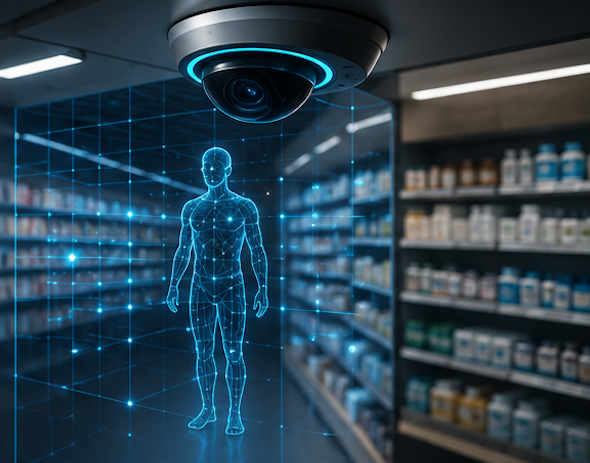
That anecdote is more than a charming quirk. It illustrates precisely the category of edge case that computer-vision-based retail automation still struggles to resolve reliably. Distinguishing intent and grouping among humans sharing a physical space is a problem considerably harder than simple object and product recognition. For example, Amazon Go faced comparable challenges in its early US rollouts. Groups of shoppers moving together or swapping items between baskets consistently produced billing errors. This required iterative software correction over years, not months.
Freeing Pharmacists for Clinical Work
Pharma & Go’s unstaffed Lisbon store targets a specific efficiency problem within European pharmacy practice. “It is a parapharmacy, and what we have tried to bring here is everything people can buy on their own, on any day of the week, at any hour of the day,” Dias explained. “The project responds to what people are [after] in terms of convenience and practicality.” A “para-pharmacy” — a category distinct from a full licensed pharmacy — carries over-the-counter medications, cosmetics, and hygiene products. However, it does not offer prescription medicines requiring pharmacist consultation or dispensing oversight.
That distinction is precisely what makes full automation legally and practically viable here without regulatory complications. Prescription medication dispensing carries strict clinical oversight requirements across the EU that no current computer vision system is authorised to replace. By separating the over-the-counter retail function from clinical pharmacy services, Dias’s model frees pharmacists to focus on specialist duties elsewhere. As a result, [the system] prevents them from spending working hours on routine retail transactions a machine can handle unattended.
TF Summary: What’s Next
Pharma & Go operates in Lisbon’s Parque das Nações district, with staff entering only periodically to restock inventory. No expansion timeline to additional Portuguese cities or other European markets has been announced. The AI billing edge cases — including the door-holding scenario — are acknowledged and unresolved as of launch. Dias has not confirmed whether software updates addressing multi-person entry detection are planned.
MY FORECAST: Pharma & Go’s unstaffed Lisbon store will generate strong initial curiosity-driven foot traffic. This will be followed by a true test of whether autonomous retail can sustain accurate billing at scale without meaningful staff oversight. The door-holding edge case will not be the last billing anomaly the specific model encounters. By contrast, the concept’s commercial logic — freeing pharmacists from routine retail transactions to focus on clinical work — addresses a real and widely documented labour allocation problem across European pharmacy chains. Expect at least one additional Portuguese city, and likely a comparable pilot in Spain or France, to test similar unstaffed para-pharmacy formats within 18 months. More testing will happen provided Pharma & Go’s billing accuracy holds up under sustained real-world foot traffic.
Related Stories
- Amazon’s Zoox Redesigns Its Robotaxi for Commercial Launch
- New AI Model Gives Humanoid Robots a 90% Success Rate on Complex Tasks
- New York Public Schools Are Getting a Humanoid Robot AI Tutor — Meet Optio