


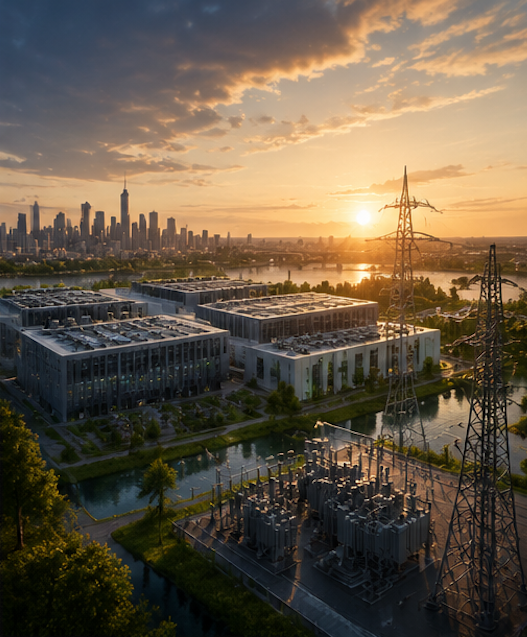
Governor Hochul signed a one-year pause on any new data centre using 50 megawatts or more. Trump called it “a terrible decision” within hours and told the industry to build in Alabama, Florida, Texas, and Arizona instead. Hochul’s response: “We call it doing our job.”
New York’s data centre moratorium was signed by Governor Kathy Hochul — making the state the first in the nation to impose a formal pause on large-scale AI infrastructure construction. The executive order restricts permitting and construction of new data centres consuming 50 megawatts or more of power, for a period of one year. “As data centre development threatens to hike up utility bills, deplete our natural resources, and create uncertainty for New Yorkers, it’s my responsibility to take action and lead,” Hochul said in a press release. President Trump responded within a day, posting on Truth Social that New York should change its policy “IMMEDIATELY.” “Governor Kathy Hochul, for political reasons, has terminated all Data Centers being built, or to be built, in New York State,” Trump wrote, calling data centres “big, strong, bold, and Money Machines” for any state hosting them.
What’s Happening & Why It Matters
What the Moratorium Restricts
New York’s data centre moratorium targets a specific and consequential threshold. The order restricts permitting and construction of hyperscale data centres — facilities housing thousands of computer servers requiring huge amounts of energy and steady water supply for cooling — at the 50-megawatt level and above. Hochul signed the executive order at a ceremony in Brooklyn, framing the pause around three specific harms: rising utility bills, depleted natural resources, and community uncertainty caused by rapid construction.
“A moratorium will give us time — time to understand the risks, time to protect working families, time to defend our democracy, and time to make sure this technology works for all of us, not just the very few,” Senator Bernie Sanders said separately, referencing legislation TF covered in its Sanders AI Sovereign Wealth Fund article, timed to reinforce the same anti-concentration argument at the federal level. New York’s move follows a pattern TF has tracked extensively across 2026 — as covered in its Seattle data centre moratorium article and C40 Cities data centre pact article, municipal and state-level governments are increasingly asserting control over AI infrastructure decisions previously left largely to utilities and developers.

President Trump: “LIQUID GOLD”
New York’s data centre moratorium produced an immediate and combative reaction from the White House. Trump warned the moratorium risked ceding ground on artificial intelligence to China and other countries, urging New York to reverse course. He named specific competing states directly: companies seeking to build data centres “are [today] being sought in Alabama, Florida, Texas, Arizona and many other States.” Trump insisted data centres “must pay” for their own power and water, with any leftover capacity returning to state and local communities — a demand that, notably, largely mirrors the “bring your own power” model TF documented in its Meta Alberta data centre article, where Meta’s Canadian facility is paired with dedicated, self-funded power generation.
Hochul responded directly on X: “We hit pause because the communities powering AI should share in its success. Maybe that’s a novel concept in Washington. We call it doing our job.” That exchange captures the core political tension driving data centre policy across the US in 2026 — a federal administration prioritising AI infrastructure speed against state and local governments increasingly prioritising resident utility costs and resource protection.
Political Timing: Affordability Ahead of the Midterms
New York’s data centre moratorium is within a specific electoral subtext. Concerns over how data centres could shoulder their own power costs have been building ahead of the midterm elections, with Democrats targeting affordability issues as residents’ anger over new data centre construction has grown. Polling — including among both Republican and Democratic voters — has shown rising opposition to data centre construction nationally, not just in politically blue states.

By contrast, industry voices have fought back on the moratorium’s underlying rationale. Kevin Frazier, senior fellow at the Abundance Institute, called Hochul’s moratorium “short-sighted,” warning that “New York may initiate a trend among governors to take unilateral action that results in more states closing their borders to AI infrastructure that is crucial to our economic and national security.” US Energy Secretary Chris Wright, speaking at an AWS Summit panel in Washington, urged industry attendees to engage directly with data centre critics and correct what he called misinformation about the facilities’ actual costs and benefits.
Maine Already Tried… and Failed
New York’s data centre moratorium is not the first attempt at the policy in the US — but it is the first to actually take effect. Maine appeared ready to establish a similar moratorium earlier in 2026, but the measure was vetoed by Democratic Governor Janet Mills, who argued it would have blocked a proposed data centre in a town struggling economically after a local mill closure. That veto illustrates the genuine economic trade-off underlying every version of the policy debate — data centres bring real jobs and tax revenue to host communities, even as they strain grids and raise utility bills for surrounding residents who may not benefit directly.
Additionally, left-wing lawmakers in Congress introduced a separate federal bill in April proposing a moratorium on data centre expansion nationally “to ensure the safety of humanity” — a considerably more sweeping ambition than New York’s state-level, time-limited pause. New York’s moratorium is at the more moderate end of the policy spectrum currently being debated across the US, but its status as the first successful statewide action gives it outsized significance as a template.
TF Summary: What’s Next
New York’s moratorium runs for one year from its 14 July signing date. No specific review or renewal process has been detailed publicly. Trump has not indicated any federal mechanism to override the state-level order. Governor Mills’ Maine veto and Hochul’s New York moratorium are the two most direct case studies for how Democratic governors are navigating the exact policy tension.
MY FORECAST: New York’s data centre moratorium will accelerate — not slow — the “bring your own power” model TF has documented across Meta’s Alberta facility and similar deals globally, as developers respond to state-level restrictions by proposing projects that pre-fund their own dedicated generation rather than drawing on strained public grids. By contrast, Frazier’s prediction of a multi-state trend is the one to watch most closely: expect at least two additional states to introduce comparable moratorium legislation within six months, specifically citing New York’s precedent, even as Alabama, Texas, Arizona, and Florida actively court the displaced investment Trump named directly. The genuine tension — jobs and tax revenue versus utility costs and resource strain — will not resolve through federal pressure alone; it will resolve state by state, driven by exactly the midterm-era affordability politics currently shaping Hochul’s calculation.
Related Stories
- Seattle Approves 1-Year Moratorium on Data Centres
- 40 Mayors Demand Standards for AI Data Centres — the UN Wants Transparency Too
- Meta Plans Its Biggest AI Data Centre Outside the US — in Canada