


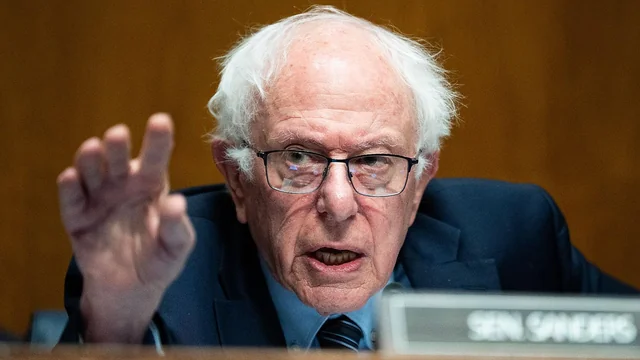
Sanders introduced the American AI Sovereign Wealth Fund Act. It levies a one-time 50% tax on AI company stock — for any firm making $200 million in annual AI revenue. The $7 trillion fund pays every American over $1,000 per year in dividends. It will not pass. But that is not quite the point.
Senator Bernie Sanders’ American AI Sovereign Wealth Fund Act — and it is the most sweeping AI wealth redistribution proposal any elected US official has advanced. Sanders introduced legislation Thursday that would give the American public a direct 50% ownership stake in the country’s largest artificial intelligence companies through a one-time tax on their stock. Under the legislation, firms crossing the $200 million annual AI revenue threshold would be required to hand over half their shares to a new federally managed fund. Sanders projects that transfer creates a fund worth approximately $7 trillion (€6.5 trillion).
A 5% annual dividend from the fund would provide direct payments of more than $1,000 to every American. Every AI company with over $200 million in AI revenue — OpenAI, Anthropic, Google DeepMind, Microsoft, Meta AI, xAI, SpaceX through its AI division — would hand the US government half their equity in a single transaction. That is the ask. Predictably, the industry is opposed. Just as predictably, that opposition does not deter Sanders.
What’s Happening & Why It Matters
The Fund’s Structure. The Norway Comparison
Senator Bernie Sanders’ American AI Sovereign Wealth Fund Act creates a specific and detailed governance structure. Oversight of the fund would fall to an independent, seven-person commission whose members would go through presidential nomination and Senate confirmation. That body would wield the fund’s voting shares to push back against corporate actions seen as harmful to ordinary Americans. The structural model Sanders cites is direct. The taxed shares would be deposited into the sovereign wealth fund, a state-owned investment vehicle similar in purpose to Norway’s Government Pension Fund, which is funded by oil revenue.
The Norway comparison is useful and limits. Norway’s Government Pension Fund — the world’s largest sovereign wealth fund at approximately $1.8 trillion — accumulated over decades through oil revenue from a state-owned company. It works because Norway controls the underlying resource being taxed. By contrast, Sanders is proposing the government assume a 50% stake in private companies it neither founded nor funded. That is a fundamentally different legal and economic mechanism. Additionally, the bill would also require large companies that operate both AI and non-AI businesses to separate those operations, ensuring the public receives an ownership stake in the AI portion. That separation requirement would be commercially and legally significant for Alphabet, Microsoft, and Amazon in particular.
The Public Resources Argument — Sanders’ Core Case
Sanders’ statement accompanying the bill makes a specific philosophical claim. “AI was not created out of thin air. It was not a brilliant idea that just popped into Mark Zuckerberg’s head or Elon Musk’s imagination. The foundation of AI is based on the collective knowledge of humanity and the creative work of tens of millions of people. The principle is simple: When a public resource generates wealth, the public should share in that wealth.” StartupHub.ai
That argument is not frivolous. The training data underpinning every major AI model draws on publicly accessible text, images, and code — much of it created by individuals who received no compensation for its use in AI training. The legal battles over that data are ongoing — as TF covered in its copyright and publisher opt-out article. Additionally, publicly funded university research and government-funded computing programmes directly contributed to the deep learning breakthroughs that made modern AI possible. Sanders’ argument is that the public investment entitles the public to equity — not just academic credit.
The AI Equity Debate
Senator Bernie Sanders’ American AI Sovereign Wealth Fund Act does not arrive in isolation. As TF covered in its Trump AI equity stake article, the Trump administration is separately negotiating with OpenAI about a donated equity stake for a public wealth fund — targeting between 1% and 5% of company equity. The gap between Trump’s proposed 1-5% donation and Sanders’ proposed 50% compulsory transfer defines the political negotiating space on AI wealth distribution. Anthropic committed $350 million to study AI’s labour market effects — as TF covered in its Anthropic AI labour fund article. OpenAI made similar voluntary wealth-sharing pledges. Sanders’ bill is the stick to those carrots.
Will It Pass? Or Does It Miss the Mark?
Senator Bernie Sanders’ American AI Sovereign Wealth Fund Act will not pass in its current form. Republicans in both chambers will oppose it on constitutional and economic grounds. Many moderate Democrats will avoid a bill that requires companies to surrender 50% of their equity to the federal government. Sanders has introduced the bill, as he has introduced similar bills before, with full knowledge that passage is not the immediate objective.
The legislative purpose is different. It sets a ceiling. When OpenAI and the Trump administration negotiate a 1-5% donated equity stake, the $7 trillion Sanders bill is in the room as the alternative. The belief shifts the negotiation baseline significantly. Additionally, the bill generates public debate that OpenAI‘s S-1 filing has to address. Public investors reading the IPO prospectus will ask about regulatory risk. The Sanders bill is a named risk factor.
TF Summary: What’s Next
The American AI Sovereign Wealth Fund Act goes to committee — where it is expected to stall. Ars Technica first reported the bill’s introduction. The Associated Press received exclusive preview access. AI industry trade groups have not yet issued formal responses. OpenAI, Google, and Meta have not commented publicly. The Trump administration’s separate AI equity discussions continue on their own track.
MY FORECAST: Senator Bernie Sanders’ American AI Sovereign Wealth Fund Act will produce one concrete outcome within 12 months — even without passing. It will force every major AI company to include explicit “government equity risk” language in their IPO filings and annual reports. OpenAI‘s S-1, Anthropic‘s S-1, and xAI‘s eventual offering documents will each carry a regulatory risk section that cites Sanders-style proposals as material risks to their cap table. That citation will make the political risk of AI equity redistribution visible to institutional investors for the first time — at exactly the moment those investors are deciding whether to participate in the largest AI IPO wave in history. The bill does not need necessarily pass. It needs to exist. It now does.