



While NVIDIA and Qualcomm dominated the Computex stage, two equally significant announcements occurred. Amazon pledged €10 billion to European warehouses with 150 AI robots. And Microsoft partnered with Mayo Clinic on a frontier AI model that could improve diagnosis, treatment, and clinical reasoning.
Computex 2026 adjacent announcements arrived this week alongside the Taipei keynotes — and two of them carry consequences that extend well beyond the tech industry’s hardware cycle. On 4 June, Amazon announced a €10 billion (€10B) investment in European fulfilment infrastructure at its Delivering the Future event in London — introducing a conversational next-generation robot and committing to 25,000 new European jobs. Separately, Microsoft and Mayo Clinic confirmed a strategic collaboration to develop and deploy a frontier AI model built specifically for healthcare — a model that will eventually be available globally through Azure Foundry APIs. Both announcements are the same underlying dynamic. AI is no longer a research project. It is deploying at scale — in warehouses, in hospitals, and in every institution that processes large volumes of complex decisions.
What’s Happening & Why It Matters
Amazon Europe: €10 Billion, 25,000 Jobs, and Robots That Talk
Amazon‘s Delivering the Future event introduced next-generation Proteus — the most significant update to the company’s flagship autonomous warehouse robot since its original deployment. The original Proteus operated only in dock areas within fulfilment centres. The new version can work anywhere in a warehouse where items need to move. More significantly, it takes instructions in plain language. An employee tells it what to do — in conversational text, without technical commands or programming — and Proteus determines the priority, the route, and the timing independently.
Amazon confirmed the expansion of Vulcan — its first robot with a sense of touch — and STARK, a collaborative tote-handling system that picks full containers from conveyors and places them on carts. STARK was first piloted in Barcelona, Spain. By 2027, it will deploy across 15 European sites. Together, the systems target the most physically demanding tasks on the warehouse floor — the work that causes injury, fatigue, and high staff turnover. As TF covered in its ‘The Humans Are Dead’ #3 article, the robot labour transition is accelerating across every physical industry simultaneously.
The 25,000 Jobs Argument
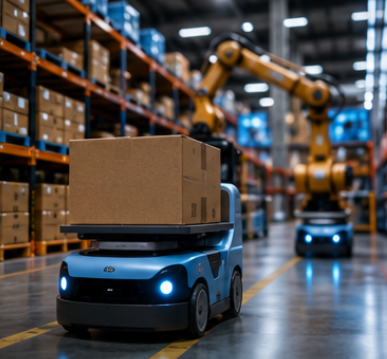
Amazon committed to growing its European fulfilment workforce by 25,000 people alongside the robotics investment. That commitment addresses the most politically sensitive element of any major automation announcement. The company already supports more than 1.5 million jobs across Europe, including 230,000 direct employees. Automation and job creation are happening in parallel — not in sequence. Amazon is simultaneously deploying robots that handle physically demanding tasks and adding workers to operate, maintain, and manage the increasingly complex logistics network those robots enable.
In addition, Amazon committed $1 billion globally to its Career Choice programme by 2030 — providing fully funded education and training for employees in cybersecurity, software development, logistics, renewable energy, and mechatronics. More than 300,000 employees globally have already accessed the programme. The delivery acceleration announcement is equally significant. Amazon Now — the 30-minute ultra-rapid delivery service — expands to Manchester and Birmingham in 2026. More than 25 sub-same-day European fulfilment hubs are planned for 2026, enabling orders placed by 5 p.m. to arrive the same evening across multiple markets. As TF covered in its Choose France article, Amazon had already committed €15 billion to European AI and cloud infrastructure — €10 billion fulfils a separate commitment to logistics and operations.
Microsoft and Mayo Clinic: A Frontier Healthcare AI Model
The second major announcement carries arguably greater long-term significance. Microsoft and Mayo Clinic announced a strategic collaboration to build a frontier AI model designed specifically for healthcare. The announcement came from both companies simultaneously — with Gianrico Farrugia, President and CEO of Mayo Clinic, describing the collaboration as “building something new in healthcare and bringing more of Mayo Clinic to more patients.”

The model combines Mayo Clinic‘s global healthcare expertise, de-identified clinical health data, and longitudinal patient insights with Microsoft‘s advanced AI, cloud engineering, and the MAI model infrastructure announced at Build 2026. As TF covered in its Microsoft Build 2026 article, Mustafa Suleyman, CEO of Microsoft AI, described the partnership at Build. “Frontier medical intelligence is around the corner. This is the best collaboration imaginable to help us accelerate towards that future.”
What the Healthcare AI Model Will Actually Do
The model is purpose-built for healthcare — not a general-purpose model adapted for clinical use. General-purpose AI models lack deep clinical context. They do not understand longitudinal patient records. They cannot reason across multiple diagnostic types simultaneously. The Microsoft–Mayo Clinic model is being built from the start with those requirements as core constraints. The applications it targets include analysing different types of clinical information, earlier diagnosis support, and more personalised treatment planning.
The ownership structure is significant and deliberate. Mayo Clinic will own the frontier model — not Microsoft. That arrangement reinforces Mayo Clinic‘s long-standing commitment to patient trust and clinical data stewardship. Microsoft will make the model available globally through Azure Foundry APIs — enabling healthcare organisations worldwide to access it. In practice, a hospital system in Lagos, a community clinic in rural Galicia, and a research institute in Singapore could all eventually access Mayo Clinic-level clinical AI reasoning through Microsoft‘s cloud infrastructure.
The Healthcare AI Challenge — and Addressing It
Healthcare AI carries specific challenges that no other AI sector faces at the same intensity. Clinical data is highly sensitive, heavily regulated, and carries life-or-death stakes if misapplied. Mayo Clinic Platform — which Farrugia described as moving “healthcare from a pipeline to a platform model” — was established seven years ago specifically to create the de-identified data infrastructure that AI collaboration requires. That foundation gives the new model something no competitor can easily replicate: decades of anonymised, longitudinal, structured clinical data from one of the world’s most trusted healthcare institutions.
By contrast, the model faces a specific and important limitation at launch. Microsoft and Mayo Clinic have not disclosed which clinical areas are currently in deployment, how widely the model is being used, or when it will become available to external healthcare providers. The initial deployment is within Mayo Clinic‘s own clinical environment — which provides real-world validation but limits the model’s immediate reach. That staged rollout is the responsible approach. Healthcare AI cannot be launched at scale without iterative real-world testing and rigorous outcome measurement.
TF Summary: What’s Next
Amazon‘s next-generation Proteus robot deploys in European fulfilment centres immediately. STARK expands to 15 European sites by 2027. Vulcan expansion is already underway. Amazon Now arrives in Manchester and Birmingham in 2026. The Microsoft–Mayo Clinic model deploys initially within Mayo Clinic‘s clinical environment. Azure Foundry APIs will eventually make the model accessible to healthcare providers globally. No timeline for external availability has been announced.
MY FORECAST: Both announcements confirm a pattern that defines 2026’s technology deployment story. Computex 2026 adjacent announcements demonstrate that the most impactful AI deployment cycles are not happening in research labs or developer conferences. They are happening in warehouses, hospitals, and critical infrastructure. Amazon‘s conversational Proteus will prove more commercially transformative than the robotics industry yet models — because it removes the training barrier that has kept AI-directed robots out of mid-sized facilities that cannot afford specialist automation engineers. The Microsoft–Mayo Clinic healthcare model will take longer. Healthcare AI validation is slow by necessity. By 2028, however, it will represent the most significant advance in democratised clinical expertise since telemedicine — because it scales Mayo Clinic‘s diagnostic quality to any institution that can access Azure.