


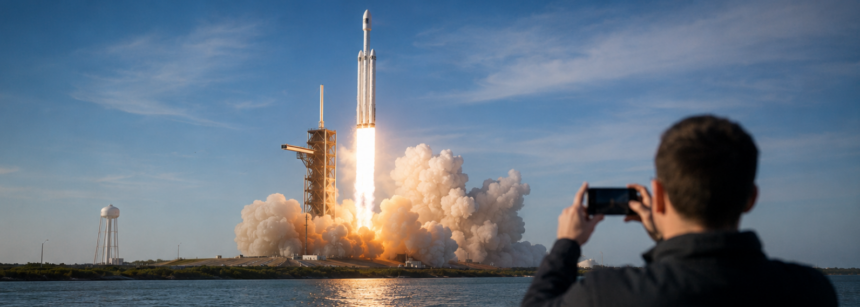
The SpaceX IPO filing launched — and it is simultaneously the most impressive and most complicated financial document of the year. SpaceX filed its S-1 registration statement with the Securities and Exchange Commission on Wednesday, targeting a listing on the Nasdaq under the ticker SPCX. The company is targeting a valuation of approximately $1.75 trillion (€1.61 trillion) and aims to raise up to $75 billion (€69.1 billion) — which would make it the largest IPO in history by a substantial margin. For context, Saudi Aramco‘s 2019 listing raised $29 billion. Alibaba‘s US IPO raised $22 billion. SpaceX is targeting more than double the all-time record. Twenty-one banks are managing the offering. The first public roadshow begins as early as June 2026.
What’s Happening & Why It Matters
The Revenue Story: Three Businesses in One Company
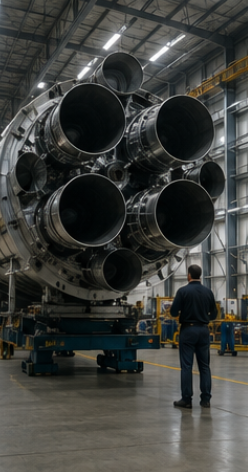
The SpaceX IPO filing reveals a company structured around three distinct revenue streams — and the financial profiles of each are dramatically different. Starlink, the satellite internet connectivity business, generated $11.4 billion (€10.5 billion) in 2025 — up 48% year on year from $7.7 billion in 2024. The connectivity segment delivered $4.4 billion (€4.1 billion) in operating profit. It is the company’s only profitable division. By Q1 2026, Starlink had reached 10.3 million subscribers across 164 countries, with more than 9,600 satellites deployed. Starlink is contributing nearly two-thirds of SpaceX’s total revenue — a proportion that has shifted decisively over the past two years.
By contrast, the space launch business generated $4.1 billion (€3.8 billion) in 2025 — up only 8% year on year. SpaceX completed 165 Falcon 9 launches last year. Of those, only 43 were for outside customers. The rest were internal Starlink deployment missions. The launch business operates at a loss. It funds SpaceX‘s infrastructure and market position, but it is not generating cash. The third segment — AI — represents the newest and most volatile element. Following the February 2026 merger with xAI, the AI division generated $3.2 billion (€2.95 billion) in its initial consolidated period. It is also the division responsible for most of the company’s escalating losses.
The Loss Story: xAI Changed Everything
SpaceX was a profitable company in 2024. Net income reached $791 million (€729 million). That figure changed dramatically in 2025. After the February 2026 merger with xAI — which consolidated retroactively into 2025 accounts — the company posted a $4.9 billion (€4.5 billion) net loss. In Q1 2026 alone, the loss reached $4.28 billion (€3.94 billion). That is a quarterly loss exceeding the full-year revenue of most aerospace companies.
At the same time, the loss requires context. SpaceX spent $20.7 billion (€19.1 billion) in 2025 — including $12.7 billion (€11.7 billion) on AI projects and infrastructure. Capital expenditure in Q1 2026 alone reached $10.1 billion (€9.3 billion). These are not operational losses. They are the financial signature of a company building infrastructure at extraordinary speed. Adjusted EBITDA — which strips out non-cash charges and capital expenditure — came in at $6.6 billion (€6.1 billion) for 2025. That figure is the one that profitability-focused investors will focus on when assessing whether the business model itself works. The answer is yes. The question is whether the infrastructure investment, compounding the losses, will eventually produce returns commensurate with the spending.
Musk’s Voting Control: 85.1% — Nobody Can Remove Him

The SpaceX IPO filing reveals a dual-class share structure that gives Elon Musk 85.1% of combined voting power. As TF covered in its earlier article on the SpaceX IPO governance terms, the structure combines supervoting shares, mandatory arbitration for shareholder disputes, and restrictions on shareholder proposals. Investors who buy into the IPO waive their right to sue SpaceX in court. Musk has stated he will not sell any shares. The only person who can remove Musk from leadership is Musk himself. That structure generates strong views on both sides. Some institutional investors will decline to participate on governance grounds. Others will accept the terms because the underlying business is too significant to ignore.
Starlink’s Economics: Volume Up, Price Per User Down
One of the most important details in the S-1 is the declining trend in average revenue per user (ARPU). Starlink charged subscribers an average of $99 per month in 2023. By the end of Q1 2026, that figure had fallen to $66 per month — a 33% decline over three years. Meanwhile, subscriber numbers have grown from 2.3 million in 2023 to 10.3 million in Q1 2026. That dynamic is a deliberate strategy. SpaceX is trading per-subscriber pricing power for global volume — accepting lower revenue per customer in order to expand into lower-income markets, broader geographic coverage, and higher-volume consumer tiers.
By contrast, the enterprise segments tell a different story. Maritime customers generate approximately $34,000 (€31,300) in annual revenue per user. Aviation customers generate approximately $300,000 (€276,600) per user annually. Government and military contracts — including the Starshield military communications programme — command premium pricing. The decline in consumer ARPU does not reflect the full pricing picture. It reflects the deliberate prioritisation of mass-market consumer growth over premium segment revenue.
The TAM Claim: $28.5 Trillion, the Largest in Human History
SpaceX made one of the most audacious total addressable market claims in IPO history. The S-1 states that SpaceX has identified “the largest actionable total addressable market in human history” — estimating its quantifiable TAM at $28.5 trillion (€26.3 trillion). That figure breaks down across three segments. Space itself — launch, logistics, exploration — represents $370 billion (€341 billion). Connectivity — primarily Starlink and satellite internet — represents $1.6 trillion (€1.47 trillion). AI — the SpaceXAI computing infrastructure, Grok, and orbital data centres — represents $26.5 trillion (€24.4 trillion). That last figure is the one that requires the most interpretive charity. It assumes SpaceX captures a meaningful portion of the global AI compute and services market. That assumption drives the valuation mathematics.
Beyond the TAM, SpaceX disclosed future market targets that read as ambitious even by the standards of an S-1. They include the lunar economy, in-orbit manufacturing, space tourism, asteroid mining, and energy production on the moon. Those are not near-term revenue lines. They are the strategic horizon that justifies the Starship development programme and the extraordinary capital expenditure currently compressing profitability.
Starship: The Risk That Tops the Filing’s Own Risk Factors
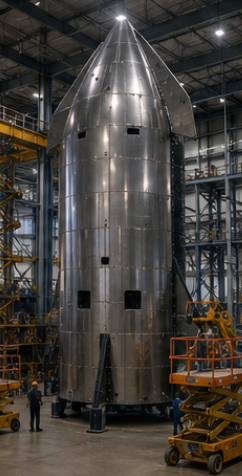
SpaceX listed Starship delays as its primary risk factor. That disclosure is honest and significant. Starship is the vehicle that underpins almost every long-term growth scenario in the filing. Full Starlink V2 satellite deployment — which requires Starship’s payload capacity — depends on Starship achieving reliable operations. The orbital data centre ambitions require Starship to launch at the cadence needed to build the Starlink constellation at scale. The lunar and Mars scenarios are entirely Starship-dependent. Starship V3 completed a full-duration static fire in April 2026 and is targeting a test flight in May. By contrast, no commercial Starship launches have yet delivered a payload to orbit. The risk is real and well understood by any investor who reads beyond the revenue charts.
The Nasdaq Fast-Entry Rule: Forced Buying Within 15 Days
One technical detail in the SpaceX IPO filing will have immediate market implications. Under Nasdaq‘s new fast-entry rule, SpaceX automatically joins the Nasdaq-100 after just 15 days of trading. That accelerated inclusion triggers mandatory “forced buying” by ETFs and index funds tracking the Nasdaq-100. Trillions of dollars in passive investment capital are indexed to the Nasdaq-100. When a new company joins, every ETF and index fund must buy a proportionate number of shares to maintain its index weighting. That mechanical demand — entirely independent of any individual investment thesis — creates sustained buying pressure from the first day of trading.
TF Summary: What’s Next
The formal roadshow begins as early as June 2026. Pricing is expected in the same month. The IPO requires regulatory review but no further SEC action before listing — the S-1 is now public. 21 banks are managing the offering. Bank of America, Citigroup, Goldman Sachs, JPMorgan Chase, and Morgan Stanley hold senior bookrunner roles. The preliminary filing did not specify a lockup period for executives and directors. Musk confirmed he will not sell any shares.

MY FORECAST: The SpaceX IPO filing describes a business that is simultaneously generating record losses and building infrastructure at a scale no other private company has attempted. The offering will be heavily oversubscribed. The Nasdaq-100 forced-buying mechanism will produce a significant first-day price increase regardless of institutional demand. That combination — oversubscription plus mechanical index buying — typically produces a sharp initial price above the IPO range. By contrast, the governance structure will materially limit the institutional investor pool. Many pension funds and governance-focused asset managers will decline to participate because of the dual-class structure and mandatory arbitration clauses. The market cap on day one will exceed the $1.75 trillion target. The critical question for long-term investors is whether the xAI AI infrastructure spending — running at more than $10 billion per quarter — will eventually convert into the $26.5 trillion AI TAM the filing claims as addressable. That bet will take five to ten years to validate. The IPO will price it as if the answer is already yes.