


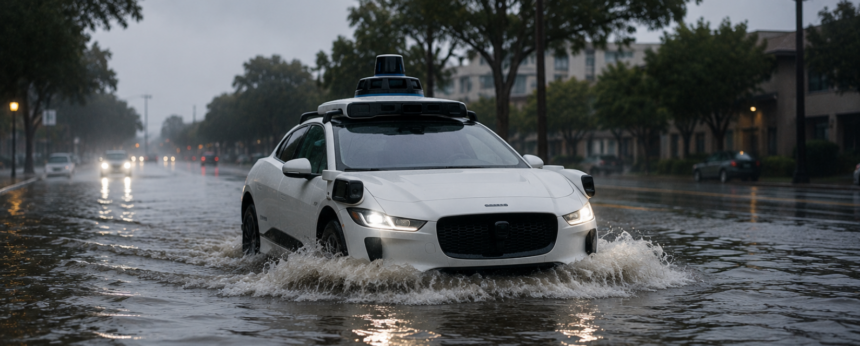
The Waymo robotaxi flood recall is the company’s third recall in just over two years — and the most visually dramatic. On 13 May 2026, Waymo filed a voluntary recall with the National Highway Traffic Safety Administration (NHTSA) covering 3,791 vehicles across its entire US fleet. The affected vehicles run on Waymo‘s fifth- and sixth-generation Automated Driving Systems (ADS). The recall traces directly to a 20 April 2026 incident in San Antonio, Texas — where an unoccupied Waymo robotaxi entered a flooded section of a 40 mph (64 km/h) road, failed to stop, and was swept into Salado Creek. Crews recovered the vehicle four days later near the Greenway Trail system. No passengers were on board. No injuries were reported. The car, however, was not where it was supposed to be — and that fact triggered a federal investigation, a fleet-wide shutdown in San Antonio, and ultimately the recall of every Waymo in America.
What’s Happening & Why It Matters
What the Software Actually Did — and Didn’t Do
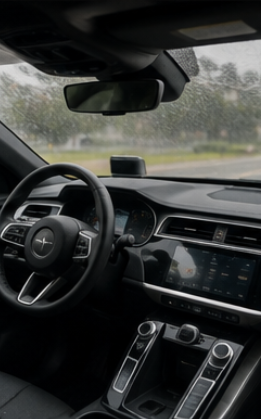
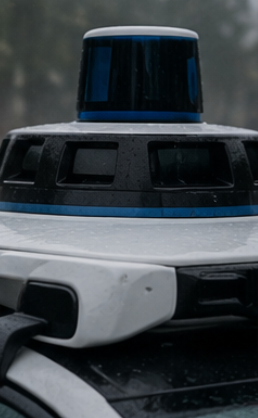
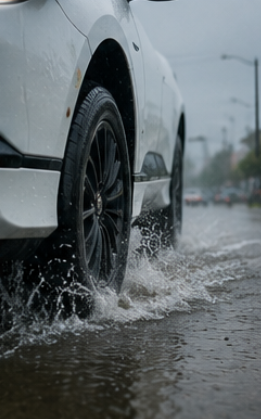
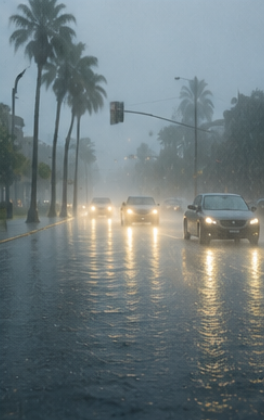
The technical failure is specific. Waymo‘s ADS detected the flooded road. That part worked as intended. The system classified the road as a hazard. What it did not do was stop the vehicle. Instead, it reduced speed and continued driving forward into the standing water. That distinction — between detecting a hazard and responding to it appropriately — is the core of the defect. The NHTSA described it plainly in its recall notice: the vehicles were “slowing but not stopping when encountering flooded roads they could not traverse.”
Under normal autonomous driving standards, a properly functioning ADS should detect untraversable hazards and bring the vehicle to a full stop. Waymo itself acknowledged the failure. “We identified an area of improvement regarding untraversable flooded lanes specific to higher-speed roadways,” the company stated. That language identifies both the nature of the gap — lane flooding classification — and its specific context — higher-speed roads where the consequences of continuing are more severe.
Two San Antonio Incidents, Then an Entire Fleet Recalled
The 20 April incident was not the first time Waymo had trouble with San Antonio flooding. On 4 April — more than two weeks earlier — a separate unoccupied Waymo had become stranded in high water at the intersection of McCullough Avenue and Contour Drive. That vehicle required recovery by road crews. Neither incident involved passengers. Both incidents went largely unnoticed nationally until the 20 April car entered Salado Creek.
After the creek incident, Waymo suspended its San Antonio service entirely. That suspension became the company’s longest-ever operational shutdown. NHTSA opened a formal investigation. Waymo reported the defect to NHTSA on 1 May 2026. The agency acknowledged the recall in a letter dated 11 May 2026. The recall covers every Waymo vehicle equipped with fifth- or sixth-generation ADS — across Phoenix, San Francisco, Los Angeles, Austin, Miami, Atlanta, Dallas, Houston, Orlando, and Nashville.
The Interim Fix — and Why a Permanent One Is Still Coming
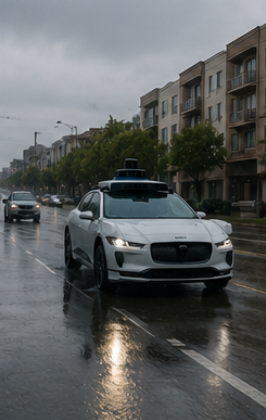
Waymo did not wait for the formal recall to begin fixing the problem. An interim software update reached all 3,791 affected vehicles by 20 April — the same day as the creek incident. That update imposed tighter weather-related restrictions and revised the navigation maps used by the vehicles to avoid flash flood risk areas. In practical terms, it limited where robotaxis could operate during periods of heavy rain and directed them away from areas prone to flash flooding.
At the same time, NHTSA flagged a significant gap in the response. Waymo has not yet filed a permanent software remedy. Under federal regulations, the company must provide a full description of the final fix before the recall closes. Waymo also faces a reporting obligation stretching years into the future — eight consecutive quarterly status reports, followed by three annual reports. That timeline signals that regulators view this as a live safety concern requiring sustained monitoring, not a one-time patch.
Waymo’s Third Recall in Two Years
The Waymo robotaxi flood recall is the third time Waymo has recalled vehicles in just over two years. The pattern is worth understanding. The first recall came in February 2024 — two Phoenix robotaxis separately struck the same improperly towed pickup truck. The second recall followed in May 2025 — 1,212 vehicles recalled after collisions with stationary roadway barriers, including chains and gates. Seven incidents between December 2022 and April 2024 prompted that action. Now the third recall covers the entire fleet.
Each recall addresses a different failure mode. Struck stationary vehicles. Failed to stop at barriers. Failed to stop at flood water. The pattern does not indicate a single systemic flaw. Instead, it reveals the challenge of teaching an autonomous system to handle the vast range of edge cases that a human driver navigates intuitively. Rain, flooding, unusual road objects, and adverse conditions all fall into the long tail of scenarios that are difficult to anticipate and expensive to test at scale. The more miles Waymo drives, the more edge cases it encounters.
Other Safety Issues Running in Parallel
The flood recall arrives alongside other open safety investigations. NHTSA has an active probe into a January 2026 incident in Santa Monica, California, where a Waymo vehicle struck a child near an elementary school during drop-off hours. The child ran into the road from behind a double-parked vehicle. NHTSA‘s preliminary evaluation focuses on whether the Waymo Driver exercised appropriate caution given its proximity to a school during high-pedestrian-activity hours. Waymo has not publicly commented on that investigation.
In Austin, the situation is also unresolved. The Austin Independent School District documented at least 24 instances of Waymo vehicles illegally passing school buses during the 2025–2026 academic year — including incidents that occurred after Waymo deployed a targeted software update to address the behaviour. The National Transportation Safety Board (NTSB) opened a separate investigation into those violations. Three open safety probes — school buses, a child collision, and now flood navigation — run simultaneously as Waymo expands its geographic footprint.
Expansion Continues — Including Houston’s World Cup Push
The recall’s announcement came on the same day Waymo expanded its Houston service area by approximately 50 square miles — adding East Downtown, the Medical Center, and NRG Park to its coverage. Waymo explicitly described the Houston expansion as part of a goal to be “match-ready” for the FIFA World Cup arriving in the city later in 2026. The recall does not affect Houston service operations.
That parallel narrative captures Waymo‘s current position precisely. The company is growing aggressively — operating in 11 US markets, providing over half a million trips per week — while simultaneously managing three concurrent safety investigations, its longest-ever service suspension, and a fleet-wide recall. Growth and safety management are running in parallel, not in sequence. That is the operational reality of being the world’s most deployed autonomous vehicle service at this stage of the technology’s development.
TF Summary: What’s Next
San Antonio service resumes with passenger pickups once Waymo completes its final weather operations review and NHTSA clears the interim mitigation. The company stated it is “readying operations to resume public rides” in the city. A permanent software remedy for the flood recall remains unconfirmed. NHTSA will track progress through quarterly reports for the next two years. The school bus and Santa Monica child investigations continue independently.
MY FORECAST: The Waymo robotaxi flood recall will not significantly slow Waymo‘s expansion trajectory. The recall is a software update — not a hardware failure — and the interim fix was deployed within hours of the San Antonio incident. The permanent remedy will close the NHTSA reporting obligation within 12 months. The more consequential long-term risk is the cumulative loss of regulatory credibility. Three recalls in two years, two concurrent NTSB/NHTSA investigations, and 24 school bus violations are individually manageable. Together, they create a pattern that Congress and state legislators will cite when proposing AV safety legislation in 2027. The question for Waymo is not whether it can fix each issue — it clearly can. The question is whether the pace of edge case discovery is slowing as the fleet grows — or whether more miles mean more incidents at the same rate. The answer to that question will determine whether autonomous vehicles earn public trust or erode it.
Related Stories
- Link “Important Testing: Airport Robots, Air Taxis, and Self-Driving” via the phrase “GM Super Cruise hit 1 billion hands-free miles” → to TF article: “Important Testing: Airport Robots, Air Taxis, and Self-Driving”
- Link “Tesla’s Full Self-Driving” referenced via the phrase “autonomous driving standards” → to TF article: “Musk: Teslas Need More Tech for FSD As Company Pivots to AI, Robots”
- Link “Texas flood waters” → No direct TF article. Link “data centres vs public” → to TF article: “Data Centers: We Have a Cooling Problem” — No fit. Flag for Nigel.