


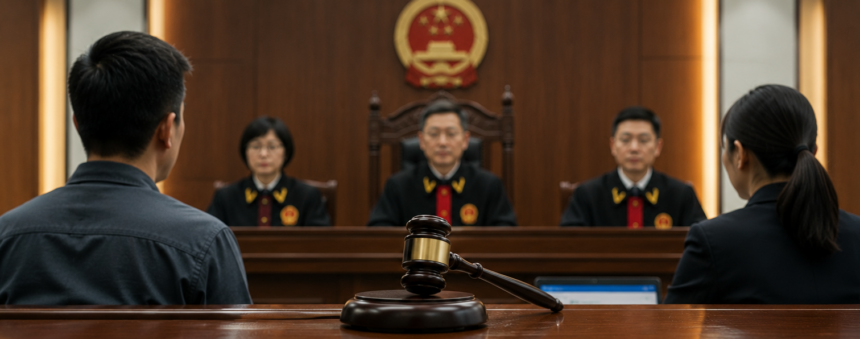
China’s AI employment ruling made global headlines on 13 May 2026 — and it carries weight far beyond one worker’s case. The Hangzhou Intermediate People’s Court published a landmark ruling confirming that companies cannot legally terminate employees simply because AI can perform their roles more cheaply. The case involved a quality assurance professional identified only as Zhou, who worked at a tech company in Hangzhou — China’s eastern AI hub and home to Alibaba and hundreds of AI startups. Zhou won at every stage of China’s legal system: arbitration, district court, and the intermediate court appeal. The company lost every time. Judge Shi Guoqiang of the Hangzhou court stated the position plainly. “We don’t believe AI technology has reached the point where it can substantially replace human workers.”
What’s Happening & Why It Matters
What Happened to Zhou — and Why He Fought Back
Zhou joined his company in 2022. His role was specific and valuable. He checked the accuracy of outputs generated by large language models — a quality assurance function that sat at the intersection of human judgment and AI production. By 2025, the company had implemented a new AI system capable of handling the same task automatically. Management moved quickly. They offered Zhou a demotion and a 40% pay cut — from 25,000 yuan ($3,655/€3,370) per month to 15,000 yuan ($2,190/€2,020). Zhou refused. The company then terminated his contract. It cited AI-driven staffing reductions as the grounds. It offered a severance package of approximately $45,000 (€41,500).
Zhou rejected the severance. He filed for labour arbitration. The arbitration panel found his dismissal unlawful and ruled in his favour. The company disagreed. It filed a lawsuit with the Yuhang District Court in August 2025 — and lost. It appealed to the Hangzhou Intermediate People’s Court — and lost again. The court ordered the company to pay Zhou over 260,000 yuan ($38,067/€35,100) in compensation. That total significantly exceeds the original severance offer.
The Legal Argument That Won — Three Times
The case turned on a single phrase in China’s Labour Contract Law. The law allows termination when there is a “major change in objective circumstances” that makes continuing the employment contract impossible. Companies argued that AI adoption qualifies as exactly that kind of objective change.
The courts disagreed at every level. The Hangzhou Intermediate People’s Court ruled that AI adoption is a deliberate, voluntary business decision — not an unforeseeable external event. The court’s reasoning was precise. “Major change in objective circumstances” typically refers to events such as mergers, company relocations, or policy-driven market collapses — circumstances outside the company’s control. By contrast, choosing to implement AI to cut costs is a strategic choice. It is not a force majeure event. “By citing AI replacement as grounds for dismissal,” the court stated, “the company had effectively shifted the risks of technological iteration onto its employees.” The outlook — shifting the cost of technology adoption onto workers — became the ruling’s defining logic.
The December 2025 Precedent That Set the Stage

The Hangzhou ruling builds directly on an earlier case. In December 2025, a separate Chinese court ruled against a mapping company that had eliminated a manual data entry role after switching to AI-powered data collection. That case involved a worker identified as Liu, hired in July 2009. His division was eliminated in early 2024 when the firm adopted AI data collection. He was dismissed in late 2024. He won arbitration compensation. A Beijing review panel confirmed the verdict. The reasoning in that case matched Zhou’s. The company’s AI pivot was a deliberate strategic choice. That choice — not an uncontrollable external event — caused the job elimination. Shifting the cost of that choice onto Liu was illegal.
Together, the two cases form a consistent judicial position across two Chinese cities. AI implementation does not constitute the kind of “objective major change” that unlocks no-fault termination rights for employers.
A Pattern Developing in Chinese Cities

The rulings are not isolated incidents. Multiple labour disputes arising from AI job replacements are working through Chinese courts simultaneously. One case that attracted widespread attention involved a company in Shandong Province. The company had created an AI digital replica of a former employee — using their voice, likeness, and work patterns — and deployed it to continue performing the employee’s tasks after their departure. Media coverage of that case generated a significant public reaction. The line between replacing a worker and cloning them is blurring. Chinese courts are being asked to draw it.
Pan Helin, an economist and member of an expert committee under China’s Ministry of Industry and Information Technology, addressed the principle directly. “While AI-driven job displacement may be inevitable, companies must ensure fair treatment during transitions, including reasonable reassignment arrangements and adequate compensation for layoffs.” That statement describes a floor, not a ceiling. Companies can adopt AI. They cannot simply pass the entire cost of that adoption to the people it displaces.
China’s Balancing Act: AI Leader and Labour Protector
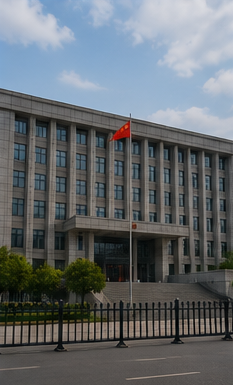
The timing of the Hangzhou ruling’s publication was deliberately chosen. The court released it on 29 April 2026 — in the lead-up to International Workers’ Day on 1 May. The publication reported part of a set of “typical examples of protecting the rights of AI enterprises and workers.” China’s government is simultaneously pushing industries to adopt AI at scale and trying to contain the social disruption caused by displacement. Both imperatives appear in official documents.
China’s 2026 government work report explicitly called for “improving measures to promote employment and entrepreneurship in response to the development of AI.” That is the first time AI’s impact on jobs appeared in a national policy framework at that level. China’s core AI industry exceeded 1.2 trillion yuan in value in 2025. The country hosts more than 6,200 AI enterprises. By 2030, the Chinese government projects that next-generation intelligent terminals and AI agents will penetrate more than 90% of China’s economy. Against that scale of disruption, the courts are being asked to hold a line that the economy keeps testing.
What the Ruling Means Outside China
China follows a civil law system — not the common law system used in the UK, US, and Australia. There is no stare decisis doctrine requiring lower courts to follow higher court precedent. The Hangzhou ruling does not automatically bind courts elsewhere in China, let alone internationally. At the same time, the ruling sends a clear signal. As one analyst noted, it suggests “the Chinese judiciary, and therefore national lawmakers, could be gearing up to protect workers from the threat of AI automation” — while workers in much of the Western world are largely without equivalent protections.
By contrast, European countries are watching closely. The EU AI Act classifies certain AI systems used in employment contexts as high-risk — requiring transparency and human oversight. The Digital Fairness Act, in development, addresses some aspects of AI workplace automation. Neither goes as far as the Hangzhou ruling in establishing a direct legal remedy for workers displaced by AI decisions.
TF Summary: What’s Next

The Hangzhou ruling does not change Chinese law on its own. It establishes a judicial position that lower courts and arbitration panels will reference when evaluating similar cases. Several similar disputes are already in the Chinese legal system at various stages. The government’s 2026 work report commitment to AI employment policy creates a legislative track that may eventually codify the judicial standard into statute. That process will take years. In the interim, the ruling gives Chinese workers a clear precedent to cite when employers use AI implementation as grounds for dismissal.
MY FORECAST: China’s AI employment ruling will accelerate global legislative proposals for AI displacement compensation frameworks. The EU will reference the Hangzhou precedent in forthcoming consultations on the Digital Fairness Act. At least two EU member states — most likely France and Germany — will introduce national AI displacement legislation within 18 months that draws on the same core principle: companies bear the cost of their own technology adoption, not the workers it displaces. In China itself, the government will codify the judicial standard into a formal amendment to the Labour Contract Law before the 2027 National People’s Congress session. The question is not whether AI will displace workers. Courts and governments have accepted that it will. The question they are answering is: Who pays?