


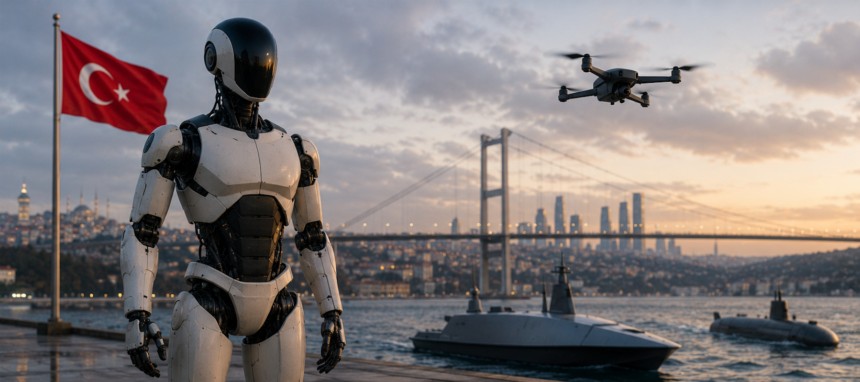
Türkiye’s robotics ambitions made headlines across two very different fronts this week. On 5 May 2026, a humanoid robot named CANIKMAN took a seat at the Canik Municipal Council’s monthly opening session in the city of Samsun. Two days later, defence company ASELSAN unveiled two new autonomous naval strike platforms at the SAHA 2026 defence expo in Istanbul — the TUFAN unmanned surface vehicle and the KILIÇ 200 autonomous underwater vehicle. Both carry warheads. Both operate in swarms. Together, these two stories illustrate the breadth of Türkiye’s robotics ambitions: from a humanoid sitting alongside elected officials to autonomous naval drones designed to saturate hostile maritime defences.
What’s Happening & Why It Matters
CANIKMAN: Türkiye’s First Population-Registered Humanoid

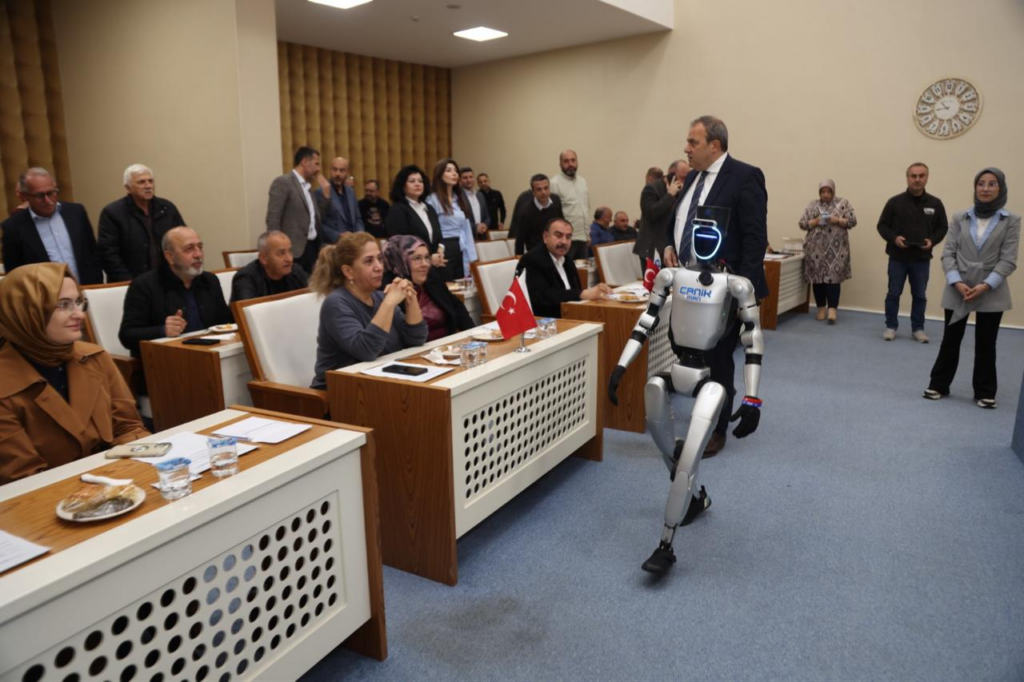
CANIKMAN is Türkiye’s first humanoid robot to receive official population registration — a legal status typically reserved for human citizens. On 5 May 2026, the robot attended the May opening session of the Canik Municipal Council in Samsun, a Black Sea coastal city in northern Türkiye. CANIKMAN followed council proceedings, interacted with participants, and answered questions from council members. The session covered local technology and infrastructure projects, including a new fibre internet rollout to 20,000 households in the district.
Canik Mayor İbrahim Sandıkçı confirmed CANIKMAN’s participation in a post on X. “Türkiye’s first population-registered humanoid robot, CANIKMAN, continues to meet with our children and young people,” he wrote. The mayor described the municipality’s goal as raising future generations with a strong understanding of innovative technology. “We are continuing our science and technology mobilization in Canik,” he added. The robot regularly visits local schools and the Canik Ozdemir Bayraktar Discovery Campus — a science and education facility connected to the municipality.
Who Built CANIKMAN — and Its Impact
CANIKMAN takes its name from its manufacturer — Canik, a Turkish precision engineering company best known internationally for high-quality firearms. That background is directly relevant. Humanoid robots require the same rigorous tolerances in joint and actuator engineering that precision firearms demand. By applying industrial-grade manufacturing discipline to the kinematics of a bipedal robot, Canik’s engineering team has moved the company from mechanical precision in weaponry to the complex physics of human-like locomotion and manipulation.
The robot represents a deliberate pivot toward technological sovereignty. Türkiye has been accelerating domestic investments across aerospace, defence, AI, and robotics education for several years. That acceleration follows a longer national tradition in robotics. Konya-based AKINROBOTICS built the world’s first dedicated humanoid robot factory in 2017. The country fields more than 100 humanoid and service robot companies at various stages of development. CANIKMAN’s debut at a government meeting is a symbolic milestone — not a production deployment — but it signals that Türkiye’s domestic robotics ecosystem has reached a level of confidence visible enough to take into public civic life.
The Civil Robotics Context
Türkiye’s civil humanoid robotics push is part of a genuinely competitive global landscape. In April 2026, China’s Honor Flash robot won the Beijing half-marathon in 50 minutes and 26 seconds — beating the human world record. In the same week, Siemens and NVIDIA completed an 8-hour autonomous factory trial with the HMND 01 Alpha humanoid robot in Germany. Sony AI‘s Project Ace robot beat elite table tennis players under official ITTF rules. Türkiye is entering this competitive environment from a different starting point — with strong manufacturing traditions, a young and technically capable population, and a government that treats domestic robotics as a strategic priority rather than an academic exercise.
At the same time, Türkiye’s defence exports reached $10.5 billion across 185 countries in 2025, according to defense industries secretary Haluk Görgün. He set a target of exceeding $11 billion in 2026 and entering the world’s top 10 in defence and aerospace exports. CANIKMAN’s civic robotics story and the SAHA defence expo’s naval drone announcements are two sides of that same national strategy.
TUFAN: The Surface Strike Drone Built for Swarm Warfare
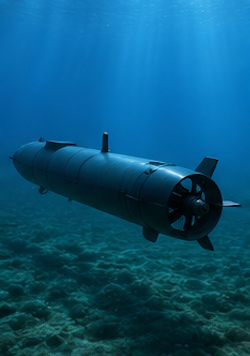
At the SAHA 2026 defence expo in Istanbul, ASELSAN unveiled the TUFAN — an autonomous unmanned surface vehicle designed for kamikaze strike missions against naval targets. The TUFAN measures approximately 26.2 feet (8 metres) in length and 5.9 feet (1.8 metres) in width. It reaches speeds of up to 57.5 miles per hour (92 kilometres per hour) and operates across a range of approximately 230 miles (370 kilometres).
TUFAN’s communication architecture combines radio links, satellite connections, and 4G LTE — allowing it to operate in high-interference environments. The drone carries a high-explosive insensitive munition warhead. Critically, TUFAN operates individually or as part of a coordinated swarm. Multiple units can synchronize attacks on a single target, saturating a vessel’s close-in weapons systems simultaneously. ASELSAN confirmed the system complies with STANAG 4817 — the NATO standard for unmanned maritime system integration. That certification signals Türkiye’s intent to position TUFAN not only for its own navy but as an export platform for allied and partner navies seeking affordable autonomous strike options.
KILIÇ 200: The Underwater Counterpart
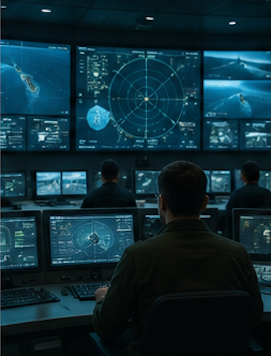
ASELSAN unveiled the KILIÇ 200 alongside TUFAN at SAHA 2026 — an autonomous underwater vehicle designed for covert strike and maritime threat engagement. The KILIÇ 200 measures approximately 137.8 inches (350 centimetres) long and 12.8 inches (32.5 centimetres) in diameter. Its base operational range is roughly 115 miles (185 kilometres), extending to 230 miles (370 kilometres) with an additional battery module.
The system integrates AI-based visual localization and target detection — allowing it to autonomously identify and engage threats. KILIÇ 200 supports satellite communication, carries an onboard warhead, and operates with low acoustic and thermal visibility. That stealth profile makes it effective for covert anti-ship missions, mine-laying analogues, and infrastructure disruption in shallow coastal waters. ASELSAN describes TUFAN and KILIÇ 200 as “New Strike Forces of the Blue Homeland”—a phrase rooted in Türkiye’s “Blue Homeland” doctrine, which asserts maritime sovereignty across extensive zones of the Black Sea, Aegean, and Eastern Mediterranean.
Why Türkiye’s Naval Drone Ambitions Are Credible
Türkiye’s naval drone credentials did not begin at SAHA 2026. In January and February 2026, the Turkish Navy deployed its task group — led by the drone-carrying amphibious assault ship TCG Anadolu — to the Baltic Sea for NATO’s Steadfast Dart 2026 exercise. On 14 February, a Bayraktar TB3 combat drone launched from TCG Anadolu and executed a live maritime strike in the Baltic — the first time a shipborne Turkish UCAV conducted a complete combat profile within a NATO exercise. Approximately 10,000 NATO personnel from 11 member states participated in the exercise. Türkiye contributed roughly 2,000 personnel — about one-fifth of the total deployed under the Allied Reaction Force flag.
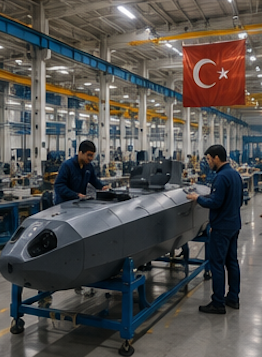
At the SAHA 2026 expo, STM — another Turkish defence company — unveiled the YAKTU, a kamikaze unmanned surface vehicle designed for swarm-based coastal strike missions. SAHA 2026’s chairman, Haluk Bayraktar — also CEO of drone manufacturer Baykar — announced plans to invest SAHA expo revenues in drone production and training centres across all 81 provinces of Türkiye. “We’ll use the revenues from the SAHA expo to establish these centres, which will help us instantly achieve the production capacity of millions of drones nationwide at any given moment,” Bayraktar said.
ASELSAN CEO Ahmet Akyol stated the strategic vision directly at the TUFAN and KILIÇ 200 unveiling. “Securing beyond the boundaries of the naval domain requires a new level of autonomy, integration, and operational flexibility. As maritime security gains increasing importance in today’s operational environment, we are leveraging our geographical advantages to enhance our capabilities at sea and introducing our new generation unmanned naval systems.”
TF Summary: What’s Next
CANIKMAN continues its educational tour of schools and science campuses in the Canik district. Canik has not announced a commercial production timeline for the humanoid platform. The robot’s current role is demonstrational — building public familiarity with humanoid AI and signalling Türkiye’s domestic robotics capability. Future deployments to other municipalities and public institutions are likely as the platform matures. TUFAN and KILIÇ 200 will move from the SAHA 2026 exhibition to procurement evaluation by the Turkish Navy and potential international buyers. STANAG 4817 compliance positions both systems for NATO-member acquisition without significant integration work. ASELSAN’s defence export growth — alongside Türkiye’s target of entering the global top 10 in aerospace and defence — creates a strong commercial incentive to push both platforms toward production contracts rapidly.
MY FORECAST: Türkiye’s robotics ambitions will converge within three years. The civil humanoid sector — led by companies such as Canik and AKINROBOTICS — will deliver commercial service robots to the hospitality, healthcare, and education markets by 2028. The defence robotics sector — driven by ASELSAN, Baykar, and STM — will see TUFAN and KILIÇ 200 enter the Turkish Navy inventory by 2027 and generate export orders from at least two NATO or partner-nation navies within the same window. The SAHA expo’s plan to build drone production centres across all 81 provinces is the most strategically ambitious element — and it will produce a domestic manufacturing base that makes Türkiye a credible Tier 2 global drone power by 2030.