


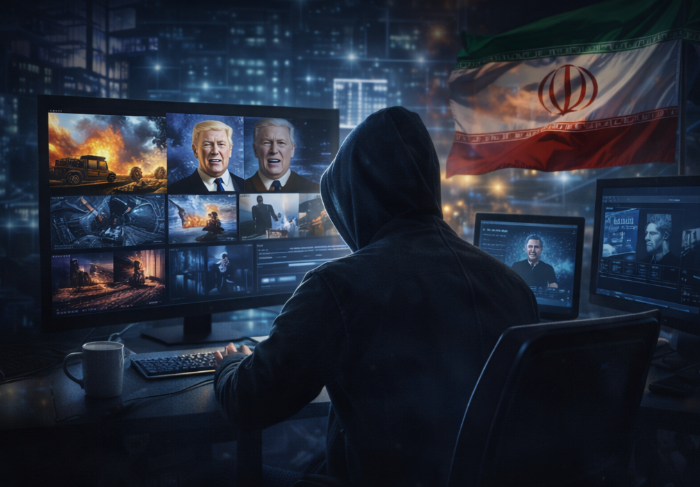
How Tehran turned memes, Lego cartoons, and AI-generated propaganda into a surprisingly effective second front in a shooting war.
War has always had a propaganda dimension. But in 2026, that dimension went digital, generative, and frankly — quite funny. When a joint US and Israeli military operation struck Iran on 28 February 2026, the country could not match the West’s firepower. So Tehran found another front. Pro-Iran groups and government-linked accounts flooded social media with AI-generated deepfakes, Lego-style cartoons, and finely crafted memes — all fluent in English, all fluent in American internet culture, and all designed to humiliate the most powerful country on earth in its own language.
The campaign reached hundreds of millions of people. It posted to TikTok, X, Facebook, and Instagram. It earned coverage in mainstream Western outlets. And it forced analysts, governments, and platform companies to confront an uncomfortable truth: AI has made information warfare cheap, fast, and devastatingly accessible — even for a country under severe military pressure.
What’s Happening & Why It Matters
The Lego Army That Broke the Internet
The most talked-about weapon in Iran’s digital arsenal is not a missile. It is a Lego brick. A group called Akhbar Enfejari — which translates as “Explosive News” — began publishing AI-generated Lego-style animations shortly after the conflict started. The videos are slick, scripted, and clearly built by people who understand American culture inside and out.
In one video, a Lego-fied Iranian military commander raps: “You thought you ran the globe, sitting on your throne. Now we turning every base into a bed of stone” — as a cartoon Trump tumbles into a bullseye constructed from “Epstein files.” In another, Trump is depicted throwing a chair at US generals during a war council. In another still, he walks off Air Force One clutching a large white flag.
The content references bruising on Trump’s hand that sparked health speculation, infighting within the MAGA base, and Secretary of Defence Pete Hegseth’s fiery Senate confirmation hearing. These are not accidental inclusions. They are precise cultural insertions designed to resonate with American audiences already primed for division.
Moustafa Ayad, a researcher at the Institute for Strategic Dialogue, described the videos’ impact clearly: “They’re making it easily accessible to understand the conflict from Iran’s point of view, and it’s hitting on points of disaffection in the United States at the same time. It’s working on two fronts.”
Deepfakes at Industrial Scale
The Lego cartoons are the visible face of something far larger and more troubling. Research firm Cyabra documented a pro-Iran disinformation campaign that generated over 145 million views and more than nine million interactions across social media platforms within days of the conflict’s start. The campaign deployed tens of thousands of fake accounts, synchronised to spread AI-generated deepfakes portraying Iran as victorious and its adversaries as weakened.

The deepfakes are increasingly indistinguishable from real footage. The New York Times identified more than 110 unique deepfake videos carrying pro-Iran messages in a two-week period alone — featuring fabricated missile strikes, downed American aircraft paraded through Tehran, and explosion footage repurposed from past conflicts in Syria and Libya.
Disinformation researcher Sam Jones put the technological shift in stark terms: “AI-generated deepfakes have crossed a critical threshold. Earlier tell-tale glitches have been eliminated, and this technology is accessible to anyone with a smartphone.” The barrier to entry for state-linked propaganda operations is, effectively, gone.
Russian and Chinese accounts further amplified the content. China‘s state-aligned media echoed anti-US narratives to compound confusion. Russia‘s bot networks provided distribution. The Iran-Russia-China information axis functions not just as a loose arrangement of shared interests — it functions as a coordinated amplification machine.
Government Embassies Join the Troll Campaign
Akhbar Enfejari claims to be a voluntary, student-run group paying for its own internet and laptops. But the sophistication of the content, combined with Iran’s severe domestic internet restrictions, tells a different story. Mahsa Alimardani, a director at WITNESS, a human rights organisation working on AI video evidence, was blunt: “If you’re able to have the bandwidth needed to generate content like that and upload it, you are officially or unofficially cooperating with the regime.”
Iranian state media reposted the Lego videos. Government embassy accounts took the trolling further. Iran’s Embassy in Thailand responded to Trump’s threat to blast the country “back to the Stone Ages” with an AI-generated image depicting Trump as a caveman, captioned: “Back to the Stone Age already? We’ve been a civilisation for thousands of years.” Iran’s Embassy in South Africa posted “Say hello to the new world superpower” alongside an image of the Iranian flag. Iran’s Embassy in Zimbabwe suggested it had lost the keys to the Strait of Hormuz after Trump issued threats.
After the ceasefire was announced, Akhbar Enfejari posted triumphantly: “Iran won! The way to crush imperialism has been shown to the world. Trump surrendered.” The propaganda machine did not wait for a diplomatic outcome. It declared one.
The Liar’s Dividend and the Reality Crisis
The deeper danger runs beyond individual viral videos. BOOM‘s Managing Editor Jency Jacob described the situation with striking clarity: “We are no longer facing a misinformation problem. We are facing a reality crisis.” The normalisation of deepfakes has produced a phenomenon analysts call the “Liar’s Dividend” — where even real, verified footage gets dismissed as AI-generated by bad actors who find it inconvenient.
Israeli Prime Minister Netanyahu released three separate videos to prove he was alive during the conflict. Each was forensically verified as authentic. None were widely believed. The deepfake ecosystem had already poisoned the information well so thoroughly that truth itself became suspect.
Trump himself accused Iran of using AI to fake a successful strike on the USS Abraham Lincoln aircraft carrier, and claimed images of 250,000 Iranians gathered at a rally were “totally AI-generated.” Both claims were disputed by independent verification. The irony is precise: in a war partly defined by AI disinformation, even accusations of AI disinformation became contested information.
Meanwhile, X announced it would remove creators from its payment programme for 90 days if they posted AI war videos without labelling them. Researchers were unimpressed. Joe Bodnar of the Institute for Strategic Dialogue told AFP: “The feeds I monitor are still flooded with AI-generated content about the war.” The financial incentive to post shocking, exaggerated content — built directly into X’s engagement model — works directly against the policy.
America’s Own Meme War Problem
Iran is not the only party weaponising content. The White House shared videos on X and TikTok that critics described as a “meme-war” approach to conflict communication. One 60-second clip opened with footage from the video game “Call of Duty: Modern Warfare II,” before cutting to actual US strike footage. Lawmakers and veterans condemned the strategy.

Senator Tammy Duckworth of Illinois wrote on X: “War is not a f*cking video game. Seven Americans are dead, and thousands more are at needless risk because of your illegal, unjustified war. And you’re calling this a ‘flawless victory.'”
Propaganda scholar Nancy Snow — who has written more than a dozen books on the subject — described Iran’s strategy with precision: “They’re using popular culture against the number one pop culture country, the United States.” The assessment cuts both ways. When the world’s most powerful military communicates through video game clips, it invites exactly the kind of satirical counterattack Iran deployed with devastating effectiveness.
Emerson Brooking of the Atlantic Council’s Digital Forensic Research Lab put the structural shift plainly: “It’s like this commodification of war — becoming part of the attention economy — which is a very strange and discomfiting experience so many of us are going through right now.”
TF Summary: What’s Next
Iran’s AI propaganda campaign in 2026 is a turning point. The combination of photorealistic deepfakes, coordinated bot amplification, and culturally precise satirical content has demonstrated that information warfare no longer requires vast resources — it requires creativity, AI access, and an understanding of how social media algorithms reward outrage over accuracy. The cuts to the FBI‘s Foreign Influence Task Force, the State Department‘s Global Engagement Centre, and the Foreign Malign Influence Centre at the Office of the Director of National Intelligence have left the US significantly less equipped to counter the campaigns when they are most needed.
The war may have reached a ceasefire. The information war has not. Iran’s Lego cartoons will keep circulating. The deepfakes will grow more convincing. And the platforms that profit from engagement — whether that engagement is built on truth or fabrication — continue to operate under rules too slow and too narrow to keep pace with AI-generated content. The next conflict will not start this way. It will start worse.
— Text-to-Speech (TTS) provided by gspeech | TechFyle