


Washington opens the door, Meta sharpens the axe, and ByteDance slams the brakes.
AI news keeps splitting into three moods at once. One room says the tools are normal enough for government work. Another room says the tools are efficient enough to justify layoffs. A third room says the tools are powerful enough to trigger copyright panic before launch.
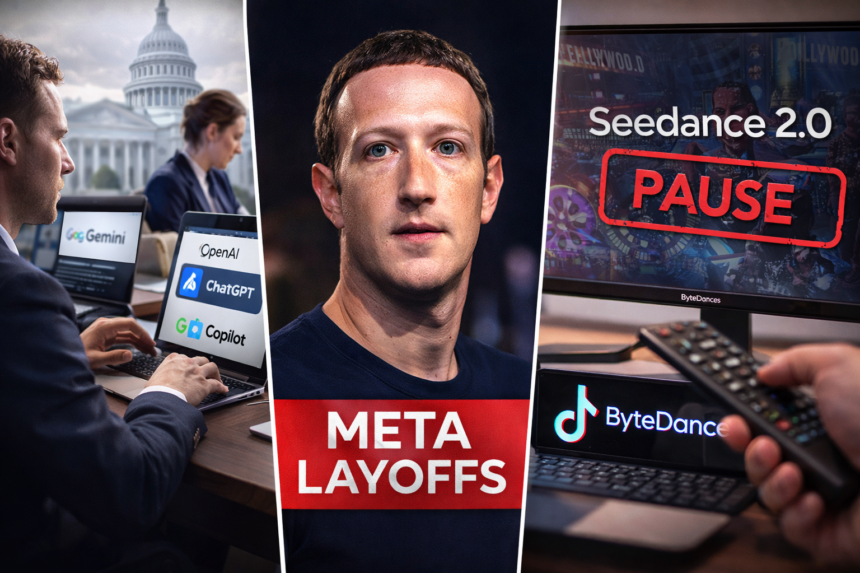
That is the story in one breath. U.S. Senate aides can use major chatbots for routine work. Meta is reportedly planning sweeping layoffs as AI costs climb and leaders chase “efficiency.” ByteDance has paused the launch of its Seedance 2.0 AI video model after legal threats from Hollywood giants.
The headlines are not random. Together, they show where the AI market is actually heading. Governments are adopting AI. Platforms are reorganising around AI. Media companies are lawyering up against AI. The cheerful demo phase is fading. The real phase is here, and it is full of policy memos, payroll cuts, and cease-and-desist letters.
What’s Happening & Why This Matters
The U.S. Senate Is Letting Aides Use Chatbots for Routine Work
Senate aides are allowed to use Google Gemini, OpenAI ChatGPT, and Microsoft Copilot for routine Senate work, according to a memo described in the uploaded file. The approved uses include drafting and editing documents, summarising information, preparing talking points and briefing material, and conducting research and analysis.
That matters because Congress has spent years grilling tech companies in public while quietly inching toward using the same tools in private. The Senate’s move formalises something that likely already existed in practice. The file notes that this may be the first time aides have received official approval, though there is a good chance it is not the first time AI has already been used for Senate-related tasks.
The policy shows where the comfort zone ends. The memo leaves open questions around sensitive data and higher-risk use cases. The House had previously allowed aides to use tools such as ChatGPT, Copilot, Gemini, and Claude, but with restrictions on sensitive data and speech drafting. Senate Intelligence Committee spokespeople did not respond to questions about what policies govern committee work involving chatbots.
That grey zone is the real story. Lawmakers want the productivity bump. They do not yet appear eager to declare exactly how the tools should behave around confidential or politically sensitive material. That makes sense. Once AI enters legislative workflows, even for “routine” tasks, the next question arrives fast: where does routine end?

There is a political wrinkle. The memo reportedly omitted Anthropic’s Claude, even though the House had allowed it. The file ties that omission to Claude being under fire from the Trump administration, including a Truth Social post in which President Trump called the company “left-wing nut jobs.” In Washington, software adoption is never only about software. It is also about who is mad at whom this week.
Meta’s AI Spending Spree Is a Jobs Story
Meta is reportedly planning layoffs that could affect 20% or more of the company as it tries to offset costly AI infrastructure bets and prepare for efficiency gains from AI-assisted workers. No date is set, and the final scale is not fixed, but top executives have reportedly signalled the plan to senior leaders and begun asking them to prepare cuts.
If Meta is on that 20% figure, the cut would be its biggest since the “year of efficiency” restructuring in late 2022 and early 2023. The company employed nearly 79,000 people as of 31 December. It had already laid off 11,000 staff in November 2022, then cut another 10,000 around four months later.
AI stops sounding like a shiny product story and is a labour story.
Meta has been spending aggressively to compete in generative AI. The company has reportedly offered enormous compensation packages, some worth hundreds of millions of dollars over four years, to recruit top researchers for its superintelligence team. It has said it plans to invest $600 billion (€515 billion) in data centres by 2028, while separately spending at least $2 billion (€1.72 billion) to buy Chinese AI startup Manus, according to the uploaded reporting. Those euro conversions use the ECB’s 10 March 2026 reference rate of €1 = $1.1641.
That is the great AI contradiction in one paragraph. Companies are throwing eye-watering money at chips, data centres, acquisitions, and superstar researchers, then turning around and talking about efficiency through smaller human teams.
Mark Zuckerberg has practically said the quiet part out loud. The file says he noted in January that he was beginning to see “projects that used to require big teams be accomplished by a single very talented person.” That sentence is the executive version of a storm warning for white-collar labour.
And Meta’s timing is not random. The company is trying to recover from a rough patch around Llama 4, including criticism of benchmarks and the abandoned release of its largest version, Behemoth. Its new model, Avocado, is reportedly underperforming expectations too. If AI success is lagging while AI costs keep rising, headcount is the easiest number for leadership to squeeze.
ByteDance Hit Pause on Seedance Because Hollywood Is Already Swinging
While Congress normalises chatbot use and Meta trims for AI scale, ByteDance is getting a different lesson: content generation is easy, legal peace is harder.

ByteDance has paused the launch of Seedance 2.0, its AI video-generation model that would compete with tools such as OpenAI Sora and Google Veo. The file says the launch freeze followed ongoing copyright disputes with Hollywood studios and streaming companies. ByteDance had reportedly planned a mid-March launch, but legal teams are working through copyright risks, while engineers are adding safeguards to prevent outputs that might trigger disputes.
That pause matters because Seedance had already attracted serious attention. The model entered limited beta in February, initially only for users of ByteDance’s Chinese apps, and some of its videos went viral fast. One clip showing a stylised fight scene between Tom Cruise and Brad Pitt drew enough attention that Deadpool screenwriter Rhett Reese reposted it and wrote, “I hate to say it. It’s likely over for us.”
That quote is half joke, half obituary for a chunk of creative labour.
The legal pushback got serious fast. The file says Disney sent ByteDance a cease-and-desist letter after the alleged use of copyrighted characters from Star Wars and Marvel. Paramount Skydance reportedly sent its own cease-and-desist, arguing that ByteDance was enabling “blatant infringement” of intellectual property tied to Star Trek, South Park, and Dora the Explorer.
This is the pattern. AI companies launch first, go viral second, and let the copyright lawyers arrive third. ByteDance is only the latest company to discover that “look what the model can do” is a lot less charming when the model can do it with someone else’s characters.
AI Stretches Its Wings
Taken together, the files describe the real AI economy more honestly than most keynote events ever will.
The Senate story shows that AI is crossing into official institutional work, even if guardrails are fuzzy. The Meta story shows that AI investment is reshaping corporate labour math in ways executives are comfortable stating more openly. The ByteDance story shows that generative AI is colliding head-on with intellectual property owners who are no longer content to watch from the sidelines.
And all three stories point to the same conclusion: AI is not a side feature anymore. It is in the operating infrastructure.
That creates three predictable fights.
First, workflow fights. Who gets to use AI, for what, and with how much oversight?
Second, the workforce fights. Which roles shrink, which roles survive, and how bluntly will management tie job cuts to AI efficiency?
Third, rights fights. Which content can models generate, remix, or imitate before creators and studios drag the product into court?
The comedy here, if we can call it comedy, is that the industry keeps selling AI as simplification. In reality, it is making institutions more complicated. More policy. More compliance and litigation. Fear inside payroll spreadsheets. Memo-writing about what the bot is allowed to touch.
That is not failure. It is adulthood. And adulthood is much less fun than demos.
TF Summary: What’s Next
The Senate is formally letting aides use major chatbots for routine work, which means AI has moved one step deeper into government operations. Meta is reportedly weighing layoffs that could hit 20% of staff as it spends aggressively on AI infrastructure and elite research talent. ByteDance has frozen the launch of Seedance 2.0 amid copyright threats from major studios.
MY FORECAST: Expect the next year to bring stricter AI rules inside institutions, more executive claims that AI lets smaller teams do bigger jobs, and more lawsuits over generated media that is too much like somebody else’s property. The early AI era was about possibility. The phase is about control — who gets it, who loses it, and who pays when the machine gets too good at the wrong thing.
— Text-to-Speech (TTS) provided by gspeech | TechFyle