



Wall Street flinches as powerful new AI tools raise doubts about software value, spending discipline, and job security.
07 February 2026: Wall Street rallied sharply on Friday. The equity markets rebounded after a three-day rout in technology and software stocks. The S&P 500 rose 1.97%; the tech-laden Nasdaq Composite rose 2.18%. The Dow and S&P each had their best day since May, while the Nasdaq had its best day since November.
The stock market does not panic often. When it does, it usually panics about the future.
That is what happens this week.
A wave of selling hits technology stocks after new AI releases trigger fresh concern about disruption, overspending, and job loss. Software and data companies lead the decline. Investors rotate away from growth and into safer ground. The Nasdaq records its worst two-day drop since April. Confidence wobbles.
At the centre of the storm sits artificial intelligence.
New tools promise to replace entire categories of software. They also promise to automate work that once required teams. That promise excites builders. It scares investors.
The market assesses whether AI creates value enough to justify the cost.
What’s Happening & Why This Matters
New AI Tools Rattle Confidence in Software Stocks

The sell-off accelerates after a major AI update from Anthropic.
Anthropic deployed a serious upgrade to its Claude model. The new release improves its Cowork AI assistant, a tool designed to act like a digital colleague. Cowork can read files, analyse documents, generate slides, and write code across large projects. The update enhances Claude’s memory and reasoning. It also improves integration with everyday office tools.
The capability is affecting Wall Street.
Investors immediately ask a brutal question. If AI can perform research, analysis, drafting, and coding inside one interface, why do companies still need expensive, specialised software?
The market answers by selling first and thinking later.
Shares of legal, financial, and analytics software companies fall sharply. An exchange-traded fund tracking software stocks posts its worst day since April. Individual names fare worse. Some stocks drop between 15% and 20% in a single session.
The markets feel the shock — the Nasdaq slides. Risk appetite fades. Fear spreads beyond pure software into adjacent tech sectors.
The Deeper worry: AI Threatens Business Models
The anxiety runs deeper than one product launch.
For years, enterprise software has thrived on complexity. Companies buy separate tools for legal research, financial modelling, compliance checks, customer data, and internal workflows. Each tool builds a moat around its dataset and process.
AI challenges that structure.
Large language models ingest documents, spreadsheets, contracts, and code at once. They do not care about product categories. They care about tasks. That shift threatens vendors whose value comes from narrow specialisation.
Analysts compare the moment to past tech resets.
Strategists at Deutsche Bank warn that the rotation out of software “echoes what we saw in 2000 as the dot-com bubble started to burst.” Their point is not that tech collapses overnight. Their point is that markets can absorb sector rotation for months before reality sets in.
In 2000, consumer staples and utilities rallied while tech slid. Indices stayed calm. Under the surface, damage grew. Eventually, the drag pulled everything down.
That historical memory modifies behaviour.
Investors worry that AI compresses margins. They fear that AI weakens pricing power. If one AI assistant can replace five tools, customers will demand lower fees. That logic hits valuations immediately.
Hyperscalers Bet Big, Investors Hesitate
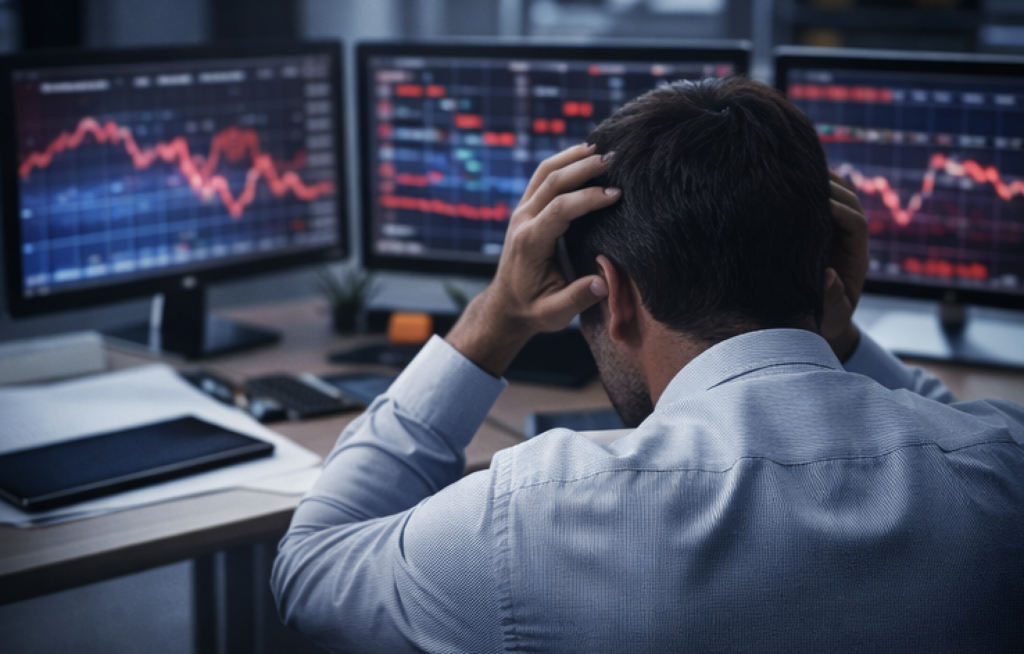
AI fear also comes from the supply side.The largest tech companies announce enormous capital spending plans. Combined, Alphabet, Amazon, Meta, and Microsoft plan to spend roughly $650 billion this year on data centres, chips, and AI infrastructure.
That number stuns markets.
Investors accept big bets when returns feel clear. They grow nervous when costs rise faster than revenue proof. Right now, AI promises future productivity. It does not yet guarantee near-term profit.
The conflict fuels doubt.
Analysts at Bloomberg compare the scale of AI spending to historic infrastructure booms. They mention railroads, highways, and the telecom build-out of the 1990s. Those investments changed the world. They also destroyed capital along the way.
The market asks who wins and who pays.
Jobs, Anxiety, and the Signs Behind the Sell-off
Markets often reflect human fear before spreadsheets catch up. AI fear is not abstract. It touches jobs.

Employment for recent graduates in computer science and mathematics has declined by about 8% since 2022, according to Oxford Economics. At the same time, surveys show that around 90% of tech workers already use AI tools at work.
That combination feels unstable.
Workers worry about replacement. Managers worry about over-automation. Regulators worry about safety and misuse. Investors worry about backlash and regulation.
Even AI builders acknowledge the tension.
Dianne Penn, head of product management for research at Anthropic, says the company carefully considers labour impact with each release. She points to internal research programs that examine how AI affects jobs and wages.
Outside analysts remain cautious.
Jacob Bourne, a technology analyst at eMarketer, says panic likely runs ahead of reality. He argues that security concerns and integration friction will slow adoption at large firms. Many enterprises hesitate to give AI tools broad access to files and systems.
In other words, AI may replace some tasks immediately. It may replace entire roles more slowly.
Markets rarely wait for nuance.
The Spread: Software, Data, and Crypto Feel the Pressure
The fear does not stop at enterprise software.
Data and analytics firms see heavy losses. One major UK-listed information company loses more than £7 billion in market value in a week. Investors worry that proprietary databases lose value when AI can summarise public information cheaply.
The ripple effect reaches crypto.
Risk assets broadly weaken. Bitcoin slides. Altcoins follow. Some of that move stems from AI-related fear — some links to risk-off behaviour. When investors unwind popular trades, they sell what they can.
Cybersecurity concerns add another layer.

A recent Coinbase disclosure reveals an insider breach involving a contractor who accessed customer data. Hackers post screenshots showing sensitive account details. Coinbase fires the contractor and notifies regulators.
The incident reinforces a growing theme. As AI systems gain access to files and workflows, insider risk grows. Security becomes a gating factor for adoption.
Investors see that risk and adjust expectations.
More Than Past Tech Scares
This sell-off is not only about valuation. It is about trust.
AI touches core business processes. It reads documents, drafts decisions, and influences outcomes. When something goes wrong, damage spreads.
Markets recognised that AI adoption introduces new operational risks. Those risks do not fit old models. They require new controls, audits, and governance.
That slows deployment. It raises costs. It delays returns. At the same time, AI clearly works. Productivity gains are real. Capabilities improve weekly. Ignoring AI is not an option.
So markets sit in an uncomfortable middle. They believe the future belongs to AI. They doubt the path from here to there.
That doubt drives volatility.
TF Summary: What’s Next
AI fears trigger a sharp sell-off in software and tech stocks as investors question business models, spending discipline, and job impact. New AI tools promise to replace entire categories of enterprise software. At the same time, hyperscalers commit hundreds of billions to infrastructure. Markets struggle to price both forces at once.
MY FORECAST: Volatility stays high through 2026. The market rewards companies that prove AI boosts margins rather than erodes them. Legacy software firms adapt or consolidate. AI builders face pressure to show security, governance, and real revenue. The panic fades, but the reckoning does not.
— Text-to-Speech (TTS) provided by gspeech | TechFyle