


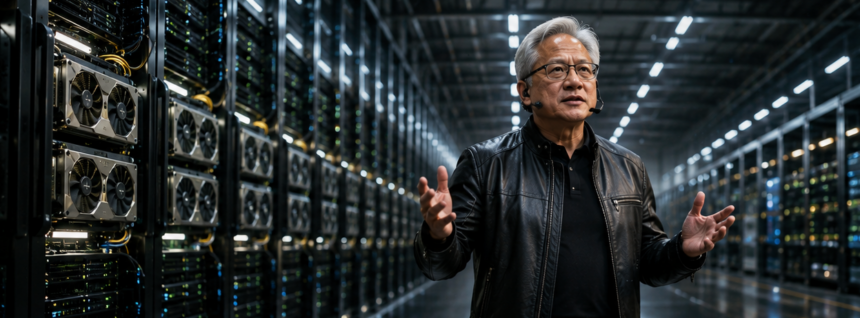
Zero dollars in the forecast come from China. Compute is now revenue, Huang says — not a promise, a line item. And memory scarcity, driven by the same AI buildout paying for it, is already squeezing next quarter’s margins.
Nvidia reported Q2 fiscal 2027 revenue of $96.2 billion Wednesday, up 106% year-over-year and beating Wall Street’s $93 billion consensus. Earnings per diluted share hit $2.22, more than double the $1.05 reported a year earlier. Gross margin came in at 75.0%, up from 72.7% a year ago. CEO Jensen Huang noted the quarter in operational terms: “AI has reached its inflexion point. It’s doing useful work. Its tokens are productive and profitable. Now, compute is revenue. And demand is accelerating.” Guidance for Q3 came in at $108 billion, plus or minus 2%, with the entire figure built on an assumption of zero data centre compute revenue from China.
What’s Happening & Why It Matters
The China Number That Isn’t There
Here’s what makes the guidance different from a typical forecast. Nvidia isn’t projecting cautious China revenue and hoping for upside. It’s projecting none at all. Any approved China sales would appear clean, unbudgeted upside rather than a forecast Nvidia needs to reach. That’s a specific hedge against a market Nvidia can’t predict — export restrictions have made China revenue too unreliable to build into guidance. Hence, the company removed it from the equation.
CFO Colette Kress was direct about a second pressure point building into next quarter. Gross margin is expected to decline and bottom out in fiscal Q4, landing between 71% and 72% — down from the quarter’s 75.0%. “We want to be direct about this, rather than let it linger as an open question,” Kress said. “Memory scarcity today is being driven in large part by the AI buildout itself.” That’s Nvidia acknowledging, in its own earnings call, that the industry it’s fueling is now constraining its own cost structure — the same DRAM and HBM shortage TF has tracked across Micron’s Hiroshima expansion and the broader semiconductor chaos is now visible in Nvidia’s own margin guidance.
A Deal with Amazon
Nvidia’s results arrived alongside a major customer announcement. Amazon Web Services and Nvidia confirmed AWS will buy 2 million Nvidia GPUs, paired with Nvidia’s new Vera CPU. Nvidia announced its Vera Rubin platform is ramping into full production, with racks already running at partners including CoreWeave, Google Cloud, Microsoft Azure, Oracle Cloud Infrastructure, and Nebius. Production shipments begin in fiscal Q3, with a larger ramp through Q4 and early 2027.
The customer list matters in context. Alphabet, Amazon, Meta, and Microsoft are expected to spend $745 billion combined on capital expenditure in 2026, according to the Financial Times. Not every dollar of that is Nvidia revenue — buildings, power infrastructure, networking, memory, and each company’s own designed chips all eat into that figure. But the direction is unambiguous. Every major hyperscaler named in Wednesday’s results is a customer, not a competitor, at least for now.
The AGI Comment During the Earnings Call
Huang’s inflexion-point echoes a much larger claim he made back in March on Lex Fridman’s podcast, which continues to shape how analysts read every subsequent Nvidia statement. “I think we’ve achieved AGI,” Huang said then, describing a scenario where an AI system could build, launch, and manage a billion-dollar company — so long as that success wasn’t expected to last forever. The claim drew immediate scepticism. Fortune’s own follow-up noted competing research papers arguing AGI hasn’t been achieved by any conventional measure, and proposed new frameworks for measuring it instead.
The scepticism carries an obvious commercial angle, as critics have pointed out. If AGI is “achieved,” Nvidia’s high-end chips are a critical requirement for every major AI lab and hyperscaler racing to build on that claim — reinforcing demand for the product Nvidia sells. Whether or not AGI has arrived, Huang’s outlook — “compute is revenue” — suggests the company has moved past debating the definition and toward monetising whatever level of capability exists.
TF Summary: What’s Next
Nvidia’s Vera Rubin platform ramps toward full production through fiscal Q4 and early 2027. Gross margin is expected to bottom between 71% and 72% in Q4, per Kress’s guidance, before any anticipated recovery. The AWS GPU order proceeds alongside Nvidia’s other hyperscaler partnerships. No timeline exists for when, or whether, China data centre compute revenue returns to Nvidia’s forecast.
MY FORECAST: Expect Nvidia to beat its own $108 billion Q3 guidance again, continuing a streak that’s now run 13 consecutive quarters — though Q2 FY27’s beat margin already sits closer to that streak’s historical low than its high, a trend worth watching if it continues narrowing. The memory scarcity Kress flagged will matter more to Nvidia’s margins over the next two quarters than any single customer announcement, given how the current DRAM shortage links every major AI hardware supplier’s cost structure. Watch whether China compute revenue reappears in guidance before fiscal year-end — any change there would be the clearest signal yet of where US export policy is heading, well ahead of any formal government announcement.
Related Stories
- Sour Sentiment Triggers AI, Chip Stocks Sell Off
- Micron Breaks Ground on a $9.3 Billion Chip Plant in Japan
- Nvidia Is Backing $500 Billion in AI Infrastructure Financing