


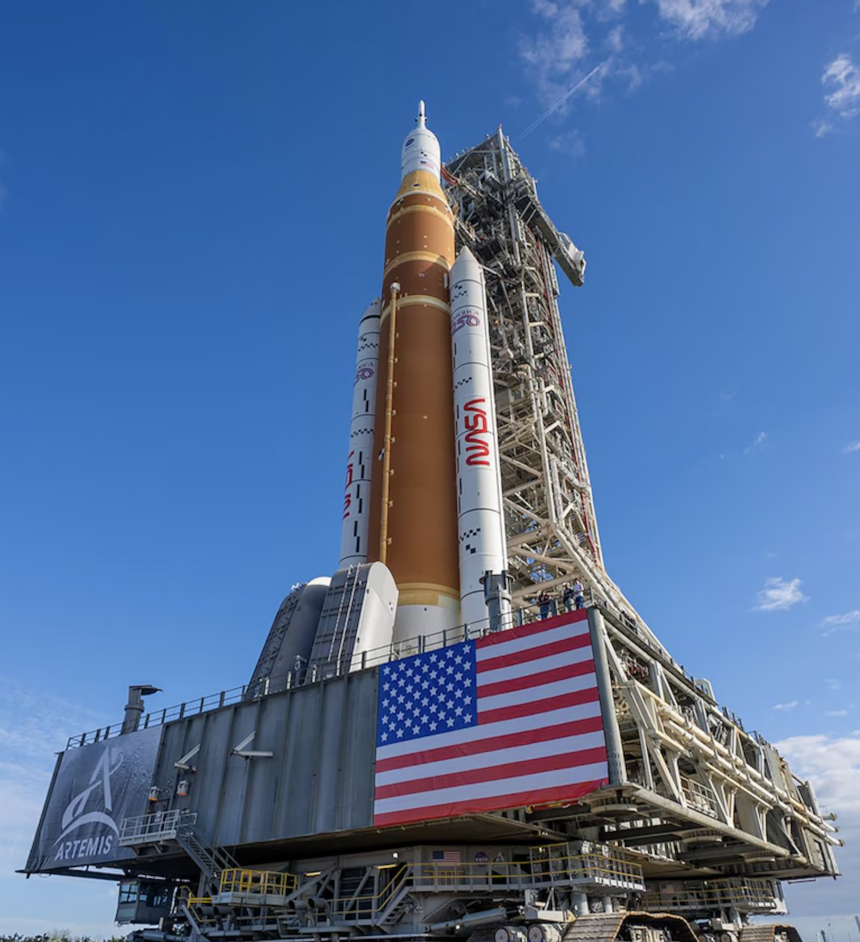
NASA is edging back toward the Moon. This time, there are humans on board instead of only hope and press releases.
For years, the Artemis program has felt like a mix of ambition, delay, hardware drama, and the occasional inspirational poster. That is the tax you pay when you try to send people back toward the Moon after more than half a century away. Rockets leak. Schedules slip. Engineers stop sleeping. The universe is stubbornly unimpressed.
NASA says Artemis II is getting close enough to taste. The agency has cleared its giant Moon rocket for a possible 1 April launch after completing fresh repairs, with a six-day window at the start of April. If the mission launches on time, it is humanity’s first crewed trip toward the Moon in more than 50 years, since the Apollo 17 mission ended in 1972.
That makes this more than another calendar update. Artemis II is the first crewed test of the Space Launch System and Orion combination around the Moon. It is also the mission that must prove NASA can actually build momentum again before later lunar landing plans have any real chance of looking credible.
What’s Happening & Why This Matters
Cleared for a Possible April Launch
NASA says the 98 m (321.5 ft) Moon rocket is ready to roll from the Vehicle Assembly Building back to the pad at Kennedy Space Centre next week, with a launch attempt possible as early as 1 April. The agency has a six-day launch window at the start of April. If it misses that slot, it must stand down until 30 April or early May.
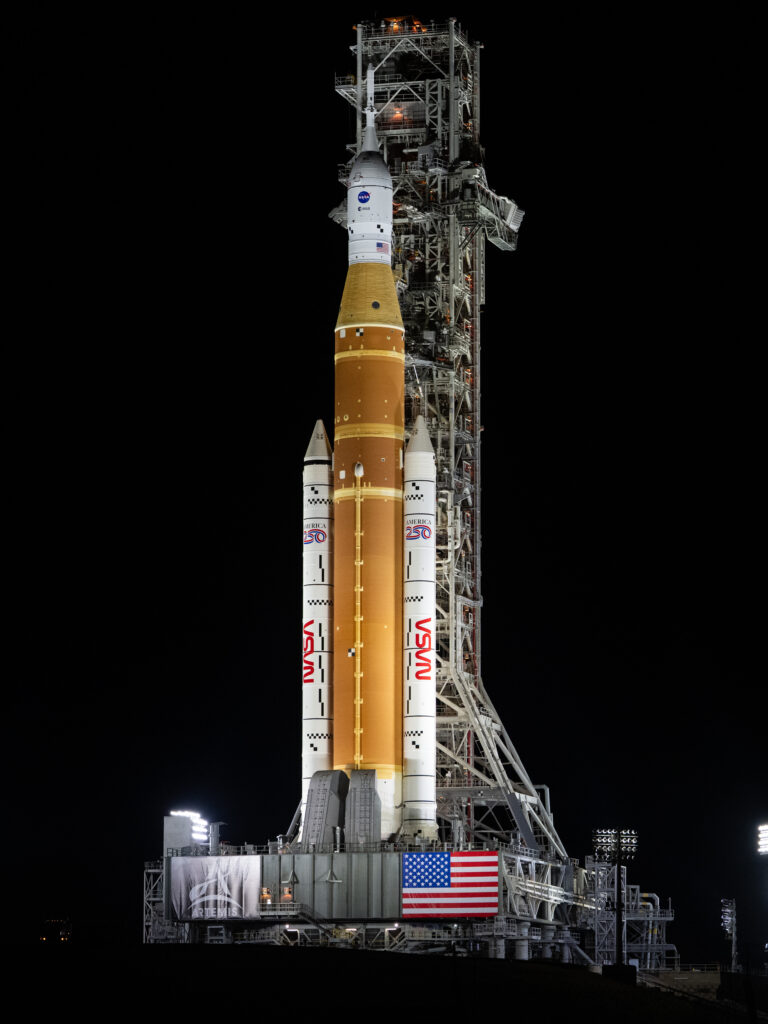
That matters because Artemis II was supposed to fly earlier in the year. Instead, the mission got tripped up by hardware problems that make spaceflight feel less like science fiction and more like a very expensive plumbing emergency. NASA says hydrogen fuel leaks and other issues with the SLS rocket interfered with the original plan. The team plugged the hydrogen leaks at the pad in February, but then a helium-flow issue forced the rocket back into the hangar for repairs, forcing the mission into April.
That sequence sounds frustrating because it is frustrating. It is also normal for new deep-space systems. Artemis is not operating on airline logic. It is operating on first-of-its-kind hardware logic, which means every leak, valve issue, pressure anomaly, and fluid-flow problem gets treated like the difference between a mission and a congressional hearing.
NASA’s language reflects that tension. Lori Glaze, Deputy Associate Administrator for NASA’s Exploration Systems Development Mission Directorate, says, “It’s a test flight and it is not without risk, but our team and our hardware are ready.” That is about as close as a senior NASA official gets to saying, “Yes, this is a little terrifying, but let’s go.”
Artemis II Is a Moon Flyby Only
It is worth being clear about what Artemis II actually is, because the public hears “Moon mission” and often pictures boots on dust and flags in slow motion.
The mission is a crewed lunar flyaround, not a landing. Four astronauts will ride Orion on a trip around the Moon and back, testing the systems, operations, and human performance needed for later missions. That makes Artemis II a proving ground. It is the mission that has to demonstrate the crewed stack can survive the trip, not the one that plants the next set of footprints.

That distinction matters because NASA’s lunar plans are already being reshuffled. According to the file, new NASA administrator Jared Isaacman announced a major overhaul of the Artemis program late last month to speed things up and reduce risk. He added an extra practice flight in orbit around Earth for next year, which is the new Artemis III, while the actual Moon landing by two astronauts has shifted to Artemis IV. Isaacman says he is targeting one and maybe even two lunar landings in 2028.
That is a big change. It tells us NASA no longer wants to pretend the original pacing still makes sense. The agency is looking at the long gaps, the slow cadence, and the fragile supply chain around lunar hardware, then deciding that another rehearsal may be smarter than bluffing its way into a landing timeline that the hardware cannot yet support.
In other words, NASA is doing the rare adult thing in space policy: admitting the schedule needed surgery.
NASA’s Honesty About the Risks
One of the most striking aspects of the source file is how plainly NASA discusses mission risk.
Glaze and other NASA officials reportedly declined to provide specific risk probabilities for the mission. But John Honeycutt, chair of the mission management team, says history shows that a new rocket has a 50 percent chance of success. That line is not exactly the kind of thing you stitch onto a souvenir pillow.
Honeycutt further notes that there has been such a large gap since the only other SLS flight — more than three years ago, and that one was uncrewed — that it is difficult to interpret any neat risk-assessment number. Glaze adds, “It’s not the first flight. But we’re also not in a regular cadence. So we definitely have significantly more risk than a flight system that’s flying all the time.”
That is the core challenge in one paragraph. Artemis II is neither a fresh prototype nor a mature transportation system. It is in the awkward middle, where the hardware is real and partially proven, but the operational rhythm is nowhere near routine. Space systems get safer with repetition. Artemis does not yet have enough repetition to enjoy that luxury.
Still, there is a strange comfort in NASA’s candour here. This is not a company trying to sell earbuds. It is a space agency trying to launch people around the Moon. A little honesty beats the usual glossy nonsense.
The Moon Landing Plan: Problems on the Ground and in Orbit
Even if Artemis II flies beautifully, later lunar missions still face serious unresolved issues.
The file says NASA’s Office of Inspector General warned in an audit this week that the agency still needs a clear rescue strategy for lunar crews. That is not a tiny administrative footnote. That is a giant red flag with a polite government font.
The audit says landing near the Moon’s south pole will be riskier than the Apollo landings near the equator because of rougher terrain. It identifies the lunar landers themselves as the top contributor to potential loss of crew during the first few Artemis Moon landings. NASA’s loss-of-crew threshold is listed at 1-in-40 for lunar operations and 1-in-30 for Artemis missions overall.
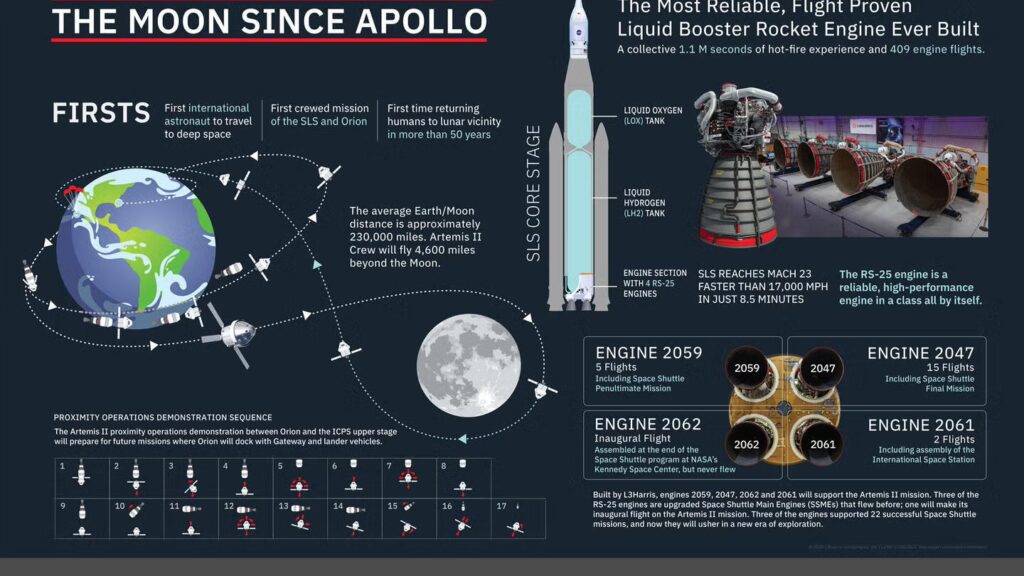
Those numbers deserve attention because they show how NASA quantifies danger in a domain where danger is never theoretical. And they underline a harsh truth: Artemis is not being held back only by rockets. It is being held back by the full chain of mission architecture — landers, rescue logic, refuelling, and surface operations.
NASA has contracted SpaceX and Blue Origin to provide Moon landers. According to the file, both companies have accelerated work to meet the new 2028 target. The inspector general says major technical challenges linger, including refuelling landers in orbit around Earth before heading to the Moon.
That is one of those sentences that slips by too quietly. “Refuelling in orbit” is not like topping off a car at a motorway service station. It is a hard, risky, infrastructure-heavy operation that still needs to be demonstrated at the scale required by the missions.
So yes, Artemis II is getting closer. The road beyond it is still full of dragons.
NASA Needs More Than a Symbolic Boost
The Artemis program has always been bigger than one launch. NASA attempts to prove that the United States can build a sustained lunar architecture again after decades away. That is why Artemis II matters so much politically and operationally.
The Apollo comparison hangs over everything. NASA sent 24 astronauts to the Moon during Apollo, and 12 of them landed on the surface. All but one of those missions — Apollo 13 — achieved their prime objectives. The program ended with Apollo 17 in 1972. Since then, the Moon has largely lived as memory, symbol, and PowerPoint slide.
Artemis is supposed to drag it back into reality.
If Artemis II launches in April and performs well, NASA gets something it desperately needs: forward motion. It gets public confidence, better political cover, and a stronger hand in keeping the rest of the lunar plan alive. If the mission slips again or suffers a major failure, then the criticism about cost, pace, and architectural complexity will get louder very quickly.
That is why every part matters — the repairs, the launch window, the cautious risk language, the reshuffled mission order, the rescue concerns, the lander delays. None of it is isolated. It all rolls into one blunt question: can NASA make the Moon feel real again?
TF Summary: What’s Next
NASA says Artemis II is nearing a possible 1 April launch after fresh repairs to the 98 m (321.5 ft) Moon rocket, with a six-day launch window at the start of April and later backup dates from 30 April into early May. The mission will carry four astronauts on a lunar flyaround, marking humanity’s first crewed journey toward the Moon in more than 50 years. NASA is reshaping the Artemis sequence, adding another Earth-orbit practice flight next year and moving the first crewed Moon landing further down the line to improve readiness and reduce risk.
MY FORECAST: Artemis II will matter less as a one-off spectacle than as a credibility test. If NASA launches in April and brings the crew home cleanly, the agency regains badly needed momentum and gives the Moon program a sturdier foundation. But the harder work lies beyond the mission: rescue planning, south-pole landing risks, orbital refuelling, and lander maturity. Artemis II can reopen the door. It cannot by itself guarantee that the path to the Moon stays open.
— Text-to-Speech (TTS) provided by gspeech | TechFyle