


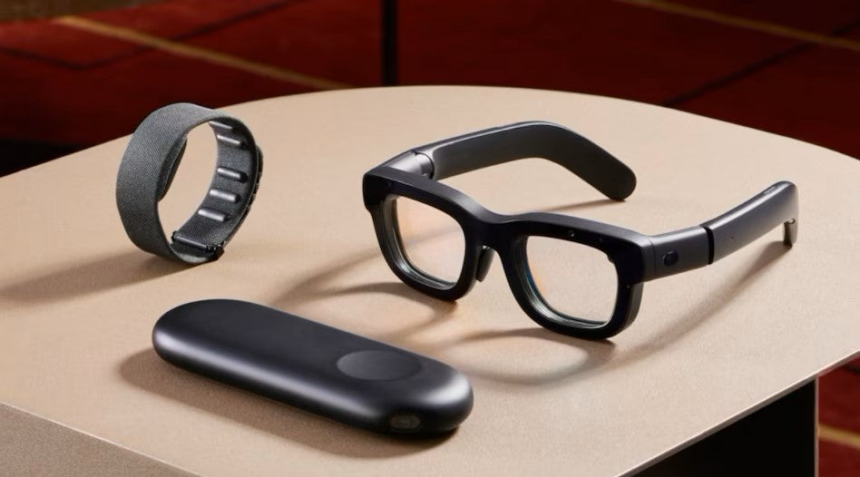
AI steps off the screen and lands right on your face. Smart glasses, once a sci-fi prop, now sit at the center of Google and Meta’s next big hardware push. Both companies treat AI wearables as the next central platform. But 2026 really looks to be the year the category has its true breakout moment. Google builds an Android XR ecosystem for manufacturers. Meta doubles down on its Ray-Ban Display series. XReal pushes a wild curveball with Project Aura, a tiny headset with big ambition.
The race is no longer theoretical. It’s physical, optical, and increasingly competitive.
What’s Happening & Why This Matters
Google: Android XR
Google’s new Android XR platform establishes the spine for a whole hardware ecosystem. It solves the fragmentation that stalled smart glasses for a decade. Developers now get unified tools. Manufacturers get a shared foundation. Consumers get a chance at consistency.
Google showcased two development prototypes: a monocular waveguide model and a binocular 3D-capable version. Both connect to a phone for computing. Both use lightweight lenses with tiny projectors etched into a waveguide pattern. The frames are thin enough to mimic regular glasses.

During demos, the glasses handled YouTube Music, Google Meet calls, and Google Maps navigation. A rep said, “Android XR removes friction. It lets developers build once and deploy everywhere.” The glasses feel early, but not experimental. They feel ready.
Gemini: Glasses as a Visual AI Assistant
Google’s Gemini acts like an always-on sidekick. Button press. Wake word. Immediate AI vision.
In one demo, Gemini identified pasta types and sweet potatoes and provided a recipe based on what the wearer looked at. This wasn’t a language model guessing ingredients — it was visual classification working in real time. A Google engineer said Gemini’s “contextual awareness unlocks new computing behaviors.”
The real sell: AI that understands the world in front of you, not just the text you type.
It’s ambient computing without the ambient confusion.
Meta: A Different Route
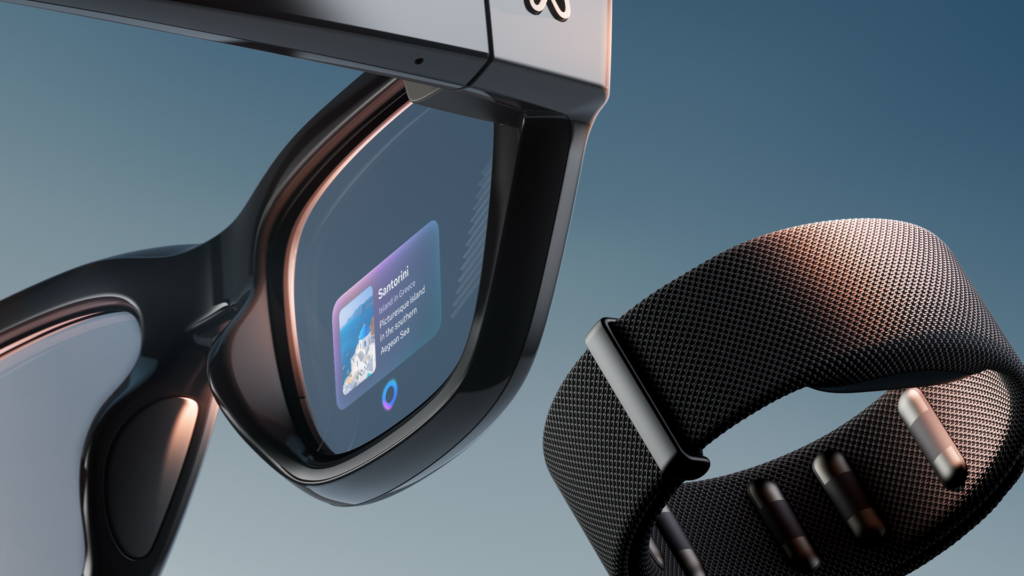
Meta focuses on a single, tightly integrated product: the Ray-Ban Display line. No ecosystem. No third-party manufacturer. Total control. It offers music, messaging previews, hands-free capture, and an AI assistant similar in concept to Gemini.
But Meta’s glasses depend on a closed operating system, limiting developer scope. Useful today. Not foundational tomorrow. A Meta spokesperson said, “Our approach is simplicity and scale.” It works — but it does not build an industry.
XReal: Project Aura
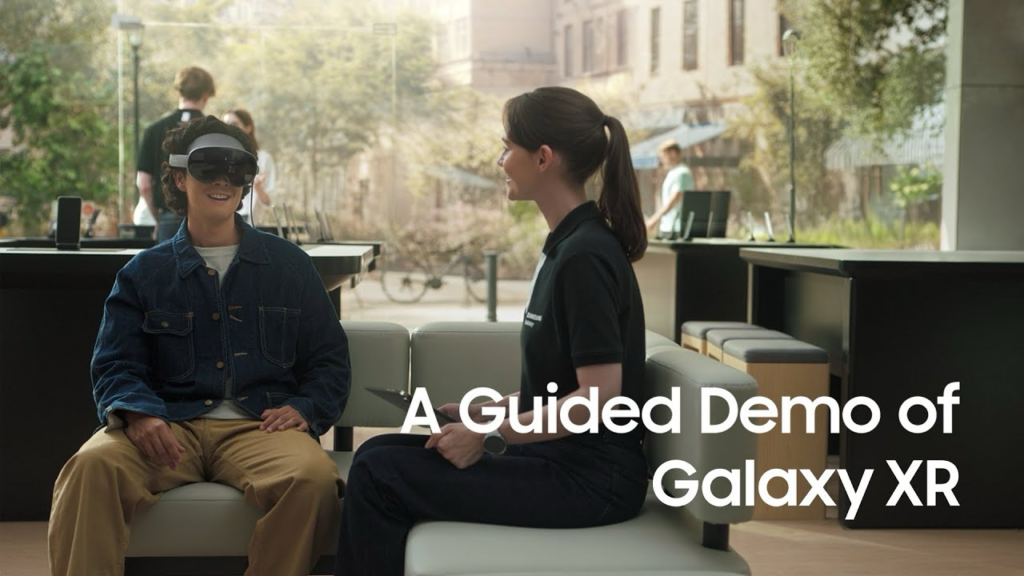
XReal’s Project Aura stunned early testers. Unlike Google’s waveguide prototypes, Aura uses prism displays for a much wider field of view. It feels closer to a tiny mixed-reality headset than traditional glasses. Aura connects to a pocket-sized compute pack running Android XR on a Snapdragon XR2+ Gen 2 chip — the same class powering Samsung’s Galaxy XR.
Aura supports full hand-tracking. No controllers. No temple swipes. Just gesture-based navigation similar to Apple Vision Pro or Galaxy XR. Reviewers said the interaction model “feels like the future, not a prototype.”
Critics noted its limitations: warped real-world vision due to thick prisms, lower resolution than a headset, and reduced camera coverage for hand tracking. But for something this small, its performance impressed nearly everyone who tried it.
Smart Glasses: No Longer Novelties
The category historically struggled due to bad battery life, privacy panic, and clunky design (hello, 2013 Google Glass). But the climate turned. Meta normalized wearable cameras. AI made context-sensitive interactions useful. Displays shrank. Hardware matured.
Now each company takes a different strategic bet:
- Google goes ecosystem-first.
- Meta goes consumer-first.
- XReal goes capability-first.
Hardware specs won’t determine the winner. It will be usability. Seamless AI. All-day comfort. And an ecosystem that actually matters.
TF Summary: What’s Next
Smart glasses no longer feel like a hobby project for tech giants. 2025 proved that AI wearables are a platform race. 2026 is the launch window for Google’s consumer AI glasses. Meta plans new Ray-Ban models. XReal enables developers in spatial computing through Aura. The category now has momentum, money, and clear strategic intent.
MY FORECAST: Google’s Android XR becomes the dominant software layer across multiple manufacturers. Meta keeps early consumer mindshare but plateaus without opening its ecosystem. XReal pressures the market by redefining what “glasses” can do, accelerating the shift from novelty to necessity.
— Text-to-Speech (TTS) provided by gspeech