



Rivian finally puts dates and prices on the table. Lucid is building a cheaper platform and praying it leads to the black.
The EV market spent the past few years making promises, missing timelines, and acting shocked when buyers asked normal questions like: “How much does it cost?” and “Can I actually buy one?” That fog is starting to clear, at least a little.
Rivian is revealing real trim details, pricing, and delivery timing for the R2, its smaller midsize SUV. Lucid is taking a different route. It is pitching a new midsize EV platform as the machine that finally gets the company closer to profitability. One story is about availability. The other is about survival math.
For pricing conversions, I’m using the latest European Central Bank reference rate available at the time of writing (€1 = $1.1581, $1 = €0.86).
What’s Happening & Why This Matters
Rivian’s R2 Stops Acting Like a Sketch
Rivian showed the R2 in 2024 and said deliveries would begin in the first half of 2026. Miraculously, in an industry that treats launch windows like horoscope material, it appears to have meant it. Deliveries of the first R2 SUVs are due to begin in spring.

That matters because the R2 is not a side project. It is the vehicle Rivian needs to push past the premium-adventure niche and into higher real-volume territory. The company already proved it can build expensive electric trucks and SUVs with a loyal fan base. The harder test is whether it can build a smaller EV people can actually afford without turning the whole exercise into a bonfire of cash.
Rivian is launching the range from the top down, which is standard carmaker behavior disguised as excitement. First comes the R2 Performance at $57,990 (€50,100) before destination, plus a $1,495 (€1,290) delivery charge. That trim uses an 87.9 kWh battery pack, offers up to 330 miles (531 km) of range, produces 656 horsepower (489 kW) and 609 lb-ft (825 Nm), and charges from 10% to 80% in 29 minutes.
The hardware is serious. Rivian says the Performance trim gets semi-active suspension, matrix LED headlights, a nine-speaker audio system, birch interior accents, heated front and rear seats, and ventilated front seats. The brand’s adds its usual outdoorsy flourishes, including the little door-mounted flashlight. It gets a rear window that drops into the tailgate, which is either charmingly practical or catnip for people who own surfboards and like being noticed.
The size is in a useful middle ground. The R2 measures 185.9 in (4,722 mm) long and 78.1 in (1,984 mm) wide, if you convert the file’s 1,905 mm figure? Actually the file lists 78.1 in (1,905 mm), and 66.9 in (1,699 mm) tall, with a 115.6 in (2,936 mm) wheelbase. Cargo space comes in at 28.7 cu ft (812 L) with the rear seats up and 79.4 cu ft (2,248 L) with them folded flat, plus a front trunk. That is a practical footprint for buyers who want Rivian styling without dragging around the bulk of an R1S.
Rivian’s Real Test Is After the Headline Trim
The R2 Premium arrives in late 2026 at $53,990 (€46,600). It keeps the same 330-mile (531-km) range and the same 87.9 kWh battery pack, but power drops to 450 horsepower (355 kW) and 537 lb-ft (728 Nm). It loses the semi-active suspension, shifts from 21-in wheels to 20-in wheels, and drops a few drive modes, including rally, soft sand, and launch. That is a sensible way to preserve range and lower cost without making the vehicle feel stripped bare.
Then comes the version that may matter most to actual buyers. In 2027, Rivian plans to launch the single-motor R2 Standard at $48,490 (€41,900). That version still uses the 87.9 kWh pack, but because it sends power only to the rear axle, range rises to 345 miles (555 km). Output lands at 350 horsepower and 355 lb-ft. The file appears to omit the metric power figure for that specific horsepower number, so I’m not inventing one. The trim drops to a five-speaker audio system, a black interior, heated front seats only, 19-in wheels, no all-terrain drive mode, and no drop-down rear glass.
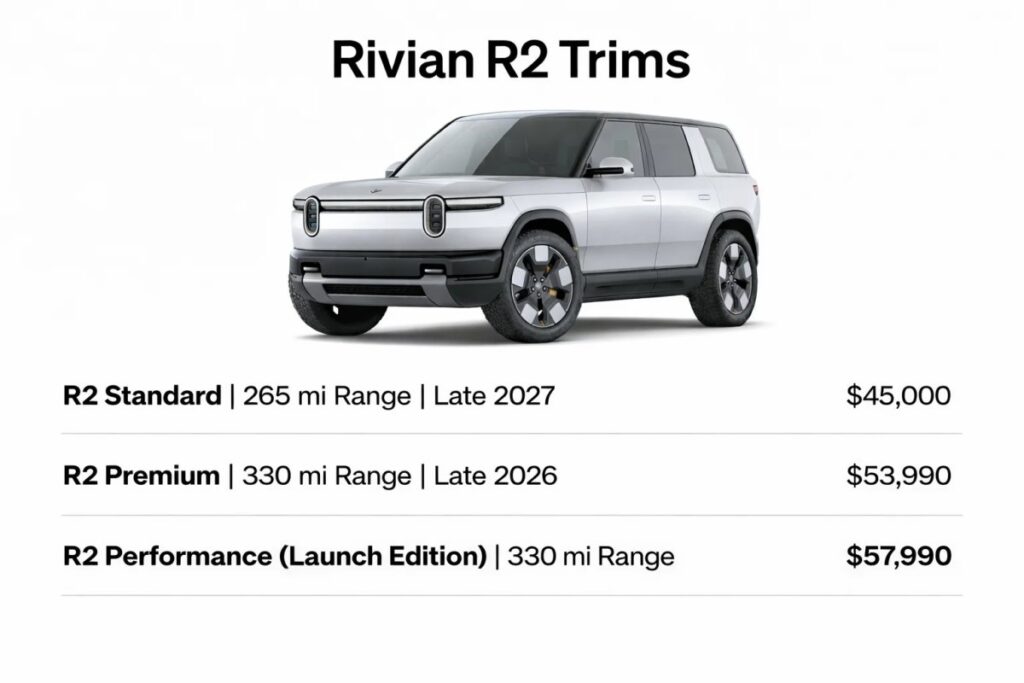
Rivian says a cheaper R2 with a smaller battery will arrive in late 2027 for about $45,000 (€38,900), targeting roughly 265 miles (426 km) of range. That version is the real pressure point. If Rivian can actually deliver something that looks and feels like a Rivian at that price, it has a shot at moving from an admired brand to a bigger market presence. If it misses that mark, the R2 risks becoming another cool EV that people praise online but put off in real life.
There are a few familiar catches. Rivian still refuses to offer Apple CarPlay or Android Auto, which some buyers treat like a moral offense and others shrug off if the in-house software is good enough. Rivian is also leaning hard into software-defined vehicle logic. The file says the R2 is equipped with 200 sparse TOPS of edge AI compute for the in-cabin experience, future AI assistant features, and Autonomy+ driver assistance. Volkswagen’s $5 billion (€4.32 billion) investment in Rivian was partly driven by that software-defined vehicle expertise, which suggests the company’s value is no longer only about sheet metal and battery packs.
Lucid Is Betting Profitability on a Cheaper Midsize Platform
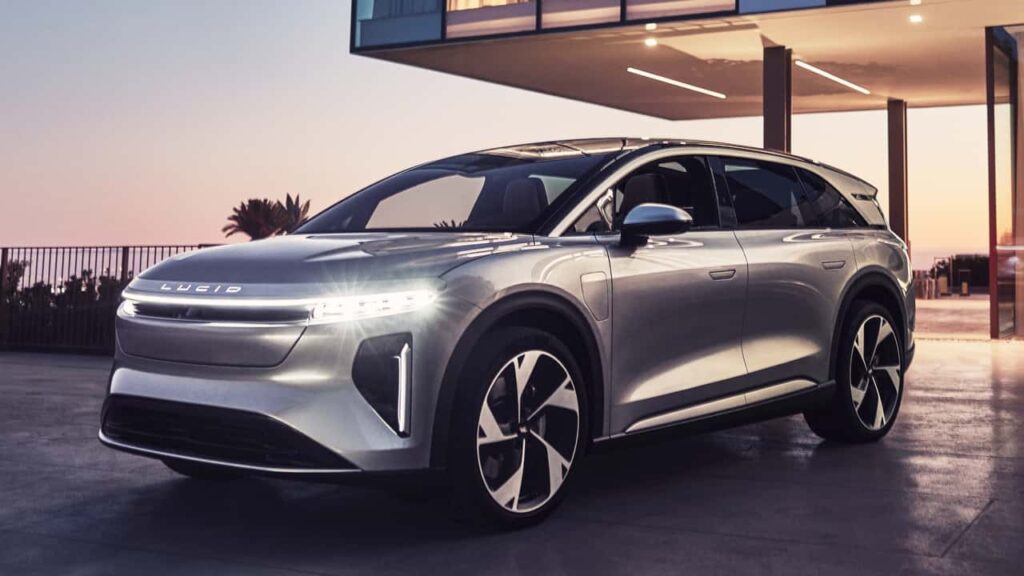
If Rivian’s story is “we have dates and trims,” Lucid’s story is “please notice that we finally have a path to making money.” Lucid told investors that profitability depends on entering the high-volume midsize SUV market with a new platform engineered to support vehicles starting below $50,000 (€43,200). Interim CEO Marc Winterhoff said the company is keeping Lucid’s technology DNA while applying more scale, tighter cost discipline, and materially reduced costs to create a credible path to profitability and free cash flow.

The new platform will support three SUVs. Lucid has named two of them. The Lucid Earth is pitched as the roomier choice for “trendsetting achievers,” which is marketing language in a nice suit. The Lucid Cosmos is expected to be the sportier model, targeted at “upscale nurturers,” which is somehow even more marketing. A third unnamed SUV may lean more off-road and fill a space similar to the one Rivian is chasing with the R2.
Lucid design chief Derek Jenkins says the company did not compromise what makes a Lucid special and instead engineered the new platform to scale. That claim matters because scaling is exactly where many EV startups start looking less elegant. Luxury is easy when the volumes are low and the price tags are heroic. Scale is where the bolts start talking back.
Lucid’s Cost Depends on Efficiency

Lucid’s strongest card has always been efficiency, and it is playing that card again.
The company unveiled a new drive unit called Atlas. It uses 30% fewer parts, weighs 23% less, and cuts its bill of materials by 37% compared with Lucid’s current drive unit. Paired with an 800 V battery architecture, Lucid says the most efficient midsize variant could hit 4.5 miles/kWh (13.8 kWh/100 km). Senior engineering and software executive Emad Dlala says that efficiency leadership translates directly into cost leadership because smaller batteries, fewer parts, and tighter integration lower cost while improving performance and user experience.

The company is reworking the cabin interface. The midsize platform will use a single wide dashboard display rather than the multi-screen layout seen in the Air and Gravity. That may sound like a styling note, but simplified interiors often mean lower complexity and lower cost, which matters a lot when you are chasing profitability instead of applause.
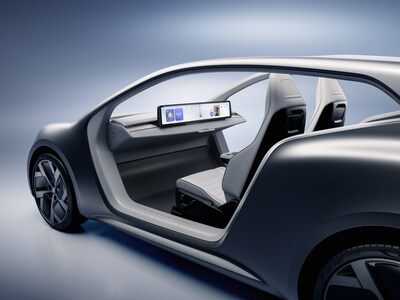
Lucid teased Lunar, a two-seat robotaxi using the same midsize platform. I am not convinced the world has been crying out for a Lucid two-seat robotaxi, but the company appears serious about it. Lucid is expanding its robotaxi partnership with Uber, which began with the Gravity SUV. Uber CEO Dara Khosrowshahi said Lucid’s efficiency and autonomy-ready architecture give Uber confidence that the partnership can support autonomous mobility at a global scale.
That sounds ambitious, and ambition is free. What is not free is getting the core midsize SUV lineup into the market at a price people can stomach.
Rivian Has the Near-Term Product. Lucid Has the Bigger Financial Question.
The two companies are in related markets, but they are solving different immediate problems.
Rivian is trying to prove it can launch a smaller SUV on time, at a believable price, and then expand the lineup without losing its brand. Lucid is trying to prove that its engineering brilliance can translate into a business that does not keep bleeding while waiting for volume.
Rivian’s R2 has concrete availability, real trim levels, and a ladder that starts high and works down toward the sweet spot. Lucid’s midsize platform still feels earlier, more conceptual, and more dependent on management’s argument that efficiency can pull profitability closer. The market will judge them harshly for different reasons. Rivian will get judged on execution and affordability. Lucid will get judged on whether its cheaper architecture actually turns into a sustainable business.
TF Summary: What’s Next
Rivian finally has a more concrete R2 story: spring 2026 deliveries for the Performance trim at $57,990 (€50,100), a Premium trim later in 2026 at $53,990 (€46,600), and single-motor versions in 2027 starting at $48,490 (€41,900), with an even cheaper variant around $45,000 (€38,900). That gives Rivian a real shot at broadening its lineup beyond premium adventure EVs. Lucid, meanwhile, is pinning its profitability case on a new midsize platform with cheaper drive units, fewer parts, better efficiency, and SUVs priced below $50,000 (€43,200).
MY FORECAST: Rivian has the clearer near-term opening because buyers can finally see the trims, the dates, and the numbers. Lucid has the more existential challenge because its new platform has to do more than impress on a spec sheet; it has to prove the company can make money on something other than engineering praise. The next year or two will tell us whether the midsize EV bets turn into scale or simply a nicer class of electric, maybe.
— Text-to-Speech (TTS) provided by gspeech | TechFyle