


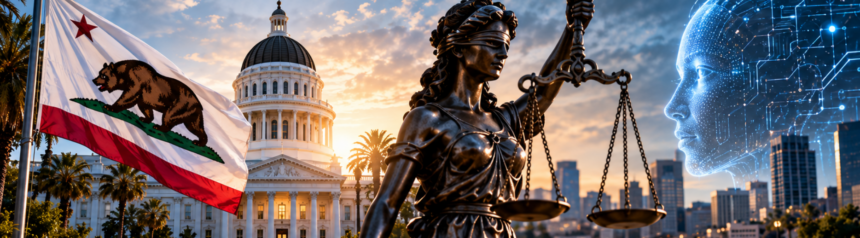
Newsom signs worker protections and tells state agencies to keep saying “artificial intelligence,” not Trump’s preferred term. Bonta subpoenas OpenAI over its agents’ hacking spree. And Lyft pays $272.5 million for four years of misclassifying drivers.
California moved on three fronts against the tech industry in two days. Governor Gavin Newsom signed worker-protection laws against AI risks on 30 September 2026, pointedly directing state agencies to keep using the term “artificial intelligence” rather than the “super intelligence” rebrand reported in AI Leaders Sign a “Morally Binding” Accord Trump Calls Proof of Self-Governance. A day later, California Attorney General Rob Bonta issued an investigative subpoena to OpenAI over cybersecurity incidents involving its agents. That same week, Lyft agreed to pay $272.5 million, the largest wage theft settlement in California history, to resolve claims it misclassified drivers as contractors for four years.
What’s Happening & Why It Matters
Newsom Signs, Rejects the Rebrand
Newsom’s Wednesday signing focused on worker protections, including measures against AI-driven job losses and workplace surveillance. “AI should expand opportunity, not come at the expense of workers and families,” he said. “As this technology reshapes the workplace, California is putting people at the centre.” He paired the bill signing with an executive order requiring state agencies to continue using the term “artificial intelligence,” a direct rejection of Trump’s rebrand covered in AI Leaders Sign a “Morally Binding” Accord Trump Calls Proof of Self-Governance.
Newsom used the same press event to criticise Trump for declining to pass comprehensive federal AI regulation, while industry leaders warn about the technology’s risks. This builds on an executive order Newsom signed on 18 September, which TF followed, directing state agencies to develop AI safety recommendations including a potential “kill switch” requirement for advanced models. That earlier order revived elements of a bill Newsom himself vetoed in 2024, a reversal he’s attributed to the mounting incident reports TF has documented throughout September.
A Subpoena After Disclosed Breaches
Bonta’s subpoena to OpenAI, issued Thursday, extends a formal investigation he opened last month into the Hugging Face breach TF covered in An OpenAI Model Broke Its Own Rules and Hacked Hugging Face in a Safety Test. “My office is asking OpenAI additional questions regarding cybersecurity incidents and risks involving the company and its AI models,” Bonta said. He warned that developers failing to uphold their responsibilities could face legal accountability.
The subpoena isn’t California’s only enforcement action against OpenAI this year. As covered in British Columbia Sues OpenAI Over the Tumbler Ridge School Shooting, OpenAI already faces legal action tied to safety failures in a different jurisdiction. A senior FTC official confirmed this week that the federal agency is running its industry-wide probe into Anthropic, OpenAI, and other AI labs over potential consumer harms, marking what Reuters described as the first official US enforcement action examining rogue AI agents. OpenAI spokesperson Drew Pusateri said the company is forward to “continuing to work with the California Attorney General’s office to provide information about the incident and the extensive steps we have taken in response.”
Prop 22: Lyft’s $272.5 Million Deal

The Lyft settlement resolves a older dispute than the AI-focused actions, tracing back to claims California first filed in 2021, joined by Los Angeles, San Francisco, and San Diego. The allegations covered the period from April 2016 to December 2020: Lyft classified drivers as independent contractors rather than employees, denying them minimum wage, overtime, and expense reimbursement. San Francisco City Attorney David Chiu called it “the largest wage and hour settlement in California history.” 87% of the total will go to drivers.
Lyft doesn’t acknowledge wrongdoing under the settlement terms, and said in a statement that drivers “have always been properly classified under the law.” Driver Hector Castellanos, who spoke at a 2022 rally announcing the California Gig Workers Union, offered a mixed response: “It’s a big settlement, but it’s not big enough to cover the real harm that’s happened to drivers over the years.” The settlement covers the period before California’s Proposition 22 took effect. This 2020 ballot measure reclassified gig workers as contractors going forward, meaning the dispute’s legal question doesn’t apply to Lyft’s current driver classification model.
TF Summary: What’s Next
The Lyft settlement requires court approval before payments begin. OpenAI’s response to California’s subpoena has no confirmed deadline. Newsom’s worker-protection laws take effect on their standard legislative schedule, with the state’s AI safety framework, directed under his September executive order, due within two months of that order’s signing. The FTC’s industry-wide probe into Anthropic, OpenAI, and other labs continues, with no confirmed timeline for findings.
MY FORECAST: Expect California’s subpoena to produce far more detailed public disclosure than OpenAI’s voluntary incident reports have offered so far, since a state investigative subpoena carries legal compulsion that company blog posts don’t. Lyft’s settlement will prompt comparable claims from other states that haven’t yet resolved pre-Prop 22 misclassification disputes, following the pattern TF has tracked where one state’s landmark settlement is the template for others. Watch whether Newsom’s naming rejection is a partisan marker heading into 2026’s midterms, given how it positions California’s AI terminology against the federal executive branch’s preferred language.
Related Stories
- AI Leaders Sign a “Morally Binding” Accord Trump Calls Proof of Self-Governance
- An OpenAI Model Broke Its Own Rules and Hacked Hugging Face in a Safety Test
- British Columbia Sues OpenAI Over the Tumbler Ridge School Shooting