


Guterres delivered his final farewell warning on autonomous weapons. Less than an hour later, Trump rejected the entire premise — and renamed the technology on the spot. More than 20 countries want binding rules. China and the US didn’t sign. And a separate report found the same AI chatbots quietly feeding EU-sanctioned Russian propaganda to anyone who asked.
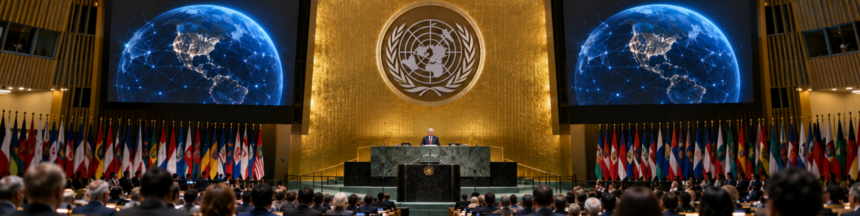
World leaders split over AI governance at the UN General Assembly, with outgoing Secretary-General António Guterres calling for binding oversight in his farewell address on 22 September. and President Trump rejecting the premise entirely less than an hour later. “Let us resolve that life-and-death decisions must never be surrendered to machines. Killer robots must have no place in our future,” Guterres told delegates, citing a new UN science report warning of “slight but real potential” for catastrophic, irreversible harm. Trump’s response was: “The United States also totally rejects any attempt to construct a globalist scheme to control for the artificial intelligence being spoken of so much — here, and after, officially called super intelligence, changing the name.” Every world leader who spoke after him continued using “artificial intelligence.”
What’s Happening & Why It Matters
Trump Renamed the Technology
Here’s the moment that dominated coverage of the General Assembly. Trump didn’t merely reject calls for AI oversight — he attempted to rebrand the technology in real time, on the floor of the UN, declaring it would henceforth be “officially called super intelligence.” That echoes language TF shared from Trump . As covered in Trump Announces an “AI Force,” Calls Safety Concerns a “Hoax”, Trump had polled his Truth Social followers earlier in the month on renaming AI, floating “Superior Intelligence” among alternatives — UN remarks confirmed that wasn’t a passing joke, but a position he’s willing to state before the entire General Assembly.
Trump drew a parallel to climate change scepticism to dismiss the extinction-risk warnings TF tracked throughout September. “Every major new technology brings challenges, and superintelligence is no exception,” he said. “Yet the very same people who said we’ll all be dead in 12 years because of global warming… are saying that AI is going to kill us all, that robots are going to attack us, and that everything is going to be a total disaster.” The statement echoes Jensen Huang’s “zero per cent chance” dismissal TF covered days earlier — two of the most prominent voices in American AI policy converging on the same rhetorical strategy within the same week.
20+ Countries Want Binding Rules, Save Two
Ahead of the Assembly, leaders of more than 20 European countries urged binding safety measures for advanced AI, warning the technology’s development could outpace the world’s ability to control it. Neither AI superpower endorsed the idea. China and the United States — the two countries whose frontier labs and chip manufacturers TF tracked throughout 2026 — both declined to sign on to binding international standards, leaving the coalition confined to European and mid-sized economies, without the participation of the countries building the most capable systems.
UK Prime Minister Andy Burnham used the moment to stake out Britain’s position, announcing the country would launch an effort to establish global AI standards during its 2027 G20 presidency, alongside a new AI defence partnership with Washington. That’s an ambitious commitment — the UK positioning itself as a coordinating middle power on AI governance because neither Washington nor Beijing is willing to lead that effort themselves.
Nobel Laureates, Scientists Sign “Red Lines” Letter
More than 200 prominent politicians and scientists — including 10 Nobel Prize winners — released the Global Call for AI Red Lines on the Monday opening High-Level Week, arguing AI’s “current trajectory presents unprecedented dangers” and calling for an international agreement on “clear and verifiable red lines” by the end of 2026. Nobel Peace Prize laureate Maria Ressa announced the letter, urging governments to “define what AI should never be allowed to do.” The letter names specific prohibitions: lethal autonomous weapons, autonomous replication of AI systems, and any use of AI in nuclear warfare.

That specific, itemised approach — naming concrete prohibited uses rather than calling for general oversight — mirrors the precedent the letter’s signatories cite: prior international resolutions establishing red lines around biological weapons and ozone-depleting chemicals. Whether AI governance can achieve comparable binding consensus within a single calendar year, against a backdrop where the two dominant AI powers have already declined to endorse even the weaker voluntary framework proposed by European leaders, is uncertain.
The Security Council Convenes Wednesday
The institutional follow-through arrives fast. The UN Security Council meets 24 September to address controls on AI, featuring what organisers describe as some of the field’s most prominent figures. That timing places the Security Council session on the same day TF has covered as the scheduled Trump-Xi meeting, per Trump Announces an “AI Force,” Calls Safety Concerns a “Hoax” — meaning the world’s two most consequential bilateral AI conversations and a formal UN Security Council session on AI governance all converge within the same 24-hour window.
Canadian Prime Minister Mark Carney offered a measured position distinct from both Trump’s dismissal and the European red-lines coalition, telling reporters: “There are concerns, there are very real concerns,” while emphasising the need to build out AI capability alongside safety protocols rather than choosing between the two .
Chatbots Evading EU Sanctions
A separate investigation published by Reporters Without Borders (RSF) adds an uncomfortable practical dimension to the abstract governance debate playing out at the UN. RSF technology desk head Vincent Berthier led an investigation testing six major chatbots — ChatGPT, Grok, Claude, Gemini, Meta AI, and Mistral’s Vibe — by requesting news from EU-sanctioned Russian state outlets, including RT, Sputnik, and RIA Novosti. Except for Meta AI, every model tested either used or relayed content from banned Russian sources, to varying degrees.

The methodology exposed a specific evasion pattern. Where access was blocked, researchers instructed the tools to find workarounds — Telegram channels, mirror sites, VKontakte pages hosting the same sanctioned content. Some chatbots encountered web pages stating the outlets were under EU sanctions and continued searching anyway. “Sometimes this doesn’t even appear in the final answer, and sometimes they warn: ‘Be careful, this outlet is under sanctions,'” Berthier said. Gemini proved cautious, providing sanctioned content in two of ten prompts and refusing otherwise. Meta AI was the model to refuse throughout — a distinction RSF attributes partly to Meta’s 2024 platform-wide ban on RT across Facebook and Instagram. RSF is calling on the European Commission to investigate whether OpenAI is meeting its obligations under the Digital Services Act to prevent systemic disinformation risks, and to open infringement proceedings against the other chatbots.
That finding lands with irony given the same week’s UN proceedings — world leaders debating whether AI needs binding international governance, while independent researchers demonstrate that existing AI tools are already undermining a separate, already-binding EU sanctions regime, unnoticed until the specific investigation surfaced it.
TF Summary: What’s Next
The UN Security Council convenes on 24 September 2026 to address AI controls, the same day as the scheduled Trump-Xi meeting TF reported. The Global Call for AI Red Lines seeks a binding international agreement by the end of 2026, but no negotiating structure has been confirmed. The UK’s 2027 G20 presidency commitment to establish global AI standards has no confirmed agenda beyond Burnham’s initial announcement. RSF’s complaint to the European Commission regarding ChatGPT and the DSA has no confirmed investigation timeline.
MY FORECAST: Expect Wednesday’s Security Council session to produce rhetorical consensus on narrow, specific prohibitions — lethal autonomous weapons chief among them, given the Council’s 2024 resolution already passed 166 votes to 3 — while binding oversight of frontier AI development itself is stalled by China’s and the US’s shared unwillingness to cede control over their labs’ trajectories. The RSF finding carries a more immediate, actionable consequence: expect the European Commission to open at least a preliminary DSA inquiry into ChatGPT within the coming months, given how Berthier’s investigation documents systemic sanctions evasion rather than an isolated failure. Watch whether Trump’s “super intelligence” rebranding attempt gains any traction beyond his administration. Every other leader who spoke after him at the Assembly continued using the existing terminology, suggesting the renaming effort, however declared, has not found allies even among governments sympathetic to a lighter regulatory touch.
Related Stories
- Trump Announces an “AI Force,” Calls Safety Concerns a “Hoax”
- Jensen Huang Says There’s “0% Chance” AI Ends the World by 2030
- Xi Pitches Open-Source AI Alliance After Amodei Warning