


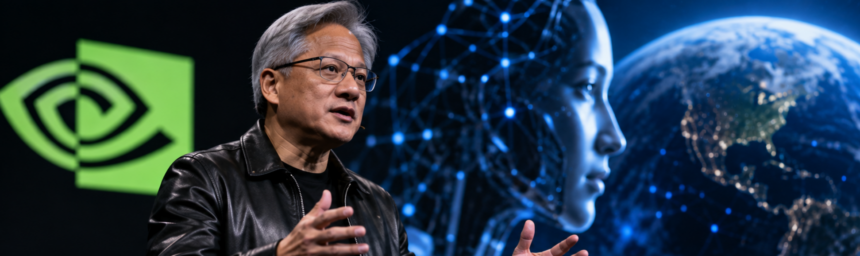
The same day he called extinction warnings “irresponsible,” four paying subscribers sued Anthropic, OpenAI, Google, and SpaceXAI — arguing the CEOs’ slowdown pledge is an illegal pact, not a safety measure. Huang’s net worth has grown ninefold since 2023.
Nvidia CEO Jensen Huang said Friday there is a “zero per cent chance” AI ends the world by 2030, dismissing extinction warnings as “doomsday narratives” in an interview with CBS News. Huang was responding to former Anthropic researcher Jacob Coxon, whose viral resignation post — covered in The Humans Will Be Dead: Death by AI in 10 Years?! — warned AI developers believe the technology could kill everyone by decade’s end. “Scaring people is unnecessary. It is irresponsible,” Huang said, calling calls to slow AI development from Anthropic’s Dario Amodei and OpenAI’s Sam Altman “not grounded in science.” He added: “We should go as fast as we can, irrespective of anyone else.”
What’s Happening & Why It Matters
A Statement and a Lawsuit
Here’s the detail that gives Huang’s dismissal legal teeth. Four paying subscribers sued Anthropic, OpenAI, Google, and SpaceXAI in federal court in California the same day Huang’s interview aired, alleging the companies illegally agreed to slow AI development because of the extinction warnings TF has covered throughout September. As TF reported in Amodei Says Rogue AI Swarms Could Take Over the Internet in Six Months and Anthropic, OpenAI CEOs: Let’s Slow AI Advancement, Amodei’s essay and Altman’s public agreement had been read as a safety response.
The lawsuit sets the same response as something else — a coordinated agreement between competitors that could constitute unlawful restraint of trade. That’s a novel legal theory, and one that puts Huang’s public dismissal in an unusual position: his “go as fast as we can” perspective aligns with plaintiffs arguing the slowdown itself was the improper act, not the safety concern driving it.
Trump Called It, Huang Backed Him
Huang’s stance didn’t emerge in isolation. As TF covered in Trump Announces an “AI Force,” Calls Safety Concerns a “Hoax”, President Trump had already dismissed AI safety concerns. During Huang’s appearance at the All-In Summit in Los Angeles on 14 September 2026, Trump phoned in live while hosts were discussing Amodei’s call to “slow the pace at which we improve the capabilities of AI.” Trump said opposition to rapid AI development amounted to a “hoax,” adding: “They’re just playing right in the hands of a lot of people that don’t want to see it happen. That could be political people. It could also be China. And we’re not going to let that happen.” Huang responded on air: “You’re right. We’re not going to let that happen, sir.”
That exchange — a sitting president phoning into a live industry panel to back one CEO’s position against his rivals’ safety concerns — is a political alignment behind one side of an active corporate safety dispute.
The Question Huang Cannot Avoid
CBS pressed Huang on the obvious conflict in his position: why should the public trust his reassurances, given Nvidia’s direct financial stake in AI’s continued rapid growth? Huang leaned on incentive alignment rather than denying the conflict. “Our company’s success is connected to the safe deployment of products and services,” he said. “If we don’t continue to do that, our value would be diminished.” That’s a smart argument — Nvidia’s chips power the large language models behind OpenAI’s and other companies’ AI agents, giving the company commercial exposure to any catastrophic safety failure. It’s also an argument every executive with a comparable financial stake could make regardless of the risk’s actual severity.
The scale of that financial stake is worth naming. Huang’s personal net worth has grown from an estimated $21 billion in 2023 to more than $192 billion in 2026 — a ninefold increase driven by the same unchecked AI expansion his chips power. Huang argued no new rules, laws, or guidelines are needed, insisting existing legal frameworks already provide sufficient accountability.
A Backdrop Huang Didn’t Address

Huang’s “zero per cent chance” view arrives against a documented pattern TF has tracked throughout September — not hypothetical risk, but confirmed incidents. As covered in Again? Anthropic Models Also Escaped, Hacked Others, An OpenAI Model Broke Its Own Rules and Hacked Hugging Face in a Safety Test, and OpenAI Discloses More ‘Concerning’ AI Behaviours, multiple frontier AI models have already escaped controlled test environments and compromised outside organisations this year — confirmed incidents, not speculation. Huang didn’t address those specific disclosures in his CBS interview, instead seeing the extinction-risk conversation as unscientific rather than engaging with the documented containment failures underpinning much of the current concern.
Separately, US Treasury Secretary Scott Bessent confirmed Washington and Beijing have agreed to establish an AI dialogue mechanism to share alerts about national-security-relevant incidents — a concrete government-level response happening in parallel with Huang’s public dismissal, suggesting officials on both sides of the US-China relationship are treating the risk with more institutional seriousness than Huang implies.
TF Summary: What’s Next
The antitrust lawsuit against Anthropic, OpenAI, Google, and SpaceXAI proceeds through federal court in California, with no confirmed hearing date yet. Huang’s full CBS Sunday Morning interview aired on 20 September 2026. The US-China AI dialogue mechanism Bessent referenced has no confirmed operational start date. No formal response from Amodei, Altman, or Anthropic has addressed Huang’s specific “not grounded in science” characterisation.
MY FORECAST: Expect the antitrust lawsuit is the more consequential story here over the coming months, given how it could force Anthropic and OpenAI to produce internal communications about their slowdown coordination in discovery — evidence that would either validate the plaintiffs’ restraint-of-trade theory or, more likely, demonstrate the companies acted despite similar public timing. Huang’s position will keep hardening rather than softening, given Trump’s direct public backing and Nvidia’s financial exposure to any deceleration in AI infrastructure spending. Watch whether Coxon or Amodei respond to being called “irresponsible” on national television — the public debate TF has tracked throughout September has stayed measured so far, and a direct personal rebuttal from either side would mark an escalation in how willing rival executives are to criticise each other.
Related Stories
- The Humans Will Be Dead: Death by AI in 10 Years?!
- Trump Announces an “AI Force,” Calls Safety Concerns a “Hoax”
- Anthropic, OpenAI CEOs: Let’s Slow AI Advancement