


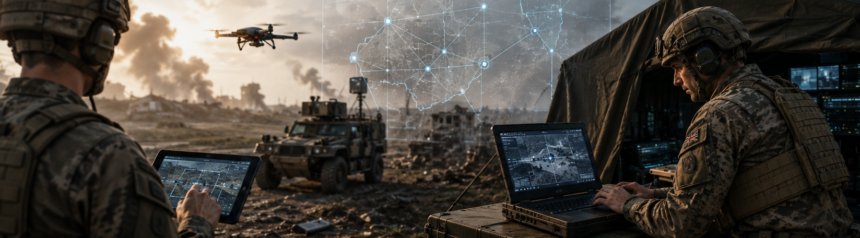
Four years of combat footage. Five million annotated images. The opening trial doesn’t watch for an invading army — it watches for protesters near a British defence site, using cable buried in the ground repurposed as a listening device.
Britain became the first foreign partner admitted to Ukraine’s Avengers AI Labs on 24 August, gaining access to a battlefield dataset built from four years of war with Russia. Prime Minister Andy Burnham and Ukrainian President Volodymyr Zelenskyy signed the agreement in Kyiv. The archive draws from Ukraine’s DELTA combat management system and includes an annotated dataset of 5 million battlefield images, collected by thousands of cameras and infrared sensors positioned across active combat zones—tanks, artillery, air defence systems, infantry, and aerial targets ranging from reconnaissance drones to Shahed attack drones.
What’s Happening & Why It Matters
What Ukraine’s Data Already Does in Combat
The dataset’s scale is significant on its own terms. Ukraine’s Defence Ministry said AI models trained on the archive already power an automated target-detection system analysing more than 100,000 drone video feeds every month, identifying 70% of enemy targets in real time. That’s a mature operational capability, built under the specific pressure of an active war — not a research prototype, but a system already doing real work at scale.
Ukraine’s then-defence minister Mykhailo Fedorov framed the offer to partners: “Partners will gain access to unique battlefield data from DELTA and other digital systems, helping them develop technologies and strengthen their own capabilities.” Britain isn’t the first country to receive any access — Germany signed a comparable data-sharing memorandum in April 2026 — but the UK’s agreement goes further, setting Britain as the primary international collaborator on the most sensitive tier of the Avengers platform itself.
Pilot Projects: Fibre Optics and Low-Power Chips
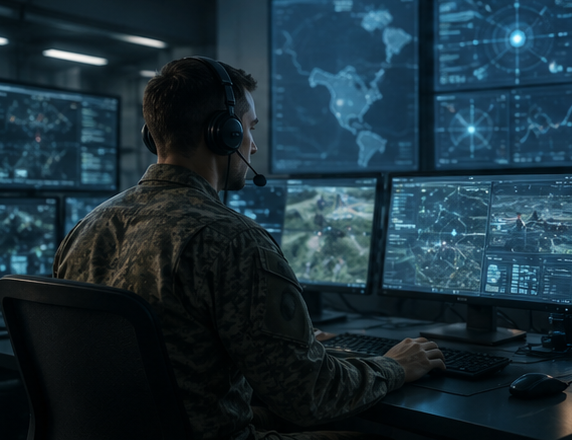
Three British companies hold the first pilot contracts under the partnership: Mind Foundry in Oxford, Skyral in London, and Sintela, a Bristol-based fibre-optics specialist. The opening trial converts buried fibre-optic cable into an AI-enabled motion sensor at a UK military site — repurposing existing underground infrastructure most people would assume carries internet traffic into a detection system. A second workstream focuses on low-power AI chips for drones and autonomous systems. Battery life and processing efficiency limit how long an unmanned system can stay operational in the field.
Burnham framed the partnership around dual benefit: “By combining Ukrainian battlefield data with British expertise, we will accelerate the development of capabilities that not only strengthen our national security but better protect our critical infrastructure and growth in every postcode here at home.” The stated scope extends well beyond defence sites — the official framing names energy plants, railways, prisons, and airports as potential future applications of the same sensor technology.
The Complicating Details
Here’s what separates the story from a straightforward defence cooperation announcement. Defence sources confirmed to journalists that the detection system is tuned to flag protest activity, not hostile foreign states. A fibre-optic sensor built to detect an intruder approaching a military perimeter doesn’t distinguish between a Russian reconnaissance team and a group of protesters walking the same ground — the detection capability is the same regardless of who’s triggering it.
That ambiguity is at a specific, awkward moment. It follows the UK’s recent proscription of Palestine Action as a terrorist organisation, a decision that itself followed activists riding scooters onto a defence site. Sintela, the Bristol firm building the fibre-optic sensing pilot, holds a £26 million ($35 million) surveillance contract with the Trump administration covering the US-Mexico border — meaning the same sensing technology being piloted on a UK defence site is deployed on an international border, under a different government, for a different stated purpose.
TF Summary: What’s Next
The joint UK-Ukraine “AI cell,” combining engineers, academics, military specialists, and businesses from both countries, is expected to begin operational work following the signing. The fibre-optic sensing pilot at the initial UK defence site has no confirmed public completion date. Vetted private UK firms beyond the three named pilot partners will gain access to the Avengers archive over time. The UK has agreed to transfer classified Storm Shadow missile component data to Ukraine as part of the “100 Year Partnership” announced alongside the AI agreement.
MY FORECAST: Expect the protester-detection capability is a domestic controversy well before the critical infrastructure rollout — energy plants, railways, prisons, and airports — reaches deployment. A defence technology capable of flagging protest activity, introduced during the same period the UK proscribed a protest group as a terrorist organisation, gives civil liberties groups a specific and concrete case to challenge, rather than an abstract surveillance concern. Watch whether Sintela’s parallel US border contract draws scrutiny in UK parliamentary questions, given how it demonstrates the same sensing technology already operating under a foreign government’s border enforcement mandate.
Related Stories
- Task Force Talon Synapse: US, UAE Launch a Joint AI Military Task Force
- GOLD EAGLE: White House Launches an AI Cybersecurity Clearinghouse
- Russian EKS Satellites Have Tested Continental-Scale GPS Jamming