


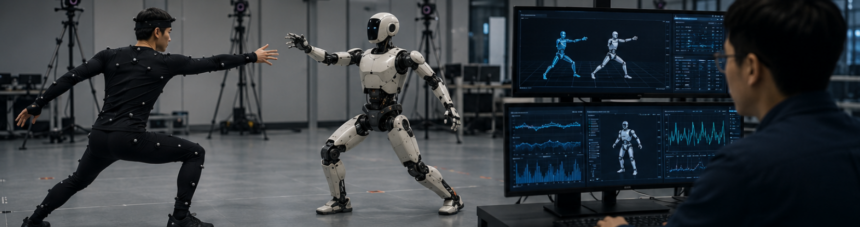
Fetch a package. Take the stairs. Ride the lift. Unpack. Put things away. That’s five sequential steps; most robots fail at step two. Flexion Robotics’ Reflect v1.0 completed the whole sequence 90% of the time — no human supervision, no scripted path.
Flexion Robotics’ (FR) Reflect v1.0 launch demonstrated a capability that has eluded humanoid robotics for years — reliable execution of long, sequential, real-world tasks without human intervention. FR unveiled Reflect v1.0, an AI platform that enables humanoid robots to execute intricate multi-step tasks independently. In tests, the system achieved a 90% success rate on complex missions, including navigating stairs and lifts. In one demonstration, a robot successfully retrieved a package, took the stairs and lift, unpacked the contents, and put the items away — completing all five steps in sequence. That combination — physical navigation, object manipulation, and sequential task completion, chained together without a human resetting the robot between steps — is precisely the capability gap that has separated flashy robotics demos from genuinely useful robots.
What’s Happening & Why It Matters
Multi-Step Tasks Are Hard for Robots
Flexion Robotics’ Reflect v1.0 launch addresses a problem that industry researchers have documented extensively throughout 2026. Humanoid robots have long struggled with more complex tasks or missions that require them to manipulate objects while moving through the space around them reliably. Most existing systems excel at a single narrow task performed repeatedly — picking a part off a conveyor belt or loading identical boxes onto a pallet. By contrast, a task like “fetch a package, take the elevator, unpack it, and put things away” requires the robot to switch between distinct skill categories — navigation, object recognition, fine manipulation, and spatial reasoning about an unfamiliar environment — without a human intervening between each step.
The industry’s own benchmarks confirm the significance of a 90% figure. The “sim-to-real” gap is a persistent hurdle. Policies that perform well in simulation, with success rates around 95%, often drop to roughly 60% when deployed in messy real-world conditions. If Reflect v1.0’s 90% figure holds in independent testing, it would place the system considerably closer to simulation-level reliability than most deployed systems currently achieve in the field.
What Reflect v1.0 Does
Flexion Robotics’ Reflect v1.0 launch is described as an intelligence platform rather than a physical robot. That distinction is important. Flexion built software that other humanoid hardware platforms can run — positioning the company similarly to NVIDIA‘s GR00T foundation models or Physical Intelligence‘s π-0, rather than competing directly with hardware manufacturers like Unitree, Figure AI, or Boston Dynamics. The elevator and stairs navigation element deserves specific attention. Most warehouse and factory robotics operate on flat, single-level floor plans specifically because multi-level navigation introduces enormous complexity — different floor surfaces, doors, elevator call buttons, and confined spaces where a robot’s typical navigation assumptions break down.
By contrast, real domestic and office environments are rarely single-level. A robot that can only operate on one floor cannot deliver a package from a lobby to an upstairs apartment, or restock supplies across a multi-storey office building. Reflect v1.0’s demonstrated ability to navigate that vertical transition — while carrying an object and completing manipulation tasks before and after — targets exactly the environments where humanoid robots need to prove commercial viability next.
The Race — 90%, 99%, and What the Numbers Say
Flexion Robotics’ Reflect v1.0 launch arrives amid a wave of competing claims about success rates from Chinese and American robotics companies throughout June 2026. AGIBOT completed a six-day livestream at a live production line in Nanchang, China, with its G2 humanoid robots completing 64,828 production-line tasks and reporting a 99% success rate in a controlled factory environment. Figure AI completed a 200-hour autonomous livestream with Figure 03 robots in May, processing nearly 250,000 packages without a single hardware failure. By contrast, those figures describe narrow, repetitive, single-environment tasks — precisely the category where humanoid robots already perform reliably.
Reflect v1.0’s 90% figure is lower in absolute terms but arguably more significant, because it spans multiple distinct skill categories chained together in sequence — the exact combination that has proven hardest to achieve. Additionally, researchers at Carnegie Mellon University and the Bosch Center for AI published a separate touch-aware system in May, called Humanoid Transformer with Touch Dreaming (HTD), achieving an average success rate 90.9% higher across five complex real-world tasks than a strong baseline. Multiple independent research groups converging on comparable 90%-range success rates for genuinely complex, multi-step tasks — after years of the field being stuck around 60% in real-world deployment — suggest 2026 is the year specific capability thresholds are being crossed industry-wide, not just by one company.
The Commercial Stakes
Flexion Robotics’ Reflect v1.0 launch is at a moment when the humanoid robotics industry is under significant pressure to demonstrate genuine commercial readiness, not staged demonstrations. As TF covered in its Optio humanoid robot article, real-world deployments are accelerating across education, logistics, and hospitality. Prices are falling fast — from over $1 million for research platforms in 2020 to sub-$100,000 commercial units in 2026, with targets of $20,000 to $30,000 by 2030. That price trajectory only produces commercial adoption if the reliability trajectory matches it. A humanoid robot that costs $30,000 but fails one in three complex tasks is not a viable product for most commercial buyers. A robot that succeeds nine times out of ten is a fundamentally different commercial proposition.
TF Summary: What’s Next
Flexion Robotics has not announced specific commercial deployment partners or a public release timeline for Reflect v1.0. Independent verification of the 90% success rate figure has not yet been published in peer-reviewed form. The demonstration video and technical claims originate from Flexion‘s own announcement. Competing humanoid intelligence platforms — NVIDIA GR00T, Physical Intelligence π-0, and Google DeepMind‘s Gemini Robotics — continue their own development and deployment programmes in parallel.
MY FORECAST: Flexion Robotics’ Reflect v1.0 launch will accelerate commercial pilot programmes specifically targeting multi-storey delivery and logistics environments — hotels, offices, and residential buildings where single-floor robots cannot operate. By contrast, the 90% figure will need independent third-party validation before enterprise buyers commit to large-scale deployment; internal company benchmarks in robotics have historically underperformed when tested in unfamiliar environments by outside evaluators. Expect at least one major hardware manufacturer — Unitree, Figure AI, or a Chinese competitor — to announce a partnership or licensing arrangement with a Reflect-class intelligence platform within 12 months, following the pattern NVIDIA established by supplying GR00T as foundation software across multiple hardware platforms simultaneously. The intelligence layer, not the hardware, is where humanoid robotics competition is increasingly being decided.
Related Stories
- New York Public Schools Are Getting a Humanoid Robot AI Tutor — Meet Optio
- GM Installed 50 Robots at Its Flagship EV Factory — While 1,300 Workers Remain Laid Off
- Amazon’s Zoox Redesigns Its Robotaxi for Commercial Launch