


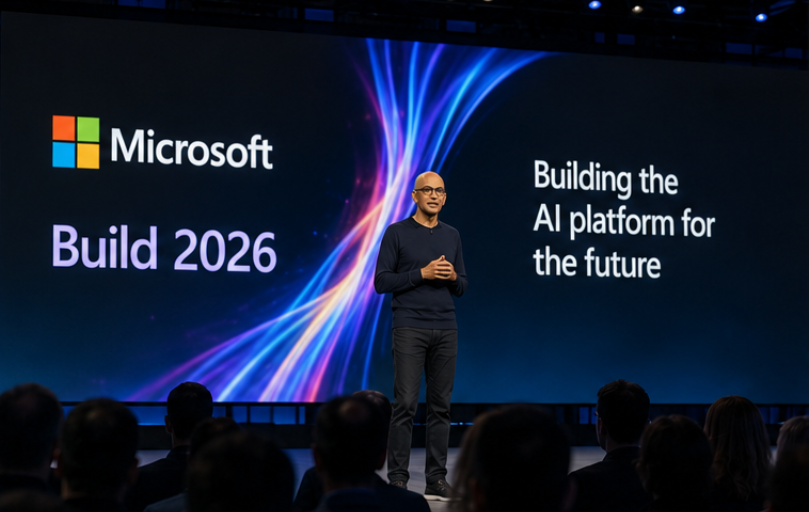
Microsoft Build 2026 announcements delivered the most strategically significant product reveals Microsoft has made in years. CEO Satya Nadella took the stage in San Francisco and declared the era of apps is over. “We believe the time has come for every company to move from consuming a frontier model to fully participating at the frontier,” he said. Microsoft AI CEO Mustafa Suleyman unveiled seven proprietary MAI models — the company’s first-ever AI models built from scratch without distillation from OpenAI or Anthropic. The MAI-Thinking-1 reasoning model matches Anthropic‘s Claude Sonnet 4.6 in blind human tests. Project Solara debuts as a new Android-based OS for AI-agent-first devices. And two concept hardware products — a desk hub and a wearable badge — show where Microsoft believes the next computing platform lives. It is not on your desk. It is on your lanyard.
What’s Happening & Why It Matters
MAI-Thinking-1: Microsoft’s First Reasoning Model — Built Without OpenAI
The Microsoft Build 2026 announcements‘ most commercially significant reveal is MAI-Thinking-1 — Microsoft‘s first internally developed reasoning model. The model carries 35 billion active parameters and a 256K context window. It is built specifically for high efficiency. In blind evaluations conducted by the independent human-rating partner Surge, MAI-Thinking-1 was preferred over Anthropic‘s Claude Sonnet 4.6. It matches Claude Opus 4.6 on widely used coding benchmarks. When tuned specifically for McKinsey‘s consulting workflows, it outperformed OpenAI‘s GPT-5.5 in quality — with what Microsoft projects to be ten times better cost efficiency, based on public pricing data.
That cost efficiency claim is the one that matters to enterprise buyers. Model quality is table stakes. Cost per token determines budget allocation. A model that matches GPT-5.5 quality at one-tenth the cost changes financial models for every developer running AI at scale on Azure. Suleyman was direct about the strategic intent. “This is all about long-term self-sufficiency for Microsoft and our partners. It’s about models you can trust.” MAI-Thinking-1 is available in private preview on Microsoft Foundry.
Seven MAI Models — and Why Clean Data Lineage Matters
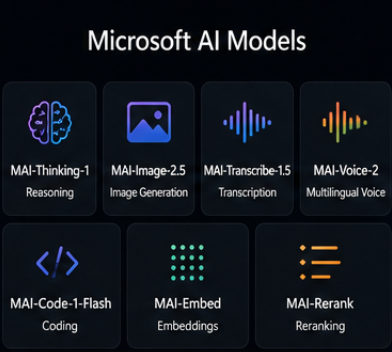
MAI-Thinking-1 is the flagship. By contrast, the full Build 2026 MAI announcement covers seven proprietary models across multiple categories. MAI-Code-1-Flash is Microsoft‘s inaugural coding model — available today across all GitHub Copilot plans. It converts written descriptions into working application code. That puts it directly in the same category as Anthropic‘s Claude Code and Cursor — currently two of the fastest-growing developer tools in the market.
The image, voice, and transcription models round out the portfolio. MAI-Image-2.5 claims to outperform Google‘s image-generation models in evaluation. MAI-Voice-2 adds 15 new languages. MAI-Transcribe-1.5 runs five times faster than competing models. Meanwhile, the critical detail: all seven models are trained on clean, commercially licensed data, with no distillation from OpenAI or Anthropic. That clean lineage is not a technical footnote. Enterprise legal and compliance teams specifically require it for regulated deployments— such as healthcare, finance, and government. It is a deliberate commercial differentiator.
A Strategic Shift: From Partner to Competitor
The MAI launch is a structural change in Microsoft‘s relationship with both OpenAI and Anthropic. Microsoft has invested approximately $13 billion in OpenAI and $5 billion in Anthropic. Both companies’ models are available through Azure — and that continues. By contrast, both companies are preparing for IPOs at near-trillion-dollar valuations, as TF covered in its article on the Anthropic IPO filing. Once they are public companies, their commercial priorities shift. Their enterprise incentives may diverge from Microsoft‘s. In April 2026, Microsoft and OpenAI amended their partnership agreement — ending Microsoft‘s exclusive access to OpenAI‘s intellectual property and removing Microsoft’s revenue-share obligation to OpenAI. The MAI models are Microsoft’s answer to the question that the amendment created: What happens when the supply chain is the competition?
Project Solara: Android, Not Windows — and That’s the Point
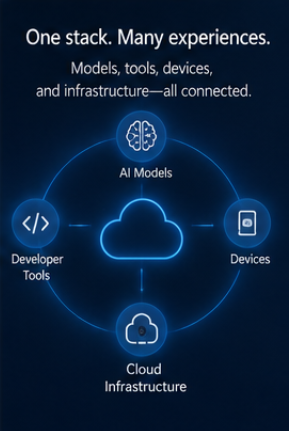
The second major announcement at Microsoft Build 2026 is the most architecturally significant. Project Solara is not a Windows product. It is an entirely new platform — a chip-to-cloud operating system built on the Android Open Source Project (AOSP) — called the Microsoft Device Ecosystem Platform (MDEP). It is designed for one purpose: devices that run AI agents instead of apps. The shift from apps to agents is the transition Microsoft is explicitly designing infrastructure for. MDEP provides enterprise-grade security through Microsoft Intune, Entra ID for identity management, and Windows Hello for Business biometric authentication. It runs an Agent Shell — a framework that dynamically loads multiple cloud-based agents onto a device’s interface, adapting the experience to screen size, interaction mode, and task context without requiring developers to redesign interfaces from scratch.
Microsoft describes this as just-in-time UI — interfaces that agents generate in the moment, rather than menus and buttons that developers pre-design. The concept rests on a specific premise. Today’s apps are static. AI agents are dynamic. A platform for agent-first devices are dynamism in its fundamental architecture. AOSP — not Windows — provides the lightweight, flexible foundation that makes this feasible. The build-on-Android choice is a deliberate break from every previous Microsoft device strategy. It signals that the Windows brand is not the priority. AI capability is.
The Two Concept Devices That Show The Future
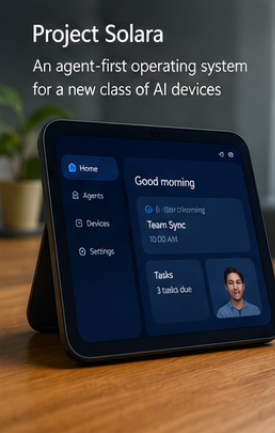
Microsoft demonstrated two working hardware reference designs built on Project Solara. These are not products yet. They are prototypes in enterprise pilot testing. The first is the Solara Desk Concept — a compact stationary smart display powered by MediaTek IoT silicon. It sits beside a PC. It authenticates through facial recognition. It surfaces upcoming calendar events, priority tasks, and Microsoft 365 data via touch and voice. Connect a monitor, and it is a full Windows machine running in the cloud. Think Amazon Echo Show — but built for the enterprise, with agents handling email, Outlook, and Teams.
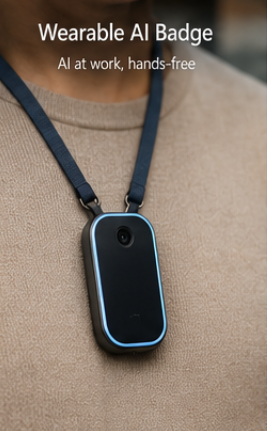
The second is the Solara Badge — the more significant device. It replaces the standard office lanyard ID card with a Qualcomm wearable silicon-powered device carrying a touchscreen, fingerprint scanner, side-facing camera, far-field microphone array, physical privacy switch, and 5G connectivity. One button press activates an agent. One tap records and transcribes a meeting. The camera lets the agent respond to what the wearer is physically looking at. In one demo, the badge camera scanned a brainstorm board and offered design suggestions. Microsoft executive Steven Bathiche described it as a device for frontline workers, healthcare providers, and information workers, where pulling out a smartphone creates friction or privacy barriers.
Who’s Piloting It — and Why It Matters
Microsoft confirmed that hundreds of its own employees are already using the badge concept internally. The first external enterprise pilots are confirmed with AccuWeather, Best Buy, CVS Health, Levi’s, and Target. The pilot sectors span retail, healthcare, hospitality, financial services, legal, and field services. Nadella noted the category. “Such gadgets represented a new form factor for technology devices.” The use case specificity is what separates this from vaporware. A nurse who cannot reach for a smartphone during patient care can access clinical AI through a badge clip. A field technician whose hands are occupied can access diagnostic data via voice and camera. A retail associate can check inventory without walking to a back-of-house terminal. Those are not hypotheticals. They are the specific deployments the pilots are designed to validate.
The Majorana 2 Quantum Chip: One More Build Announcement
Build 2026 included one further announcement that TF will note briefly. Microsoft confirmed its Majorana 2 quantum chip is 1,000 times more reliable than its predecessor. Qubits on the new chip survive for an average of 20 seconds — compared to milliseconds on Majorana 1. Microsoft described this as comparable to upgrading from a phone that requires daily charging to one that lasts several years. It is not commercially useful quantum computing yet. It is the clearest signal yet that Microsoft‘s topological qubit approach — long derided as a multi-decade project — is producing measurable, validated progress.
TF Summary: What’s Next
MAI-Thinking-1 is available in private preview on Microsoft Foundry. MAI-Code-1-Flash is live across all GitHub Copilot plans today. Project Solara enterprise pilots begin with AccuWeather, Best Buy, CVS Health, Levi’s, and Target. Microsoft has not announced a hardware release date or a retail product launch. The pilot data will “inform how these form factors can be built” in the future. The full MAI model family will roll out progressively across Azure and Microsoft Foundry over the coming months.
MY FORECAST: Microsoft Build 2026 announcements establish Microsoft as a genuine three-layer AI competitor — foundation models, platform infrastructure, and novel device categories — for the first time in the company’s history. MAI-Thinking-1 will not displace Claude or GPT-5.5 in the near term. Cost efficiency and clean data lineage are real advantages — but enterprise AI workflows do not switch providers in months. They switch in contract cycles.
MAI’s commercial impact will arrive in 2027 as the first Azure renewal cycles incorporate the new models as default options rather than add-ons. Project Solara’s badge is the riskier bet — and the more interesting one. Apple has not announced a competing wearable. OpenAI‘s rumoured 2027 AI phone targets the same replacement-for-smartphone narrative. Microsoft is betting that enterprise use cases — where a phone is too distracting and too generic — produce the first commercially viable non-phone always-on AI device. If the CVS Health and Best Buy pilots succeed, the badge concept will enter production in 2027 and reframe the wearable AI category. If they fail, it is a curious footnote. Build 2026 made it a credible bet.