


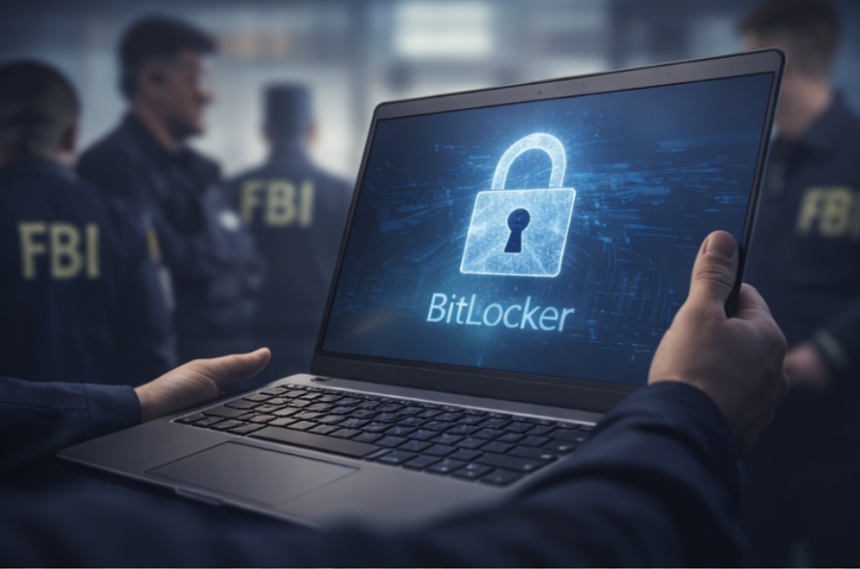
Encryption, privacy, and legal access collide inside Windows’ default security layer.
In early 2025, Microsoft quietly did something that instantly reignited one of tech’s oldest fights: the battle between user privacy and government access. According to a Forbes report, Microsoft provided the FBI with encryption keys for BitLocker-protected laptops, allowing investigators to access encrypted device data stored on Microsoft’s servers.
This was not a hacking incident or a breach. It is legal compliance. And that distinction is precisely what makes the story so uncomfortable. Because BitLocker exists for one reason: to keep data locked away from anyone without the key. Including criminals, thieves, and… governments.
So when the key changes hands, the entire meaning of encryption changes with it.
What’s Happening & Why This Matters
Microsoft Hands Over BitLocker Keys During FBI Probe
Microsoft confirms that it provided encryption keys for BitLocker-encrypted data during an FBI investigation in early 2025. The request involved access to data on three separate laptops, connected to a federal case involving alleged unemployment fraud in Guam, where several individuals face charges.
BitLocker comes built into Windows, and it encrypts device storage by default on many modern systems, especially since Windows 11. Users often assume encryption means total privacy.
But BitLocker introduces a critical detail: encryption keys can be stored not only locally, but also on Microsoft-managed servers.
That storage choice becomes the entire story.
Legal Orders Trigger Key Disclosure
Microsoft spokesperson Charles Chamberlayne tells Forbes that Microsoft provides keys upon receiving a valid legal order. He also notes the company receives around 20 BitLocker key requests per year from federal authorities.
That number surprises people because encryption discussions usually live in extremes: either the government gets nothing — or the government gets everything.
Microsoft’s approach lands somewhere in the middle, and that middle feels unstable. Because encryption does not work halfway. A lock either holds, or it opens.
FBI Lacks Tools to Break BitLocker Alone
The report includes a striking detail: forensic experts affiliated with ICE Homeland Security Investigations admit they lack the tools to bypass BitLocker encryption without Microsoft’s keys.
One court document states investigators “did not possess the forensic tools” to access the protected drives without assistance.
That means BitLocker works.
It does its job.
Until the key exists somewhere else.
This is the modern encryption dilemma: Security protects users… but cloud-connected key escrow protects compliance.
Microsoft Stands Apart From Apple’s Public Resistance
The story draws immediate comparison to Apple, which famously refused to create a backdoor for the FBI after the 2016 San Bernardino shooting. Apple CEO Tim Cook called the demand “overreach,” warning that it would undermine freedoms and open a dangerous precedent.
Cook argued that forcing access to encrypted systems creates a tool that never stays limited to a single case.
Even if intentions stay good, the mechanism spreads.
The Department of Justice eventually withdrew its case against Apple.
Apple held the line.
Microsoft, at least here, did not.
Cryptography Experts Warn About “Windfall Access”

Matt Green, a cryptography professor at Johns Hopkins University, tells Forbes that Microsoft possesses the power to resist these requests.
His words cut sharply:
“If Apple can do it, if Google can do it, then Microsoft can do it. Microsoft is the only company that’s not doing this.”
Green also warns that handing over keys gives the government access far beyond one narrow crime window.
Once decrypted, the hard drive becomes a complete archive:
- personal photos
- private messages
- medical files
- business documents
- years of digital life
And investigators gain what Green calls a “windfall.”
That requires trust.
And trust is not a security model.
Who Really Controls Encryption?
This story forces one brutal question: When encryption keys sit on corporate servers, who owns the lock?
BitLocker feels like personal protection. But server-stored recovery keys transform encryption into conditional privacy.
The user encrypts the laptop.
The corporation holds the spare key.
The government knocks with paperwork.
The door opens.
That is not hypothetical anymore. That is documented reality.
TF Summary: What’s Next
Microsoft’s BitLocker key disclosure is a defining moment in encryption and data protection. The company complied with legal orders, but the public sees how cloud-stored encryption keys create access pathways that users rarely understand.
Governments continue pushing for lawful access. Privacy advocates continue demanding rigid boundaries. And consumers live in a new reality: encryption only stays absolute when the key stays truly private.
MY FORECAST: Encryption is the next consumer trust battlefield. Users demand zero-access defaults, regulators push lawful entry points, and Big Tech faces mounting pressure to pick a side.
— Text-to-Speech (TTS) provided by gspeech | TechFyle