



RedVDS Network Targeted Schools and Businesses
Cybercrime often feels abstract until it lands in your inbox or drains a company account. That reality became sharply visible after Microsoft moved against RedVDS, a sprawling cybercrime subscription service that quietly powered fraud across Europe and beyond. Investigators traced phishing waves, payment diversion scams, and impersonation attacks back to a single marketplace that sold criminals the tools to operate at scale.
The takedown is one of the most coordinated private-sector cybercrime disruptions seen in recent years. It also shows how subscription-based crime now mirrors legitimate SaaS businesses — cheap, global, and frighteningly efficient.
What’s Happening & Why This Matters
How Microsoft Uncovered RedVDS
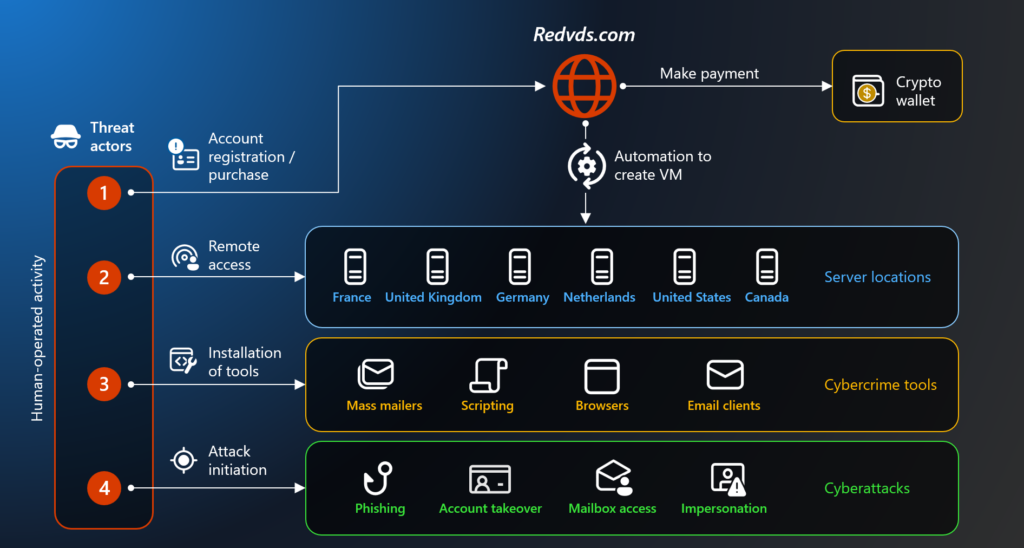
Between late 2025 and early 2026, Microsoft’s Digital Crimes Unit tracked a surge in coordinated phishing and business email compromise attacks. Analysts linked these campaigns to RedVDS, a service that sold access to virtual machines running Windows and other operating systems. For roughly $24 per month, customers gained access to infrastructure that masked identities, bypassed borders, and automated fraud at scale.

Microsoft confirmed that RedVDS activity touched hundreds of thousands of accounts worldwide. In the United States alone, reported losses linked to the service reached about $40 million, with actual totals expected to be far higher due to underreporting.
Leading Target: Europe
The impact across Europe proved severe. Victims surfaced in the United Kingdom, France, Germany, Italy, and Spain. Schools, healthcare providers, consumer goods companies, and professional services firms all faced attacks. Educational institutions ranked among the most affected, a detail that alarmed regulators and law enforcement.
For the first time, Microsoft pursued parallel legal action in both U.S. and U.K. courts. German prosecutors and Europol joined the response, seizing servers and dismantling infrastructure supporting the RedVDS marketplace.
Cybercrime as a Service
RedVDS exemplifies a growing cybercrime-as-a-service economy. Instead of building tools from scratch, criminals subscribe. They rent servers, automate phishing, and deploy scams that mirror legitimate workflows. Investigators observed attackers pairing RedVDS infrastructure with generative AI to draft realistic emails, identify high-value targets, and impersonate trusted contacts.
Microsoft described the model bluntly: organized criminal groups intercept real conversations, alter payment details, and exploit trust. “Falling victim to a scam should never carry stigma,” the company said, stressing that even well-run organizations face professional deception .
Real-World Harm
The damage goes far beyond spreadsheets. One co-plaintiff, H2-Pharma, lost funds set aside for cancer treatments, mental health medication, and children’s allergy drugs. Real estate firms reported payment diversion scams timed precisely to property closings. Attackers watched email threads for weeks before striking.
In one month alone, more than 2,600 RedVDS virtual machines sent nearly 1 million phishing messages per day to Microsoft customers, according to internal monitoring.
The Takedown
Microsoft filed suit in U.S. federal court, triggering domain seizures and service shutdowns. German authorities seized nearly 70 servers, while Europol coordinated action across multiple countries. The RedVDS website now displays a seizure notice, and its marketplace sits offline.
Microsoft confirmed ongoing efforts to identify both operators and customers. Many suspects operate from jurisdictions that resist extradition, yet the disruption removes a pillar supporting global fraud campaigns.
TF Summary: What’s Next
The collapse of RedVDS disrupts a major artery of cybercrime, yet the model itself persists. Subscription-based fraud platforms continue to appear, often faster than governments respond. Microsoft’s move signals a more aggressive stance by tech companies, which now combine litigation, technical enforcement, and cross-border law enforcement partnerships.
MY FORECAST: Cybercrime marketplaces keep fragmenting. Big platforms fall. Smaller, faster clones emerge. The advantage shifts toward companies that act early, share intelligence, and treat fraud infrastructure like organized crime rather than a nuisance.
— Text-to-Speech (TTS) provided by gspeech