



Governments are regulating technology. They are using it, cutting it, and weaponising it in policy theatre.
Politics and technology keep colliding in louder ways. In the United States, NASA has laid out a sharper Artemis roadmap that points toward a permanent lunar foothold and annual missions, with early moon-base work expected before the decade closes. In the same country, the Trump administration has backed a plan to pay nearly $1 billion (€0.93 billion) to kill two offshore wind lease projects rather than let them move forward. In the United Kingdom, Prime Minister Keir Starmer says the government will “have to act” against addictive social media features aimed at children and teenagers.
Each story sounds separate. One points to the Moon. One points to the sea. Another points to the phone in a teenager’s hand. Together, they show the same truth. Technology policy is no longer a niche file buried in one ministry. It is becoming a core political tool for national ambition, economic signalling, and cultural control. That is why the week’s headlines deserve to sit in one room.
What’s Happening & Why This Matters
NASA’s Moon Base Vision
NASA has refined the Artemis architecture and put more public shape around a long-term lunar presence. The agency said on 3 March 2026 that it is increasing mission cadence, adding a new mission in 2027, and aiming for one lunar mission per year after astronauts return to the Moon’s south pole in 2028. The same update says Artemis V, targeted for late 2028, is when NASA expects to begin building its Moon base. That is not just a science note. That is a political statement.

The language is telling. NASA tied the plan to “maintaining U.S. superiority in exploration and discovery.” That phrasing does not float in a vacuum. It fits a wider U.S. mood that treats the Moon as strategic ground, not only symbolic ground. A lunar base is science, prestige, logistics, and geopolitics all at once. That is why the plan arrived with surprise.
The practical hurdles still loom. Artemis II still faces launch work after a helium issue. Commercial landers from SpaceX and Blue Origin are still under pressure. Even so, the architecture moves the conversation away from isolated missions and toward sustained presence. In politics, sustained presence beats one-off spectacle. A flag is nice. A base is policy.
The Moon Story Equals Competition With China
No one needs to squint hard to see the bigger strategic angle. The United States is not discussing a lunar base in a calm, post-history environment. China has its own lunar ambitions, and U.S. lawmakers and officials are increasingly blunt about the race. The Moon’s south pole is attractive because of possible water ice, long-term science value, and strategic positioning. Whoever builds durable infrastructure there first gets more than bragging rights.
That is why the Artemis revision carries more heat than a normal NASA update. A moon base sounds futuristic, but the politics are old-fashioned. Major powers still want to plant capability where rivals may soon arrive. Space policy keeps talking in the language of discovery. Power politics keeps hearing the language of control.

There is a British-English way to put it. The whole thing smells less like a campus research project and more like an early rush with rockets. The difference is altitude.
From a TF angle, the larger shift is plain. Space technology is re-entering frontline politics. Budgets, launch cadence, nuclear surface power, and habitat design are no longer only engineering details. They are instruments of national competition. Once that happens, delays get political and progress gets mythic. That is a dangerous blend. It is still real.
Trump’s Anti-Wind Policy
The most jarring contrast in the roundup is in U.S. energy policy. While Washington is backing high-tech lunar expansion, it is simultaneously backing a plan to pay nearly $1 billion (€0.93 billion) to stop offshore wind development. Reports say the administration agreed to reimburse TotalEnergies for leases tied to two East Coast wind projects, in exchange for abandoning the projects and shifting capital into fossil fuel activity, including LNG and shale gas.
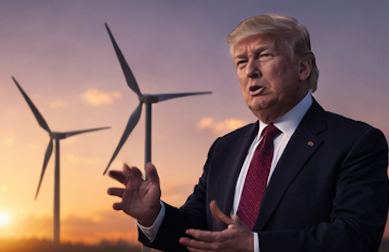
That is not a market correction. That is political demolition.
The number alone stings. Paying a company to stop building clean-energy infrastructure is a different kind of industrial policy. It tells investors that energy transition projects are disposable if a new administration decides they are ideologically offensive. It tells global firms that U.S. clean-energy commitments can swing wildly. And it tells climate advocates that the government is willing to use public money not only to build things, but to unbuild them.
The administration argues that offshore wind is unreliable, costly, and out of step with its energy goals. Critics argue the policy trashes long-term stability and strengthens dependence on fossil fuels at exactly the wrong moment. Both sides understand one thing clearly: energy technology is culture-war territory.
Canceling Wind Projects Continues the War on Green Tech
The two projects were not yet fully built, which makes the policy easier to sell politically. Yet that almost makes the signal stronger. If governments are willing to kill projects before full deployment and still write a cheque, then the real target is confidence. The administration is not only stopping turbines. It is warning the whole sector.
Offshore wind projects already struggle with high capital costs, long timelines, supply-chain pressure, and regulatory drag. Add political cancellation risk and the whole equation worsens. Banks, utilities, developers, and foreign investors all start asking the same question: can any U.S. offshore project survive a hostile turn in federal policy?
That is why the anti-wind move belongs in a tech-and-politics roundup. It is not just an energy story. It is a lesson in how quickly governments can change the technology mix by rewarding one path and punishing another. A moon base can be sold as national strength. Wind turbines can be sold as national weakness. The science behind either story matters less than the political storytelling around them.
And yes, that is absurd. A government that wants nuclear reactors on the Moon but not turbines off the coast is telling you something about politics, not engineering.
Starmer’s Social Media Crackdown
Across the Atlantic, the U.K. government is moving toward tougher action on addictive social media features. Keir Starmer said Britain will “have to act” and argued that features such as infinite scroll and daily engagement streaks “shouldn’t be permitted” when they trap children in compulsive use patterns. Education Secretary Bridget Phillipson echoed the concern and said policymakers cannot allow young minds to be shaped by manipulative systems built for maximum engagement.

That stance shifts the political target from content moderation alone to product design itself. For years, debates around social platforms focused on harmful posts, dangerous users, or illegal content. The new argument goes deeper. It says the platform’s architecture may be harmful before any post even appears.
The U.K. consultation reportedly has already received nearly 30,000 responses and is due to close on 26 May. Policy ideas under discussion include restrictions on addictive algorithms and stronger limits for younger users. The direction is clear. Britain is inching from debate toward intervention.
For tech companies, that is bad news in the short term and overdue news in the long term. Design choices once sold as clever retention features are being recast as behavioural manipulation. Once a prime minister starts talking that way, the issue is no longer a parental complaint. It is political ammunition.
Social Media Design Is a Governable Surface
The deeper point is easy to miss. Governments are starting to treat user-interface design as something that can be governed, not merely criticised. That is a major shift. Infinite scroll, autoplay, streaks, reward loops, and algorithmic nudges are in the category of “product optimisation.” Policymakers increasingly classify them as “public harm.”

That changes the balance of power. Tech firms still build the features. Politicians are signalling they may decide which ones are acceptable, at least for minors. Australia has already moved toward under-16 restrictions. Britain is clearly testing how far it can go next. Europe has shown no shortage of appetite for regulating digital systems that shape youth behaviour.
The columnist take is simple. Social media companies spent years acting as if behavioural design was a private business choice. Governments are starting to answer: not when children are the raw material.
That does not mean regulation will be elegant. It rarely is. Yet once the political class decides that addictive design is closer to public health than to product polish, the old industry defences start to sound thin. “Users love it” is not much of a shield when lawmakers think the system is built to keep children trapped.
TF Summary: What’s Next
The week’s politics-and-tech stories pulled in different directions, yet they shared the same lesson. Governments are using technology policy more aggressively to shape national ambition and daily life. NASA’s Artemis roadmap points toward a U.S. moon base and annual lunar missions. The Trump administration’s offshore-wind reversal shows how brutally a government can change a tech sector’s prospects. Starmer’s warning on addictive social features signals that user-interface design is moving closer to regulation.
MY FORECAST: Space policy will get more nationalistic, clean-energy policy will stay brutally partisan, and social platform design will face harsher legal scrutiny. The common thread is power. States want more control over which technologies rise, which stall, and which behaviours survive. For tech leaders, that means one thing: policy is no longer the side quest. Policy is the operating system.
— Text-to-Speech (TTS) provided by gspeech | TechFyle