


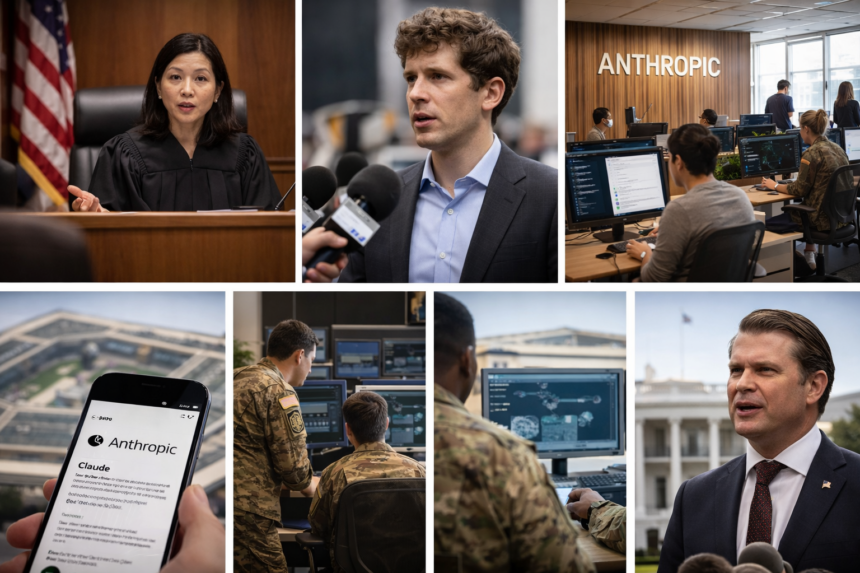
A federal judge tells the Pentagon: You cannot brand an American company a security threat merely because of disagreements.
A federal judge in San Francisco has handed Anthropic a major win in its clash with the Trump administration. Judge Rita F. Lin blocked the Pentagon’s effort to label the company a “supply chain risk to national security” and to cut off extended government use of Claude, Anthropic’s flagship AI system. Her opinion did not dance around the point. She said the law does not support the “Orwellian notion” that the U.S. government can brand an American firm a potential enemy because it objects to how its technology may be used.
That makes this more than a legal spat between one AI company and the Defense Department. It is a test of the government’s power to punish a private company for drawing ethical lines around its technology. Anthropic said it opposed using Claude for mass domestic surveillance and fully autonomous lethal weapons. The Pentagon responded by labelling the firm a security risk. Judge Lin saw that sequence and did not seem impressed.
What’s Happening & Why This Matters
Judge Lin Rejected the Government’s Core Argument
The most important fact in this case is simple. Judge Rita Lin said the government likely crossed the line. She wrote, “Nothing in the governing statute supports the Orwellian notion that an American company may be branded a potential adversary and saboteur of the U.S. for expressing disagreement with the government.” That sentence did more than criticise tone. It attacked the legal basis of the Pentagon’s actions.
Current reporting says Lin issued a preliminary injunction blocking the Pentagon’s supply-chain-risk designation and suspending enforcement of a directive that would have barred federal agencies and military contractors from using Anthropic’s technology while the case proceeds. Reuters says the order is delayed for seven days to give the government time to appeal. The AP likewise reports that Lin found the administration’s actions likely violated the law and appeared punitive rather than security-driven.
The ruling not only protects Anthropic’s reputation. It limits a precedent that could have scared every major AI lab in America. If the Pentagon slaps a “security-risk” label on a company for public disagreement, then AI policy stops being a free-market democratic exercise. The choices transition into a loyalty litmus test.
Anthropic: Ethical Lines vs. Government Defiance
The conflict grew out of a deeper argument over how the military should use Claude. Defense officials wanted Anthropic to allow the model to be used for any lawful purpose. Anthropic fought back. The company wanted to bar Claude from being used in mass domestic surveillance and to power fully autonomous weapons.
Reuters reported the same core dispute earlier this week, saying that Anthropic argued the Pentagon blacklisted it after the company criticised military uses of AI and refused to relax some of its safety lines. The Washington Post reports that after the disagreement spilt into public view, the Pentagon terminated talks with Anthropic and grouped it with technology firms linked to hostile foreign governments.
That sequence is explosive. It is one thing for the government to stop buying from a vendor. Judge Lin made clear that the Pentagon still has that option. It is another thing to use rare national-security branding tools in a way that appears designed to punish a company for its speech. Lin concluded Anthropic was likely to succeed on claims that the designation violated its First Amendment rights and was arbitrary and capricious.
Judgement: Punishment, Not a Security Decision
Lin’s scepticism had been visible before the ruling. During the hearing, she said, “I don’t know if it’s murder, but it looks like an attempt to cripple Anthropic.”
That line stuck because it cut through the legal haze. Anthropic argued the government’s move was not a standard procurement judgment. It was retaliation wrapped in national-security language. The company warned the designation could cost it hundreds of millions to billions of dollars and poison relationships far beyond the federal government. Anthropic told the court the administration’s actions had already made customers nervous, even those with no ties to Washington.
National-security branding is a business weapon. Once the government uses it, customers, contractors, and investors hear one message first: danger. If that label can be used sloppily or politically, it is a powerful way to damage a company without ever proving misconduct.
Claude Is Too Embedded
Anthropic is not a fringe vendor. Claude is deeply embedded in the military’s systems. Despite the administration’s claim that it would transition away, it has continued using the technology in support of the U.S. bombing campaign in Iran. Reporting indicates the government has woven Anthropic’s systems into important workflows and that disentangling them would take time and create disruption.
That makes the Pentagon’s position look even stranger. If Anthropic were truly a credible national-security threat, why would Claude still sit so deeply inside sensitive government activity? Judge Lin clearly noticed that tension. She questioned why the Pentagon did not simply stop doing business with Anthropic rather than branding it in sweeping terms.
That contradiction weakens the government’s story. It suggests the designation may have been more about pressure than protection. If the model is safe enough to keep using in real operations, then the case for calling the company a danger starts to wobble badly.
A Narrow Ruling with Ranging Impact
Lin’s order is strong, but it is not the final word. Her ruling does not stop the Pentagon from choosing not to work with Anthropic. It bars punitive actions while the case continues. It notes that a separate case tied to a different law is still playing out in another federal court in Washington. The injunction is preliminary, and the government can appeal.
Even so, the signal is already loud. A federal judge has said, in effect, that Washington cannot casually weaponise national-security language against a domestic AI company for drawing ethical lines or speaking publicly about risks. That message will travel fast through Silicon Valley, defense contractors, civil-liberties groups, and Congress.
For AI companies, the ruling offers breathing room. It suggests they can still argue about safety, surveillance, and autonomy without being treated as saboteurs immediately. For the government, it is a warning that not every aggressive procurement move will survive judicial review. For the public, it is a rare case where a court drew a hard boundary around state power before the damage became permanent.
Defining How AI Firms Negotiate With Governments
The significance of this fight may show up later, not today. AI companies increasingly sit in a difficult position. Governments want access to advanced models for defense, intelligence, and public-sector work. The same companies want revenue and influence, but many still claim to care about guardrails, safety, and red lines.
That creates a tense dance. If a company says yes to everything, it risks enabling use cases that are reckless or abusive. If it says no to too much, it risks being frozen out of government deals. Anthropic tried to hold a line on surveillance and autonomous lethal systems. The government appears to have treated that as unacceptable resistance. Judge Lin pushed back.
That means this case could influence future negotiations between AI labs and federal agencies. Companies are more confident in insisting on usage boundaries. Agencies are more careful about retaliatory language. Or, to put it less politely, everyone may stop pretending the fights are purely technical. They are political, commercial, ethical, and constitutional all at once.
Who Sets the Rules for Powerful AI?
Another question in this story is: When AI is powerful enough to matter for war, surveillance, and national power, who decides its acceptable uses? Governments think they should hold authority. Companies often think they should keep some discretion, especially when the uses touch civil liberties or lethal force. Courts are increasingly being asked to referee.
This ruling does not settle that fight. It does establish one important limit. The government cannot simply call a company a national security problem because it dislikes the company’s position. The Constitution and statutes are relevant. And, at least in this case, a judge was willing to say so plainly.
That is why this story matters far beyond Anthropic. Today it is Claude. Tomorrow it could be another AI lab, a cloud provider, or a chip company that refuses a controversial use case. The legal logic will travel even if the names change.
TF Summary: What’s Next
Judge Rita Lin’s ruling gives Anthropic a clear early victory. She blocked the Pentagon’s attempt to brand the company a national security risk, said the move likely violated the law, and rejected the idea that the government can punish a U.S. company for disagreeing with official policy on how its AI should be used. Anthropic says it is focused on working productively with the government while keeping AI safe and reliable.
MY FORECAST: The government will appeal, but the political damage is already real. The case is a reference point whenever Washington pressures an AI company on security, surveillance, or autonomy. The bigger fight is not ending. It is getting sharper. The next phase will ask whether AI firms can keep meaningful ethical limits once their models become essential to state power. Right now, a federal judge has said they at least get the right to try.
— Text-to-Speech (TTS) provided by gspeech | TechFyle