


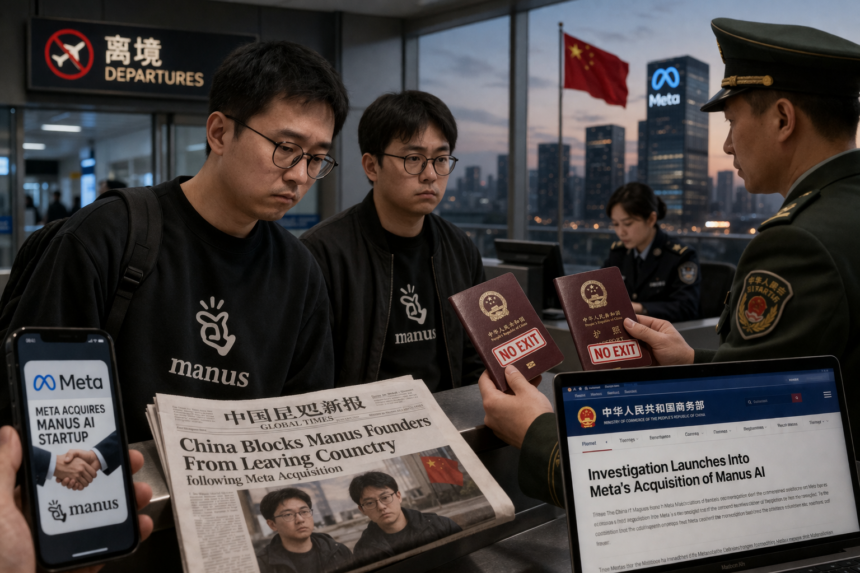
China’s AI clampdown hit the travel plans of two Manus founders, and Meta’s big bet is a lot less simple.
China has blocked two founders of Manus, the fast-rising AI startup acquired by Meta, from leaving the country while regulators review the deal. The executives are Xiao Hong, Manus’s chief executive, and Ji Yichao, its chief scientist. Reports say the restriction followed a meeting in Beijing, during which Chinese authorities examined whether Meta’s purchase of Manus violated investment rules.
That instantly turned a flashy AI acquisition into a geopolitical problem. Meta had presented Manus as a major step in its race to build stronger autonomous AI agents. China views the same company as a strategic asset that may have crossed a regulatory line on its way out. That makes the story bigger than one deal. It shows how AI talent, AI software, and cross-border acquisitions are all getting pulled deeper into the U.S.-China tech struggle.
What’s Happening & Why This Matters
Restricted Movement for Two Manus Leaders
The basic facts are sharp and unusual. Citing the Financial Times, Chinese authorities barred Manus co-founders Xiao Hong and Ji Yichao from leaving China while regulators reviewed Meta’s roughly $2 billion acquisition of the company. The two are free to travel within China, but they cannot leave the country during the review.
Additional reporting offered the same core detail and added that the restriction came while Chinese officials examined whether the Meta-Manus transaction complied with local laws and regulations. The article said Meta had announced the acquisition in December 2025 and that China’s commerce ministry soon signalled it would investigate the deal.
Exit restrictions are not a routine footnote in global tech mergers. They send a message. Beijing is not treating this as a normal corporate paperwork review. It is a sign that a Chinese-linked AI company can still fall under Chinese control even after moving pieces of its operation abroad.
Manus’ Value Is More Than a Chatbot
Manus is not a random small startup. Manus was once dubbed “China’s next DeepSeek” and marketed itself as the world’s first fully autonomous AI agent. The company claimed its software could buy property, program video games, analyse stocks, and plan travel itineraries. Manus’s own creator said in a video that it was more than “just another chatbot or workflow” and instead a “completely autonomous agent.”
Manus is a startup that develops general-purpose AI agents for digital work tasks, while the company specialises in advanced AI agents capable of doing more complex tasks than ordinary chatbots. That profile helps explain why Meta wanted it. Agentic AI is one of the hottest battlegrounds in the current AI race, and Manus is one of the more visible names in that space.
In simpler terms, Meta did not buy Manus for logo value. It bought Manus because agent software that can take action, not only answer questions, is where the market is heading. China seems to understand that value, too.
Meta’s Acquisition Is Clever and Politically Risky
Meta announced the Manus acquisition in December as part of its initiative to stay competitive in generative and agentic AI. Meta has insisted the deal complied with relevant laws and that it expects a resolution. Meta integrated the Manus team into its Superintelligence Labs division in Singapore.
From Meta’s point of view, the logic was easy to see. Buying Manus gave access to a team already building autonomous AI products with strong market buzz. Instead of waiting to catch up internally, Meta could buy speed. That is classic platform behaviour. When a market moves fast, large firms often buy the builders rather than chase them from behind.
The trouble is that AI is no longer just another software category. It is inside national security, industrial policy, and geopolitical competition. A deal that is smart in Menlo Park can appear very different in Beijing. Meta may have thought it was buying a startup. China may see the same move as a transfer of strategically important AI capability to a U.S. giant. That is the part that changes the tone.
The Difficulties of Reocating AI Talent and IP Across Borders
China’s concern appears to centre on investment compliance, ownership changes, and the transfer of AI-related assets outside the country. Reuters said the review concerns possible violations of investment rules. Beijing’s Ministry of Commerce had launched a probe in January into potential violations of foreign direct investment regulations, while AP earlier reported Chinese authorities were examining whether the sale complied with investment, technology export, and data regulations.
AI companies do not only carry code. They encompass talent, training methods, datasets, ownership structures, and sometimes export-controlled or strategically sensitive know-how. Once a company has roots in China, even if it later shifts operations to Singapore or elsewhere, Chinese regulators may still argue that local laws apply to pieces of the business or the technology.
This is where a lot of Western tech thinking still lags reality. For years, companies assumed that moving the corporate shell or headquarters could simplify cross-border control. In AI, that assumption is getting weaker. Governments care about where the talent came from, where the product was built, where the IP originated, and where the future benefits fall. China is making that clear in public.
Exit Restrictions Add to the Geopolitics
There is a business angle here, but there is a human one too. The two Manus leaders are still free to move within China but cannot leave the country. The exit bans in China are often imposed during investigations and are criticised for their opaque legal basis.
That detail changes the story from abstract policy to lived pressure. When founders cannot leave the country during a deal review, the state is not only reviewing a transaction. It is exerting leverage on people. That can affect negotiations, future compliance discussions, and the climate for entrepreneurs who hope to build globally while staying connected to China.
It may even chill future exits. If founders believe that a successful AI sale to a foreign buyer could trigger personal movement restrictions, some will hesitate to take the same route. Others may work harder to move operations, people, and ownership structures earlier. Either way, the regulatory signal is loud. China wants a say in where high-value AI companies go.
A Warning Shot to Other AI Startups
Some analysts already see the Manus case as a warning. A Table.Media’s report described it as a signal to potential copycats. This instance is the first known use of exit restrictions by China to intervene in an AI-related acquisition by a U.S. firm.
The AI startup world is eyes wide open. Founders across Asia often dream of three endgames: scale fast, sell to a major platform, or move into a more favourable regulatory market. If China starts treating major AI exits as strategic losses rather than ordinary business outcomes, that changes every founder’s map.
This is especially true for companies with agentic AI ambitions. Manus attracted attention because its products promised autonomy and workflow execution, not only conversational answers. If that category is viewed as strategically important enough to justify travel restrictions and direct state review, it is much harder to pretend that consumer AI and state power live in separate rooms. They do not. They are sharing the same building.
Meta’s AI Strategy Under Scrutiny Henceforth
Meta is unlikely to walk away from its AI ambitions because of one difficult deal. But the episode may force the company to rethink how it approaches acquisitions involving Chinese-linked talent, technology, or corporate histories. Meta expects the issue to be resolved, but even a clean resolution would still leave a lesson behind: buying frontier AI capability across borders is becoming a regulatory minefield.
That lesson goes well beyond Meta. Every major U.S. platform, cloud company, and AI lab has to think harder about where acquisitions can trigger national-security logic, export rules, or political retaliation. A company may still want the product and the team. The real question is whether the home state of that team is willing to let the asset go.
In older markets, this would look like merger friction. In AI, it is increasingly strategic containment. That is why the Manus case is different. It is not only about whether regulators sign off. It is about whether governments are willing to let elite AI capacity cross borders at all.
TF Summary: What’s Next
China’s decision to block Manus founders Xiao Hong and Ji Yichao from leaving the country during its review of Meta’s acquisition has turned a flashy AI deal into a global warning sign. Regulators appear to be testing how far they can go to keep control over Chinese-linked AI talent and technology, even after a company shifts operations abroad. Meta still says the transaction complied with the law and expects a resolution, but the pressure is already visible.
MY FORECAST: This will not be the last AI deal caught in a sovereignty trap. More governments will treat agentic AI startups as strategic assets, not ordinary software companies. That means more reviews, more movement restrictions, more political bargaining, and fewer easy cross-border exits. The Manus case may fade from headlines later, but the rule it hints at will stick: in frontier AI, founders may build global products, yet states still claim the right to decide who gets to own the future.
— Text-to-Speech (TTS) provided by gspeech | TechFyle