


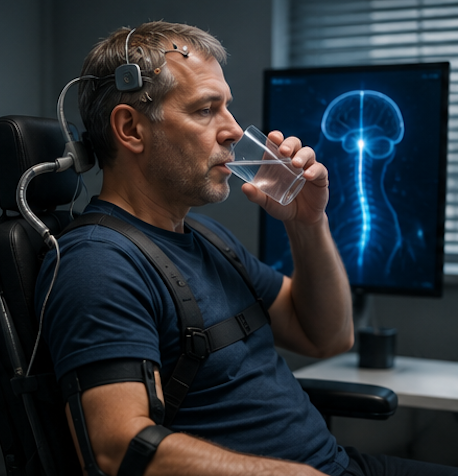
Keith Thomas broke his neck in a 2020 diving accident. Complete tetraplegia. Couldn’t lift his hands to his face. After three years wearing a “double neural bypass,” he can drink from a cup, scratch his nose, and wipe his mouth — unaided. Some of the recovery held even when the device was switched off.
The article discusses spinal cord injury and paralysis at a scientific and medical level.
The double neural bypass trial results were published in the peer-reviewed journal Nature Medicine — nearly three years after researchers first enrolled participant Keith Thomas in the study.
Thomas broke his neck in a 2020 diving accident, resulting in complete tetraplegia — he could not lift his hands to his face. He enrolled in the three-year trial 13 months after his injury.
The system, developed by the Feinstein Institutes for Medical Research, the research arm of Northwell Health, combines a brain-computer interface, artificial intelligence, and electrical stimulation of both the spinal cord and brain. After training, Thomas could feed himself and drink from a cup using his own hand — a capability the researchers describe as restored, not merely assisted.
“This approach is a new way to treat severe paralysis — we’re not just bypassing the injury, we’re actually rewiring the nervous system,” said Chad Bouton, a bioelectronic medicine specialist and study co-author.
What’s Happening & Why It Matters
How a “Double” Neural Bypass Works
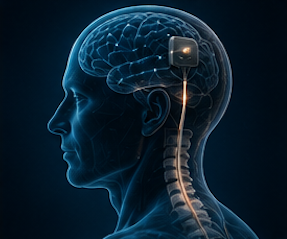
The double neural bypass trial results describe a system meaningfully more complex than earlier brain-computer interfaces. Five microelectrode arrays are surgically installed in Thomas’s brain. Machine learning algorithms then interpret brain signals denoting movement intention with nearly 85% accuracy. Those neural messages are translated into electrical stimulation patterns delivered to his forearm muscles, which then move as intended.
By contrast, the system’s second — and novel — component addresses sensation, not just movement. Sensors inside a 3D-printed limb brace measure grasping pressure. That pressure data creates electrical stimulation in the sensory cortex — the part of the brain responsible for processing touch — generating the perception of touch in a hand that cannot otherwise feel anything. Combining a motor bypass with a sensory bypass in a single integrated system is precisely what earns the “double” designation, and it is the element previous brain-computer interface systems have not achieved together.
The Results That Go Beyond Movement
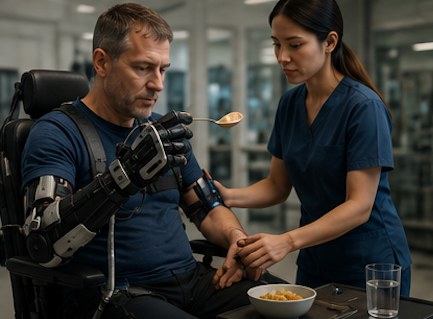
The double neural bypass trial results demonstrate outcomes considerably more precise than earlier feed-himself milestones from comparable BCI research. Over 35 weeks, Thomas’s right arm grew 86% stronger and his left arm 62% stronger, the researchers reported. He is able to grab and lift hollow eggshells without breaking them nearly 90% of the time — a task requiring fine motor control and pressure sensitivity, not simply gross movement. He can perform this and similarly demanding tasks while talking simultaneously — a vast improvement compared to existing BCI systems, which typically require a patient’s complete cognitive focus on the movement task alone, leaving no capacity for conversation.
Additionally, Thomas can scratch his nose and wipe his mouth entirely unaided — small, specific actions that carry outsized significance for someone who previously could not perform any voluntary movement below his neck at all.
Surprise! Recovery Persisting Without the Device
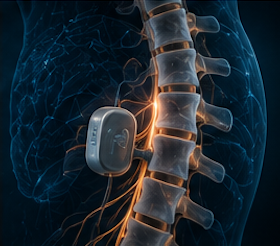
The double neural bypass trial results contain a finding that extends beyond the expected scope of the technology itself. Some of the system’s benefits continued even when the device was turned off, suggesting the system may support longer-term recovery, as well as helping movement in real time. Previous brain-computer interface systems have helped restore some movement but have not yet demonstrated this specific combination — touch restoration alongside evidence of lasting neurological recovery that persists independent of the device’s active operation.
That persistence is scientifically significant because it suggests the system is not merely providing a temporary electronic workaround. It may be actively strengthening or rebuilding functional neural pathways damaged by the original spinal cord injury — a fundamentally different therapeutic mechanism than a prosthetic device that only works while switched on.
Scaling Spinal Cord Injury
The double neural bypass trial results address a condition with substantial and largely unmet clinical need. Spinal cord injury is a leading cause of paralysis, and more than half of cases involve tetraplegia — impaired movement of both the arms and legs. Complete spinal cord injuries, involving no voluntary movement or feeling below the injury site, are particularly difficult to treat, and previous brain-computer interface systems have generally been unable to restore both movement and sensation together in the same patient.
By contrast, this is a single-patient case study published in a peer-reviewed journal — a scientifically meaningful proof of concept, not yet evidence of a scalable clinical treatment available to the population of people living with complete tetraplegia. The path from a successful individual trial participant to a widely accessible medical device typically spans years of additional trials, regulatory review, and manufacturing scale-up.
TF Summary: What’s Next
The Feinstein Institutes for Medical Research has not announced a timeline for expanding the double neural bypass trial to additional participants. Chad Bouton and colleagues will continue monitoring Thomas’s progress and the durability of the recovery effects observed when the device is switched off. No regulatory submission timeline to the FDA for clinical use has been disclosed. The full study, including complete methodology and additional patient outcome data, is available in Nature Medicine.
MY FORECAST: The double neural bypass trial results will accelerate research funding and clinical interest specifically in the sensory-restoration component of brain-computer interfaces — most prior BCI research and commercial development, including consumer-facing efforts from companies like Neuralink, has prioritised motor control and output over restoring sensory feedback. By contrast, scaling this specific dual motor-and-sensory system to additional patients will take considerably longer than the headline results suggest, given the surgical complexity of implanting five separate microelectrode arrays and the extensive machine learning calibration each individual patient’s neural signals require. Expect the Feinstein Institutes to expand to a small additional cohort of trial participants within 24 months, with the persistence-without-device finding becoming the primary research question the next phase specifically investigates.
Related Stories
- New AI Model Gives Humanoid Robots a 90% Success Rate on Complex Tasks
- Snap Specs Cost $2,195 — and Beat Meta, Apple, and Google to Consumer AR
- Mayo Clinic Is Testing AI Across Diagnostics and Patient Care