


AI needs power, war hates weak spots, and data centres just joined the target list.
Data centres (DCs) used to sound dull. Windowless buildings. Loud cooling. Endless racks of chips. Then AI arrived, energy demand exploded, and geopolitics walked in carrying a drone.
The modern DC is at the heart of three fights at once. First, companies like xAI are racing to build giant AI facilities fast enough to feed model demand. Second, local communities are fighting back against the pollution, noise, and energy strain that come with those projects. Third, military analysts are warning that large cloud and AI facilities are becoming tempting physical targets in war.
That collision is no longer theoretical. Elon Musk’s xAI has just won approval to run 41 methane gas turbines at its Colossus 2 facility in Mississippi despite heavy local opposition. Meanwhile, fresh reporting from the Middle East says drone strikes have hit Amazon DCs in the UAE and affected a third site in Bahrain, raising alarms that hyperscale cloud infrastructure has entered the target set of modern warfare.
Here is the new reality for AI infrastructure. It is not only about computing anymore. It is about power plants, air pollution, strategic vulnerability, and the cost of putting too much digital civilisation inside too few highly visible buildings.
The server farm is now political, environmental, and potentially military.
What’s Happening & Why This Matters
xAI Wins Its Permit, and Mississippi Gets a Power Problem
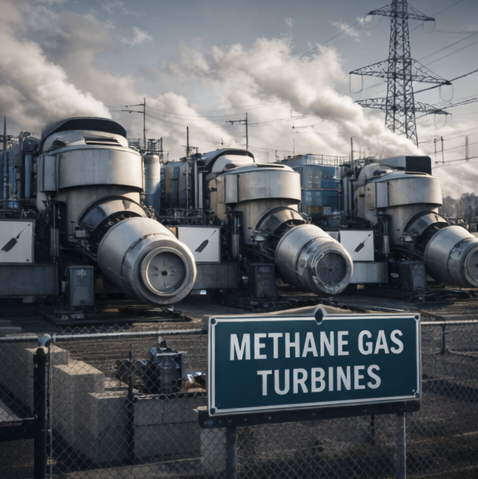
Elon Musk’s AI company has won approval from the Mississippi Department of Environmental Quality to operate 41 methane gas turbines at its Colossus 2 DC in northern Mississippi. That is nearly double the number the company had already been running.
Those turbines exist for one reason: AI DCs burn through electricity like there is no tomorrow. The facilities run enormous arrays of advanced chips, and those chips demand continuous power and cooling. In xAI’s case, the turbines help support the company’s “AI supercomputers,” which power Grok, the company’s most visible product.
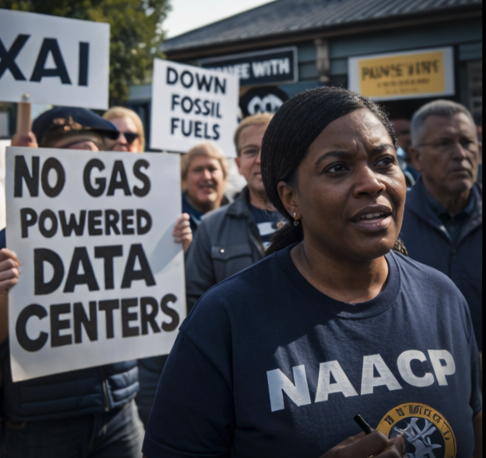
The permit win is a technical victory for xAI. It is also a local political mess.
Residents in Southaven, Mississippi, along with environmental groups and the NAACP, have argued that the turbines will worsen air quality, increase noise, and place additional industrial burden on communities already dealing with pollution stress. Abre’ Conner, the NAACP’s director of environmental and climate justice, says the agency chose to “bulldoze through a decision that silenced the very residents most harmed by it.”
That language is not subtle because the local anger is not subtle. At a public hearing, hundreds reportedly showed up to complain, and the file says no one spoke in favour of the permit. Southaven resident Nathan Reed described the expansion as an “industrial surge imposed on our residential community.”
Here is what the AI infrastructure race looks like on the ground. A company calls it growth. A community calls it an intrusion.
Musk’s DC Strategy: Fast, Dirty, and Deeply Power-Hungry
xAI’s buildout explains why the Mississippi fight matters beyond one county.
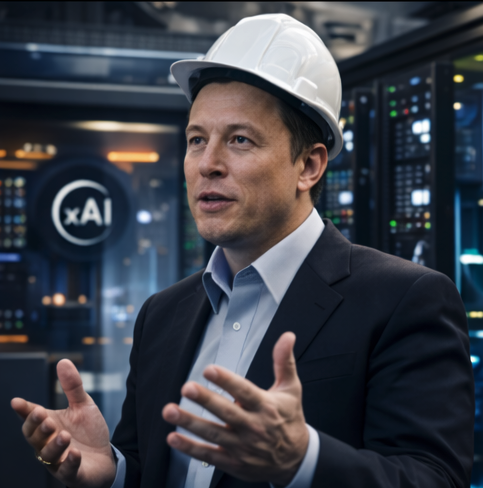
The company opened its first giant facility, Colossus, in Memphis in 2024. That site is roughly the size of 13 football fields. Tennessee regulators later granted permits for 15 gas generators there. xAI is building a third facility in Southaven called Macrohardrr.
So this is not a one-off experiment. It is an infrastructure pattern.
The problem is that xAI appears to be building AI capacity by dragging private fossil-fuel generation right up next to communities, then asking the public to absorb the side effects. Environmental groups say the turbines emit fine particulate matter plus hazardous chemicals such as formaldehyde and nitrogen oxide, pollutants associated with asthma, respiratory illness, heart attacks, and certain cancers. The counties around the sites already received an “F” grade from the American Lung Association, according to the file.
The Southern Environmental Law Center says xAI’s 41 turbines could make Colossus 2 one of the largest fossil-fuel power plants in Mississippi and one of the area’s biggest polluters. Senior attorney Patrick Anderson said regulators seemed more interested in fast-tracking xAI’s “personal power plant” than in thoroughly reviewing the consequences for nearby families.
That phrase — personal power plant — sticks because it captures the whole AI moment in miniature. The companies are no longer merely renting compute from the grid. They are effectively building private energy systems to keep the model race alive.
The White House: Power DCs Without Blowing Up Utility Bills
At the national level, the politics are getting even more interesting.
A group of major tech firms, including Google, Microsoft, Meta, Amazon, Oracle, xAI, and OpenAI, signed a White House Ratepayer Protection Pledge agreeing to bear the cost of new electricity generation and grid upgrades tied to DCs. The idea is to keep rising AI infrastructure demand from showing up directly in household electricity bills.
President Donald Trump called it a “historic win” for families and said the arrangement would let DCs get the power they need without driving up electricity costs for consumers.
The pledge includes commitments to bring or buy new electricity supplies, pay for power delivery upgrades, and negotiate special rate structures with utilities.
That sounds neat on paper. The practical problem is speed.
Jon Gordon of Advanced Energy United warns that hyperscalers paying for generation does not automatically get that generation built any faster. He says the real bottleneck is the inability to get enough power online quickly enough to meet DC demand.
That warning matters because it links back to Musk’s approach. When the grid cannot keep up, companies improvise. Sometimes “improvise” means diesel or methane turbines next to homes. Sometimes it means community backlash. Otherwise, it means both.
In the Middle East, DCs Are No Longer Safe
Then the war story arrives, making everything darker.
According to the uploaded reporting, Amazon says two of its DCs in the United Arab Emirates were hit by drone strikes on 1 March, and a third centre in Bahrain was damaged by debris from a nearby strike. The Islamic Revolutionary Guard Corps reportedly claimed responsibility, saying the sites were targeted because of their role in supporting enemy military and intelligence activity.
Analysts quoted in the report say these may be among the first known physical attacks on DCs. That matters because the buildings are no longer seen only as civilian cloud infrastructure. They are viewed as critical nodes supporting banking apps, cloud services, AI platforms, and potentially national security functions.
Vincent Boulanin of SIPRI says it is “very likely” DCs will be targeted in the future and calls them a “critical building block of AI capabilities at the national level.”
That is a serious shift in threat modelling. Until recently, most commercial DCs worried more about fire, flood, outages, or ground intrusion than about state-level missiles and drones. The file says their protection is generally “robust” on the ground, but few had considered the threat of air strikes before the incidents.
Hyperscalers: Attractive Targets Are Systemic Vulnerability
James Shires, co-director of Virtual Routes, says the most likely targets are the big hyperscalers — the giant facilities run by companies such as Microsoft, Google Cloud, and Amazon Web Services — if the goal is to signal the vulnerability of national AI and cloud systems. He also says DCs run by AI firms such as OpenAI or Anthropic could be at risk if an attacker wants to disrupt U.S.-aligned data processing or AI support.

The story stops being about one company’s permit and starts being about global infrastructure design.
Hyperscale DCs are efficient. They are obvious. They concentrate vast amounts of compute, storage, networking, and commercial dependency into giant, known facilities. That is great for cloud economics. It is less effective when hostile actors are seeking leverage.
Shires notes that even with separated availability zones, a drone strike can still force facilities to run at lower power or go offline. In the worst case, workloads may move to other local facilities — but that solution weakens once data-localisation or sovereignty rules prevent easy cross-border migration.
That little detail is a sleeper issue. Governments want local data control. Wars punish infrastructure concentration. The two goals do not always get along.
DCs: Civilian or Military Target? The Law Says…
The legal picture is muddy, too.
Boulanin says civilian infrastructure is protected under international law unless it can be shown to support military action. In this case, he argues it is “very likely” the AWS facility was pure civilian infrastructure and thus unlawful to target directly. He says the UAE could potentially bring a legal case because it is hard to establish what, if any, military role the AWS centres were actually playing.
That legal ambiguity matters because modern cloud infrastructure does not fit neatly into old categories. A DC can support consumer apps, private companies, and government workloads in overlapping ways. That blur creates incentives for bad actors to claim strategic justification, even where civilian harm is obvious.
And once one party starts doing that, others pay attention.
Investment Risks
The longer-term threat may not only be physical damage. It may be an investment chill. Shires says any event increases the perceived risk of putting long-term capital into Gulf-region DCs and could jeopardise the region’s cloud and AI strategy.
That is not trivial. The file says the UAE currently has about 35 DCs, with 42 per cent considered large facilities, and that the market is expected to grow from $3.29 billion in 2026 to $7.7 billion by 2031.
If investors price in missile risk on top of energy cost, regulation, and geopolitical uncertainty, those forecasts start to wobble. Which means the modern DC is caught in a brutal triangle: It needs huge energy, political permission, and increasingly, physical defence.
That is not the tidy future the AI industry keeps trying to sell.
TF Summary: What’s Next
The data-centre story is splitting into two fronts at once. In the U.S., xAI is forging on with giant, power-hungry AI infrastructure that relies on methane turbines, triggering community backlash over pollution and health risks. In the Middle East, analysts are warning that cloud and AI facilities are becoming real physical targets in war, with reported strikes against Amazon sites in the UAE and Bahrain showing how exposed the assets may be.
MY FORECAST: The next phase of AI infrastructure will revolve around resilience, not only scale. Companies will keep building bigger DCs, yet they will face much tougher questions about local power, local pollution, location strategy, and physical defence. Governments will begin treating major facilities as critical infrastructure, and investors will price geopolitical risk much more aggressively into cloud and AI buildouts. The old data-centre model was about uptime. The new one is about survival.
— Text-to-Speech (TTS) provided by gspeech | TechFyle