


A Fully Implanted, Fully Wireless Breakthrough
A paralyzed man in China now controls digital tools and physical devices using only his thoughts. This moment marks a sharp turn in how brain-computer interfaces move from labs into daily life. What once lived in science fiction now enters clinical reality, quietly and quickly.
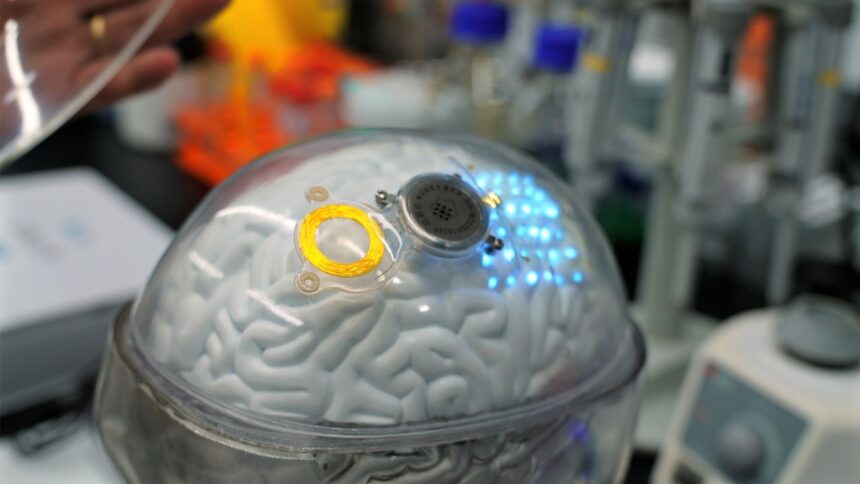
The trial places China squarely in the global race to turn brain-computer interfaces (BCIs) into usable medical technology. Unlike earlier experiments, this system works wirelessly, lives fully inside the body, and operates without external hardware tethering the patient to a lab.
What’s Happening & Why This Matters

Doctors at Huashan Hospital, affiliated with Fudan University, implant a tiny neural device into a 28-year-old man who lives with paralysis from a high spinal cord injury. Five days later, he controls devices using thought alone.
The system uses 64 ultra-thin electrodes, each thinner than a human hair. Engineers implant them directly into the brain. A processor, antenna, and battery sit beneath the skin near the chest. Wireless charging keeps the system running without external cables.
This design matters. Earlier BCIs rely on external processors or wired connections. Those setups limit mobility and raise infection risk. This implant removes those barriers.
From Thought to Action
Within weeks, the patient performs tasks many paralyzed people lose forever. He operates smart home devices, browses the internet, and plays video games. He even navigates a wheelchair.
Professor Mao Ying, president of Huashan Hospital, explains the impact clearly: the patient regains functional independence through neural intent. That shift changes rehabilitation, long-term care, and quality of life.
How This Stacks Against Neuralink
Comparison is unavoidable. Neuralink, backed by Elon Musk, pursues similar goals in the United States. Neuralink patients already control robotic arms and digital interfaces via direct brain signals.
China’s system differs in one key way. It already integrates power, processing, and communication fully under the skin. That integration solves a major usability challenge.
Zhang Xu of the Chinese Academy of Sciences stresses why this matters. Long-term power supply determines whether BCIs work outside short trials. Without it, the tech stalls.
Governments and Industry at the Ready
BCIs intersect healthcare, AI, and national strategy. The systems generate neural data. They rely on machine learning. They raise ethical questions about privacy and consent.
Yet the upside is enormous. Millions live with paralysis worldwide. Stroke, spinal injuries, and neurodegenerative diseases strip autonomy. BCIs offer a path back.
TF Summary: What’s Next
BCIs develop quickly from experimental promise to practical tools. China’s fully implanted system proves that neural control works beyond controlled demos. The next phase focuses on scaling trials, extending durability, and refining signal accuracy.
MY FORECAST: Within five years, medical-grade BCIs enter mainstream rehabilitation clinics. Competition between China and U.S. developers accelerates progress. Regulation struggles to keep pace. Patients gain real independence faster than policymakers expect.
— Text-to-Speech (TTS) provided by gspeech