


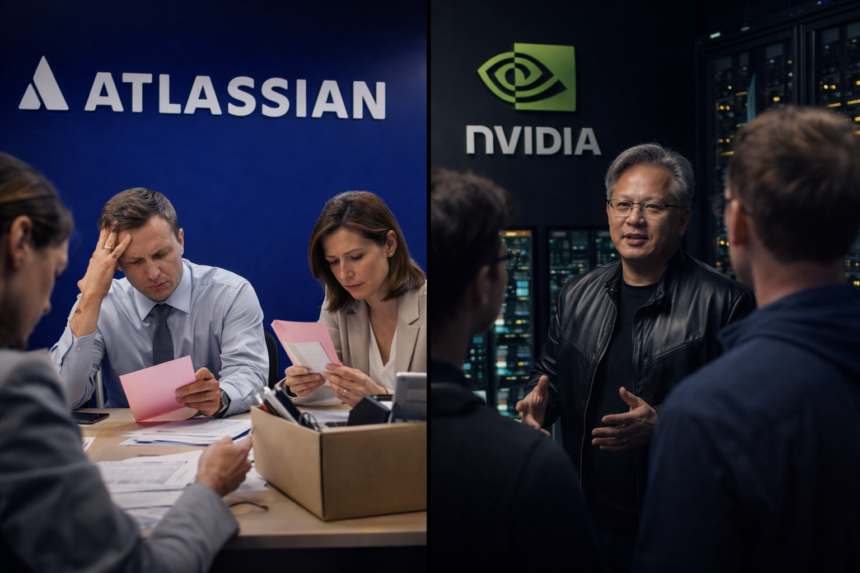
One company trims humans to fund AI. Another races to own the agent layer before everyone else does.
AI hype keeps splitting into two very different stories. In one story, executives talk about productivity, efficiency, and the glorious future of software. In the other, workers lose jobs, org charts get redrawn, and entire product categories start looking like a knife fight in a server room.
This week, we get both versions at once. Atlassian is cutting about 1,600 jobs, roughly 10% of its workforce, while telling staff it needs to free up money for more AI investment and enterprise sales. At nearly the same time, Nvidia is reportedly preparing an open-source OpenClaw rival called NemoClaw, a platform designed to help AI agents run for extended periods and integrate with business workflows.
Put those stories side by side, and the message is hard to miss. The AI boom is no longer a theory deck. It is currently rearranging payroll, product strategy, and control over the software stack. One company is paying for the next chapter by cutting staff. Another wants to own the stage where those next-generation agents perform.
What’s Happening & Why This Matters
Atlassian Cuts 1,600 Jobs and Ties the Move to AI
Atlassian says it is laying off about 1,600 employees, or roughly 10% of its workforce, as it restructures to invest further in AI and enterprise sales. The company says more than 900 of the affected roles were in software research and development. In June 2025, Atlassian had 13,813 full-time employees, with more than half working in software engineering and design.
The geographic spread is telling. About 640 affected employees are in North America, 480 in Australia, and 250 in India, with the rest spread across Japan, the Philippines, Europe, the Middle East, and Africa. A layoff map like that doesn’t feel surgical. It feels like a company redrawing its internal logic.
Co-founder Mike Cannon-Brookes told staff the decision was “the right decision for Atlassian,” even while admitting the impact weighed heavily on him and the company. He also wrote that it would be “disingenuous to pretend AI doesn’t change the mix of skills we need or the number of roles required in certain areas.”
That quote matters because it drops the corporate mask for a second. The company says this is not “AI replaces people,” yet it says AI changes how many roles are needed. That is not a contradiction. That is the real boardroom script in 2026.
Investors Cheer While Workers Get the Exit Packet
Atlassian says the restructure will help it “self-fund further investment in AI and enterprise sales” and speed up its path toward breaking even. Investors liked the sound of that. The company’s share price rose 4% in extended Nasdaq trading after the announcement.
The financial context explains why management took the knife out. Atlassian has lost more than half its market value since the start of 2026 as traders worry AI could make parts of its software stack look less special. The company brought in $1.6 billion (€1.47 billion) in revenue in the last three months of 2025, up by $300 million (€276 million) year over year. Yet it still posted a net loss of $42 million (€39 million), down from $38 million (€35 million) a year earlier.
So the company is not collapsing. It is repositioning under pressure. That makes the layoffs sting more, not less. This is not a bankruptcy story. It is an optimisation story. Workers hear “future-readiness.” Finance hears “margin discipline.” The spreadsheet grins. The office chat goes quiet.
Atlassian says affected employees will receive a minimum separation package of 16 weeks of pay, extended healthcare plans, early pro-rata bonuses, and a $1,000 (€920) technology payment after returning corporate laptops. That is better than a cardboard box and a security escort. It is still a brutal way to discover that “AI transformation” has your desk number on it.
The Union Response Is Furious, and for Good Reason
The union, Professionals Australia, says workers were told on Thursday that consultation will run until 19 March and that final terminations are expected on 2 April. Union director Paul Inglis says employees were made redundant without consultation or warning that the restructure would hit their jobs. He said they deserved “respect, transparency and proper consultation.”
That language shows the emotional cost here is not conceptual. Atlassian reportedly left internal Slack work chat functions open for at least six hours longer than usual so staff could say goodbye to colleagues. If your HR process includes extending chat access so people can mourn in real time, the company knows full well how hard the blow falls.
The company further announced that chief technology officer Rajeev Rajan will step down at the end of March and be replaced jointly by Taroon Mandhana and Vikram Rao, described as “next generation AI talent.” Even the wording tells a story: old structure out, AI structure in.
This is the new management pattern in tech. Layoffs and leadership reshuffles are getting wrapped in language about intelligence layers, next-gen talent, and self-funded transformation. The rhetoric sounds futuristic. The human experience feels ancient: fewer people, tighter teams, harder targets.
Atlassian Is Not Alone, Which Is Exactly the Problem
The file notes that similar cuts have already hit other companies. Block cut 40% of its global workforce, from 10,000 to under 6,000, while WiseTech announced plans to cut 2,000 jobs over two years, around 30% of its workforce.
That matters because it tells us this is not one company panicking in a corner. It is an industry trend. AI is becoming the explanation, the justification, and in some cases the public-facing villain for large-scale headcount cuts.
Of course, analysts note that companies often have reasons to cut staff beyond AI alone. Quite right. AI is rarely the only reason. It is often the most convenient reason.
Nvidia Wants the Agent Layer, Not Only the Chips
Now to the other half of the story, where the mood changes from layoffs to a land grab.
Nvidia is reportedly building an open-source AI agent platform called NemoClaw to compete with OpenClaw. Wired reports that Nvidia has been pitching the platform to corporate partners ahead of its annual developer conference, with companies such as Salesforce, Cisco, Google, Adobe, and CrowdStrike reportedly involved in discussions.
This is not Nvidia getting bored and trying a side quest. It is Nvidia trying to move further up the stack.
OpenClaw drew heavy attention earlier this year because it let users run “always-on” AI agents from personal machines using different underlying models. Last month, OpenAI hired creator Peter Steinberger “to drive the next generation of personal agents,” while saying the OpenClaw project itself would continue under an independent foundation with OpenAI’s support.
Nvidia CEO Jensen Huang even called OpenClaw “the most important software release probably ever.” When a man who already owns a huge chunk of the AI hardware market starts praising an agent framework that loudly, you should assume he wants a piece of the software territory around it.
NemoClaw Is Really About Control, Trust, and Distribution
NemoClaw reportedly includes security and privacy tools, which would make sense given the concerns around OpenClaw giving users all-around access to local data and systems. That security angle is not decoration. Corporate partners will not let autonomous agents near valuable data without some way to explain the risk to legal, security, and compliance teams who already sleep badly enough.
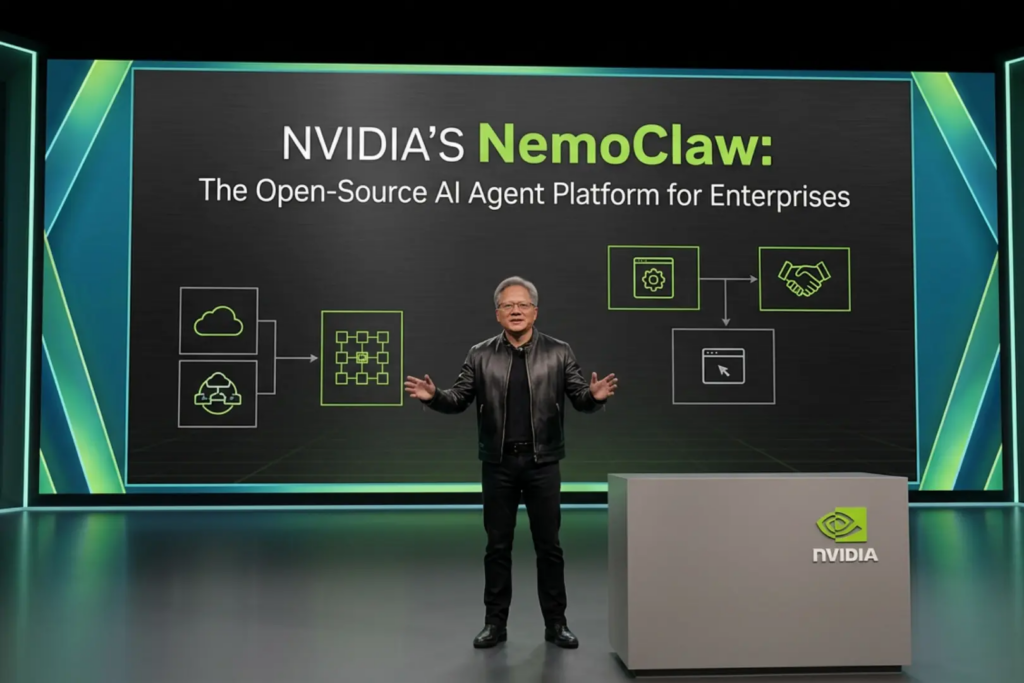
The more interesting detail is that NemoClaw is expected to run on machines without Nvidia GPUs. On the surface, that sounds generous. Underneath, it is strategic. Nvidia does not need every edge device to carry its hardware if the wider adoption of agent platforms still drives demand for GPUs used for training and serving the underlying models.
And there is another layer. If Nvidia is closely tied to the software orchestration layer for AI agents, it gets more influence over how enterprises choose hardware, cloud services, and deployment patterns. The company would no longer only power the brains of AI systems. It would help direct the hands.
That is a far more powerful position.
The Two Stories Belong Together…
Atlassian’s cuts and Nvidia’s NemoClaw emergence may look unrelated at first glance. They are not.
Atlassian is adjusting its workforce because AI is changing the mix of roles it needs. Nvidia is building tools to accelerate the rise of agent-driven software workflows that could further change those role mixes. One company is reacting to the AI era. The other is trying to define it.
That is why this matters beyond earnings calls and product leaks. The companies supplying the tooling for autonomous agents are helping shape the labour math inside the companies that buy or adopt those tools. When management says AI is changing the number of roles required, remember that somebody is building the systems meant to make that sentence sound practical.
This is a powerful story that extends beyond software capabilities. The companies controlling chips, models, orchestration, and agent frameworks are increasingly influencing how work gets split between humans and machines.
And no, they are not doing that out of pure love for productivity.
TF Summary: What’s Next
Atlassian’s decision to cut around 1,600 jobs while redirecting energy into AI and enterprise sales shows how quickly the “AI productivity” narrative is reshaping headcount, org charts, and investor expectations. At the same time, Nvidia’s reported NemoClaw project shows that the next AI battleground is no longer only model quality or GPU supply. It is the agent layer — the software that enables AI systems to act continuously, integrate with business tools, and perform multi-step tasks over hours or days.
MY FORECAST: More companies will cut roles while describing the move as an adjustment to the AI skills mix, not a replacement story. Expect that line everywhere. At the same time, Nvidia, OpenAI, and others will race to own the infrastructure for autonomous agents because that layer could shape enterprise software for years. The next fight will not only ask which AI is smartest. It will ask which AI gets to do the work, on which platform, with which profit margin attached.
— Text-to-Speech (TTS) provided by gspeech | TechFyle