


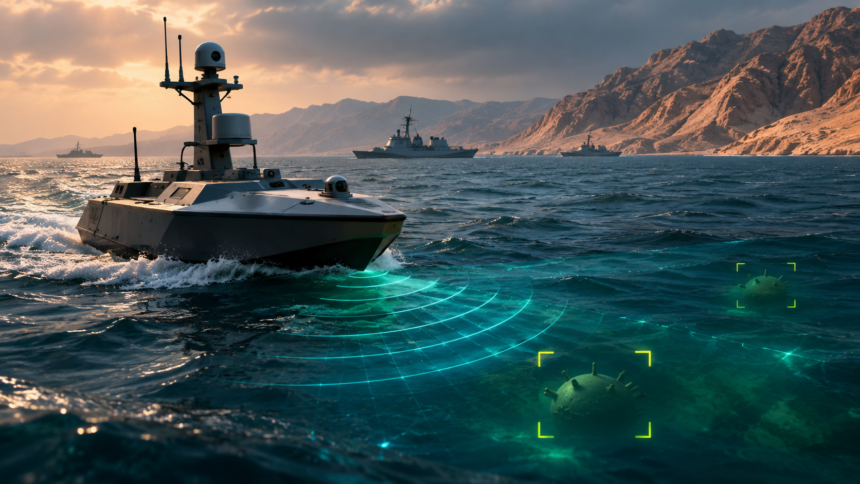
The US trials autonomous mine hunters in the Gulf, and Iran recovered one uncrewed submarine in September
By Joseph Adebayo
Robot vessels are mine-hunting in the Strait of Hormuz, and the Gulf conflict gives the US a live test. The BBC reports ships still face attacks.
TF‘s report draws on a syndicated copy of the BBC report and on Army Recognition. No sources identified the robot vessels’ patrol scheduling or timeline in the strait.
What’s Happening & Why It Matters
Why the Strait Needs Mine Hunters
The BBC says shipments through the strait run at about 75% of pre-conflict levels. Ships still come under attack, and the US says it has cleared the Omani route. Army Recognition says the US Central Command announced mine-clearance preparations on 11 April 2026.
Reuters put Hormuz oil flows at about 5 million barrels per day on 25 August 2026. Flows topped 20 million before the conflict. Army Recognition adds US forces struck Iranian launchers prepared to lay mines in August. The BBC report quotes Ian McFarlane of Thales, Neil Roberts of Lloyd’s and Steve Cameron, a former merchant navy officer.
My take: Shipping needs proof of a clear route, and proof is slow to gather. Robots can search for long hours without risk to sailors.
What the Robots Do
Conventional minehunters carry crews of about 80 sailors. Autonomous systems watched from shore may need about 20 people. The BBC says the technology has been in development for about 20 years.
Thales builds an uncrewed surface vessel with a towed 5-metre sonar. AI refines the sonar data into a 3D picture of the seabed. The US Navy used the Remus 100, a small underwater robot, in the 2003 Iraq war.
Steve Prest of the RUSI think tank served as the Royal Navy’s first fleet robotics officer in 2014. The BBC links the Royal Navy’s hybrid navy concept, which pairs crewed and uncrewed ships, to the same trend.
My take: Fewer sailors per ship eases a recruitment gap in NATO navies. The savings depend on reliable shore control links.
Navy Contracts and a Lost Submarine
Advanced Acoustic Concepts, a Thales subsidiary, won $53.9 million (about €48.0 million) from the US Navy, per Army Recognition. The award covers two Remote Mine Hunting modules. With options, the total could reach $196.2 million (about €174.6 million).
The Navy retired four Avenger-class minehunters in Bahrain in September 2025. Independence-class Littoral Combat Ships with unmanned systems replaced the ships. The Navy’s 38.5-foot Mine Countermeasures Unmanned Surface Vehicle carries the AN/AQS-20 sonar.
In early September 2026, Iranian forces pulled an Anduril uncrewed submarine from the strait, per the BBC. The Pentagon said the craft was older, malfunctioning and held no classified equipment. TF cannot verify the Pentagon account.
My take: The recovered submarine shows the risk of fielding robots near hostile shores. Losing a robot costs less than losing a crewed ship.
TF Summary: What’s Next
The US will keep testing mine hunters in Gulf waters while the conflict continues. Thales has not released detection range, depth or accuracy figures. Insurers and captains will watch for evidence that the main routes are clear.
MY FORECAST: The Navy will add neutralisation payloads to uncrewed mine hunters before 30 June 2027. Insurers will keep war-risk premiums for Hormuz transits above pre-conflict levels through 2027.
Related Stories You May Like:
- France Blames Iran’s Revolutionary Guards for European Fridge Hacks
- Satellite Wars: SpaceX Taps Qualcomm for Starlink Mobile as Viasat Shrinks
- Google’s Project Suncatcher Returns Its First AI Response From Orbit
- What We Learned at Web Summit 2026 in Lisbon: China, Robots and a Storm
- United CEO Doubts Boom’s 2029 Date as Superpower Turbines Target Data Centers