


ServiceNow Advances Its AI Governance Strategy with Control Tower
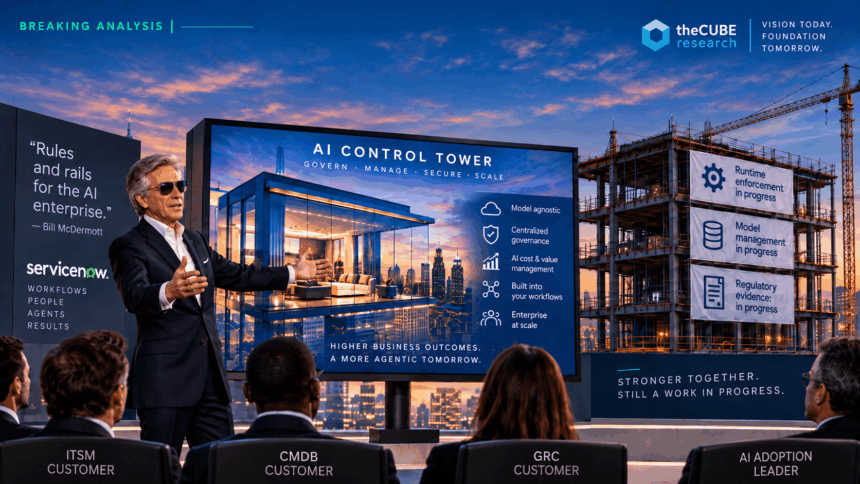
ServiceNow Inc. is making significant strides in the realm of enterprise artificial intelligence with the introduction of its AI Control Tower. The company asserts that this innovative tool can discover and govern any AI agent, facilitate integration across various models and cloud platforms, track associated costs and value, and terminate any activities that violate organizational policies. This capability aligns perfectly with ServiceNow’s biggest strength: its vast installed customer base.
ServiceNow’s established dominance in information technology service management (ITSM) and risk workflows, combined with its comprehensive configuration management database (CMDB), provides a competitive edge that many AI governance solutions lack. Industry research corroborates this advantage, although customer data presents a more complex picture of Control Tower’s performance. While it proves effective as a governance workflow and system of action, the full extent of its capabilities as a comprehensive technical governance platform across diverse enterprises remains unverified.
In a recent episode of Breaking Analysis, we applied the same rigorous methodology used in our CoreWeave analysis to evaluate management claims against findings from 15 in-depth interviews with ServiceNow customers, conducted in partnership with Qualitate. We seek to answer a critical question: Is Control Tower evolving into the enterprise AI control plane, or is it constrained to functioning merely as a governance system of action?
ServiceNow’s Control Tower: Three Key Functions
ServiceNow does not need to dominate every technical aspect of AI governance to thrive; it can generate considerable value simply by streamlining workflows around essential controls, including inventory management, accountability, approvals, and audit history. However, its marketing messaging may lead customers to conflate three distinct technical tasks under the umbrella of “AI governance.”
The first role is governance workflow and accountability, where ServiceNow currently excels. The second is the evidence of the AI lifecycle, encompassing model versions, lineage, validation, bias, explainability, and performance monitoring. Although ServiceNow can coordinate these aspects, they are often generated outside its platform. Lastly, runtime enforcement and AI security involve real-time actions to intercept or block deployments, which our survey indicates frequently occurs through external systems or manual processes.
While obtaining model approvals and issuing remediation tickets is beneficial, these actions do not equate to validating the model technically or imposing timely interventions. ServiceNow’s challenge lies in connecting these three layers comprehensively. According to customer feedback, the notion that Control Tower provides end-to-end governance is somewhat exaggerated.
Five Pillars of ServiceNow’s AI Strategy
Control Tower is part of a broader agentic AI strategy for ServiceNow, centered around five interconnected pillars. The first pillar emphasizes a model-agnostic approach that accommodates any agent, cloud, data source, or system of record. The second focuses on the transition from chat assistants to autonomous workers capable of planning, executing, and adapting workflows.
The third pillar involves centralized governance through AI Control Tower, focusing on discovery, ownership, access, and remediation tasks. The fourth pertains to managing the costs and value of AI, incorporating elements like token economics and return on investment. Finally, the fifth pillar covers pricing and packaging strategies, which aim to move customers through foundational, advanced, and premium tiers while adding consumption-based features on top of subscriptions.
Numerical Evidence of AI Momentum
Management’s argument for market leadership is grounded in ServiceNow’s deep understanding of enterprise workflow dynamics. Bill McDermott encapsulates the company’s competitive edge in a single word: context. As of mid-2026, ServiceNow claims to support approximately 100 billion workflows and has processed nearly 8 trillion transactions. Remarkably, over 500 customers had adopted AI Control Tower within just six months of its launch. The company reported an annualized contract value (ACV) from AI exceeding $1 billion in Q2, with a goal of reaching $1.5 billion by year’s end.
The CMDB offers insights into assets, services, and dependencies, while ITSM and change management systems streamline workflows. However, while specialized vendors may provide superior model analytics, they often lack the operational knowledge that enables identification of owners and paths to remediation. ServiceNow’s installed base thus positions it favorably within the competitive landscape.
Insights from Customer Interviews
A recent study conducted through theCUBE Research, in collaboration with Qualitate, yielded valuable insights. From September 15-21, 2026, 15 extensive interviews were completed across multiple sectors, including financial services, healthcare, technology, and manufacturing. Importantly, all respondents had some engagement with ServiceNow, with 11 organizations having already piloted or evaluated AI Control Tower.
The research methodology aimed to provide a qualitative assessment relevant to customers, focusing on expansion opportunities, coexistence, and boundaries of implementation. Respondents’ experiences should be understood within the context of ServiceNow’s established customer base, allowing for an accurate reflection of the product’s performance in its intended environment.
Challenges in Runtime Enforcement and Evidence Gaps
All participants acknowledged ServiceNow’s advantage in integrating workflows and operational processes. Nonetheless, a significant portion—14 out of 15—characterized runtime enforcement as largely external, custom-built, or reliant on manual interventions, lacking scalability. Furthermore, 12 of 15 highlighted a deficiency in model-specific evidence such as validation records and AI regulatory artifacts. This signifies a complex landscape where governance connects value to ServiceNow’s comprehensive platform, yet gaps persist in real-time enforcement and formal AI lifecycle monitoring.
Some interviewees likened ServiceNow more to a governance orchestration layer than a direct governance authority. While there is truth to this view, it remains justifiable within its current operational framework, particularly in its capability to organize accountability and action.