


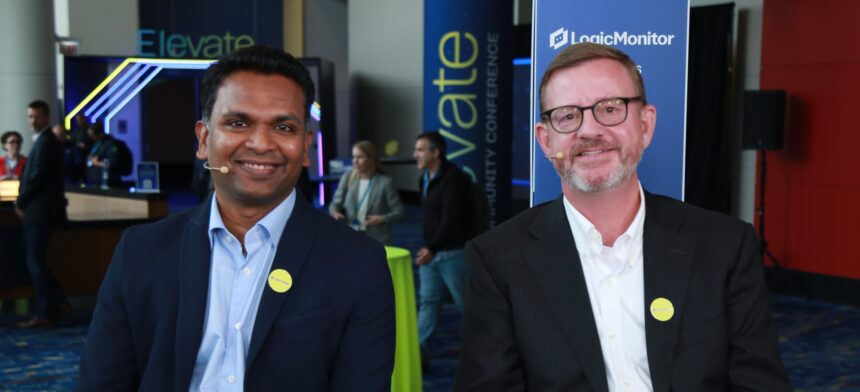
AI-Driven Observability Enhances Enterprise IT Management at LogicMonitor Elevate 2026
Enterprise IT is evolving with the integration of AI-driven observability, empowering organizations to effectively manage complex infrastructures and resolve incidents more swiftly. At the recent LogicMonitor Elevate event held in Chicago, the focus was on merging operational data, AI automation, and governance to tackle challenges inherent in hybrid environments. The impact of this shift is notable; GlobalFoundries reported a remarkable 98% reduction in alert noise utilizing Edwin AI, while managed service providers discussed enhancements in incident resolution and engineering efficiency. Although these developments reflect LogicMonitor’s commitment to autonomous IT, there remain critical questions surrounding adoption, trust, and operational oversight.
“Observability is becoming an essential foundation for both human decision-making and autonomous workflows,” noted Paul Nashawaty, practice lead and principal analyst for application development at theCUBE Research. He emphasized the opportunity to intertwine performance, availability, resource utilization, and costs, which will empower engineering teams to better understand the operational trade-offs involved. Nashawaty engaged with technology executives, customers, and partners at the event, examining the transformative effects of Edwin AI, OpenTelemetry, application dependency mapping, and governed automation on enterprise operations. Discussions also highlighted the rising significance of digital experience monitoring and the evolving responsibilities of managed service providers amidst the practical challenges of transitioning AI from experimental phases to production environments. (* Disclosure below.)
Here are eight key insights emerging from the event:
1. LogicMonitor’s AI Strategy Drives Observability Toward Governed Automation
Today’s enterprise observability surpasses static dashboards and endless alerting, as AI-driven operations require enhanced context, automation, and control. Steven Dickens, CEO of HyperFRAME Research, collaborated with Nashawaty to evaluate LogicMonitor’s keynote announcements, which outlined five strategic pillars, including unified context, AI-governed action, and building trust. Their discussions underscored how OpenTelemetry, Edwin AI, and Catchpoint are integral to LogicMonitor’s mission to connect complex hybrid environments and provide actionable insights within existing workflows. Dickens underscored that customer adoption, effective governance, and execution will be crucial in transforming LogicMonitor’s AI roadmap into tangible operational value.
For further insights, watch the full interview on theCUBE.
2. The Rise of Autonomous IT with a Focus on Governance and Trust
As enterprises increasingly turn to autonomous IT to simplify operational complexity and enhance incident resolution, trust in AI-driven systems is paramount. LogicMonitor’s Karthik Sj, Chief Artificial Intelligence Officer, and Garth Fort, Chief Product Officer, explained how their latest enhancements to Edwin AI facilitate multi-agent investigations and intricate integrations with existing workflows. These innovations are crucial to improving visibility into application performance while providing necessary oversight over autonomous agents, thus supporting the organization’s transition to AI governance.
Don’t miss the complete interview on theCUBE.
3. AI Adoption Drives Workforce Transformation and Measurable Business Results
Successfully adopting AI technology requires more than simply rolling out new tools; employee trust, leadership, and organizational change are vital components. LogicMonitor’s Alyene Schneidewind, Chief Performance Officer, revealed that the company saw a 95% employee adoption rate for ChatGPT within four months, fostering the creation of over 2,000 custom GPTs in its inaugural year. This internal shift is evolving toward workflow redesign and assessing tangible business outcomes, including an AI-enabled sales assistant that saves staff considerable time each week. Effective governance, cross-departmental collaboration, and innovative workforce development approaches are reimagining team operations and ensuring that AI investments yield significant business value.
For more details, check out the complete conversation on theCUBE.
4. AI-Powered Managed Services Emphasize Business Outcomes
Managed service providers are reevaluating traditional IT operations as AI automation opens up avenues to cut costs and enhance incident resolution, allowing technical teams to concentrate on higher-value tasks. According to John Grosshans, President of Field Operations at LogicMonitor, and Tim Wheeler, Chief Artificial Intelligence Officer at Bell Techlogix Inc., AI-powered observability and autonomous workflows are enabling a proactive shift in service delivery. Bell Techlogix is employing AI assistants to refine incident triage and automate documentation, while LogicMonitor’s initiatives are propelling organizations toward autonomous IT through improved data integration and event correlation.
To learn more, view the complete discussion on theCUBE.
5. Eliminating IT Silos Paves the Way for Autonomous Operations
The fragmentation of IT environments is prompting enterprises to reconsider their strategies for managing observability, automation, and service delivery in hybrid infrastructures. According to Ryan Crosby, Vice President of Intelligent Operations Sales at AHEAD, consolidating disparate tools and standardizing operations can boost efficiency and accelerate AI adoption. One client successfully streamlined its technology footprint from 72 tools to just seven platforms, driving a simpler support model that lays the groundwork for greater automation. Achieving autonomous IT also necessitates strong executive leadership, governance, and an integrated strategy linking observability with incident management, change control, and automated remediation.
For deeper insights, check out the full theCUBE interview.
6. AI Agents Expedite Incident Resolution and Enhance Customer Retention
AI is reshaping the economics of managed services as providers shift from reactive incident management to proactive prevention, all while demonstrating quantifiable business value. Enhanced resolution times, improved service-level agreements, and increased customer retention are some advantages stemming from AI implementation, highlighted by Kyle Hill, CTO of ANS Group Ltd., and Steve Smith, CTO of Cloud Services at Specialist Computer Centres PLC. Hill noted that employing Edwin AI has fostered superior engineering efficiency and customer retention at ANS. Meanwhile, Smith referenced an AI agent that pinpointed a technical issue in approximately three minutes, a task that had occupied engineers for 40 to 50 hours prior. Cultivating customer confidence in autonomous IT is a gradual process that relies heavily on governance, compliance, and tangible results.
Watch the full conversation on theCUBE.
7. AI-Driven Observability Achieves 98% Alert Noise Reduction at GlobalFoundries
In semiconductor manufacturing, maintaining operational continuity hinges on preemptively addressing potential infrastructure issues. GlobalFoundries U.S. Inc. recently launched an observability modernization initiative that has achieved a remarkable 98% reduction in alert noise within only six months, utilizing Edwin AI, as shared by Vishal Mehra, CIO. The company is also consolidating its observability tools, leveraging dependency mapping to enhance understanding of legacy applications while integrating AI-driven insights with ServiceNow to bolster incident management. With strong executive sponsorship and a phased automation strategy, GlobalFoundries aims for autonomous IT operations that can proactively detect potential failures, preventing costly disruptions before they escalate.
The full interview is accessible on theCUBE.
8. Five Pillars of AI-Driven Observability Lead Toward Autonomous IT
The realm of enterprise observability is transitioning from traditional monitoring toward a model that aligns telemetry, operational context, and AI governance, ultimately enhancing application reliability and incident response. During his concluding remarks at Elevate, Nashawaty outlined five priorities steering this evolution: enterprise data foundations, unified context, AI-governed action, integrated experiences, and trust and governance. Tools such as OpenTelemetry and Edwin AI, combined with deeper integrations into current workflows, are crucial for linking infrastructure performance to business outcomes while reducing alert noise and optimizing root cause analysis. The forthcoming phase of observability will hinge on connecting operational evidence with informed decision-making, enabling enterprises to shift from AI experimentation to production-level autonomous operations.
Further insights can be found in the full analysis on theCUBE.
For more extensive coverage of LogicMonitor’s Elevate event, visit SiliconANGLE’s and theCUBE’s resources:
(* Disclosure: TheCUBE is a paid media partner for LogicMonitor’s Elevate event. LogicMonitor, the sponsor of theCUBE’s event coverage, and other sponsors do not have editorial control over the content on theCUBE or SiliconANGLE.)