


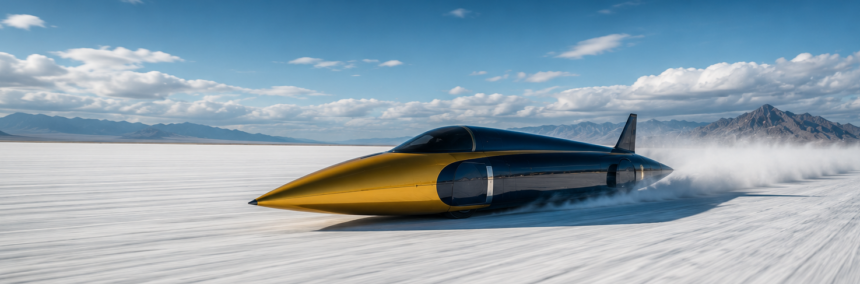
It’s the same engine sitting inside a digger on a construction site. Same block. Same combustion process. JCB just bolted two of them into a 32-foot streamliner, drove it across the Utah salt flats, and doubled the previous hydrogen speed record in a single afternoon.
Britain’s JCB just rewrote the hydrogen speed record books. On 11 August, the company’s Hydromax streamliner averaged 406.320 mph across the Bonneville Salt Flats, more than doubling the previous hydrogen internal combustion benchmark of 185.5 mph, set by the BMW H2R back in 2004. The record stands pending official ratification from the Fédération Internationale de l’Automobile (FIA), the global governing body for motorsport. Wing Commander Andy Green OBE drove it — the same man who’s the only human alive to break the sound barrier on land, at 763.035 mph. He wasn’t chasing a barrier. He was chasing his own two-decade-old number.
What’s Happening & Why It Matters
A Digger Engine, 400+ MPH
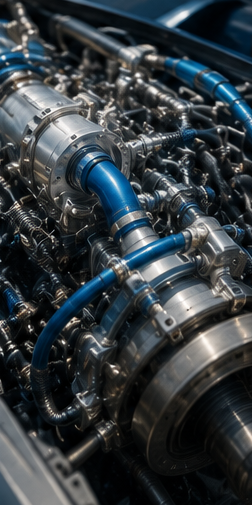
Here’s what makes the record different from a typical land speed attempt. The Hydromax ran on two production-based hydrogen combustion engines — the same 1,600-bhp units JCB already builds into its diggers, rolling off the company’s production line in Foston, Derbyshire. JCB didn’t employ a bespoke racing motor engineered for a salt flat sprint with no connection to anything real. It was construction equipment hardware, unmodified in its fundamental design, doing 406 mph.
FIA rules require two timed runs in opposite directions within a single hour, with the official speed calculated as the average. Green posted 400.623 mph on the first pass. He came back at 412.135 mph on the return run. Average those two numbers, and you get 406.320 — a figure that clears both the previous hydrogen record and JCB’s own diesel benchmark of 350.092 mph, set two decades earlier at the same location with the same driver.
20 Years Later: Green Outpaces Himself

There’s a specific symmetry worth contemplating. Green drove JCB Dieselmax to that 350.092 mph diesel record at Bonneville in August 2006. Twenty years on, almost to the week, he came back to the same salt with JCB’s next-generation hydrogen engines and beat his own number by more than 55 mph — using a fuel that produces zero CO₂ at the tailpipe. “Coming back to the same place with their new generation hydrogen engines to go faster than Dieselmax was very much the target,” Green said.
He wasn’t expecting to blow past it by much. “Anything above 351 would have been a result,” he told reporters after the run. “To get 406 has blown us all away and we’re still looking around to go, ‘Did we really just do that? Are the JCB hydrogen engines really that fast?’ The answer is yes.” The time it took to complete the measured mile: just under nine seconds.
More Than Winning a Trophy

JCB isn’t a racing company chasing headlines. It’s one of the largest construction equipment manufacturers in the world, and the record fits into a much larger, more expensive bet the company’s already made. Green tied the achievement to JCB’s US ambitions: “Part of their future offering in zero-carbon technology of the future is going to be hydrogen-powered construction equipment.” That future arrives with a specific price tag attached — a new $500 million factory opening in San Antonio, Texas, expected to employ around 1,500 people, backed by JCB’s $130 million hydrogen engine program.
Chairman Anthony Bamford placed the record around that commercial argument: proof that hydrogen combustion works today, at the highest performance level, with zero emissions at the point of use. FIA president Mohammed Ben Sulayem offered a similar read from motorsport’s side, calling the achievement “a truly historic milestone for motorsport showcasing how innovation, performance, speed, and sustainability can go hand in hand.”
TF Summary: What’s Next
The 406.320 mph record is pending official ratification by the FIA. JCB’s $500 million San Antonio factory continues construction, with no confirmed opening date announced beyond the 2026 timeline the company’s already outlined. Green and the Hydromax team have not announced whether they intend to push for a faster run before the current Bonneville Speed Week season closes.
MY FORECAST: Expect JCB to lean hard into the record commercially over the next 12 months, using it as the centrepiece of its hydrogen construction equipment marketing right as the San Antonio factory comes online. A 406 mph proof point does more to convince a sceptical construction-industry buyer that hydrogen combustion is viable than any spec sheet could. Watch for at least one rival construction equipment maker — Caterpillar or Komatsu are the obvious candidates — to announce a comparable hydrogen combustion demonstration within the next two years, given how the record moved the credibility bar for the category.
Related Stories
- The 2027 Q9: Audi’s Techy, Full-Size Luxury SUV
- Spain Launches Floating Solar Platform That Uses the Sea to Boost Output
- Where the Climate Fight Actually Stands: The Technologies, the Money, and the Warnings