


Trump and Vance killed the first order last year. Apple already disabled encrypted backups for new British users rather than build a backdoor. The Home Office is back with a narrower demand, targeting only UK citizens’ data. Apple says the distinction doesn’t matter.
Apple filed a new legal challenge against the UK government in July 2026, escalating a dispute over encrypted iCloud data that first surfaced in early 2025. The complaint went to the UK’s Investigatory Powers Tribunal, the court that hears cases involving government surveillance, according to the Financial Times. The filing centres on a Technical Capability Notice the Home Office issued last September, demanding Apple provide access to encrypted iCloud backups belonging to British users. Apple confirmed the filing to CNBC but declined comment, repeating a familiar position: “We have never built a backdoor or master key to any of our products or services and we never will.”
What’s Happening & Why It Matters
A Second Attempt After Political Pressure

This isn’t the UK’s first try. The Home Office demanded access to encrypted data belonging to both British and American users in early 2025, a request broad enough to draw direct intervention from Washington. Former Director of National Intelligence Tulsi Gabbard said in August 2025 that the UK dropped the original order following pressure from President Trump and Vice President JD Vance. That version of the fight ended with a public retreat from London.
The retreat didn’t last. The Home Office issued a narrower Technical Capability Notice in September 2025, targeting only UK citizens’ encrypted data rather than American users too. Apple’s new complaint argues the distinction changes little in practice, since any backdoor built for one group of users creates an exploitable weakness for all of them. As Apple’s own filing states, non-American data mixes with American data across shared iCloud accounts, family sharing, and cross-border communication, making a UK-only backdoor harder to contain than the Home Office suggests.
What Advanced Data Protection Does
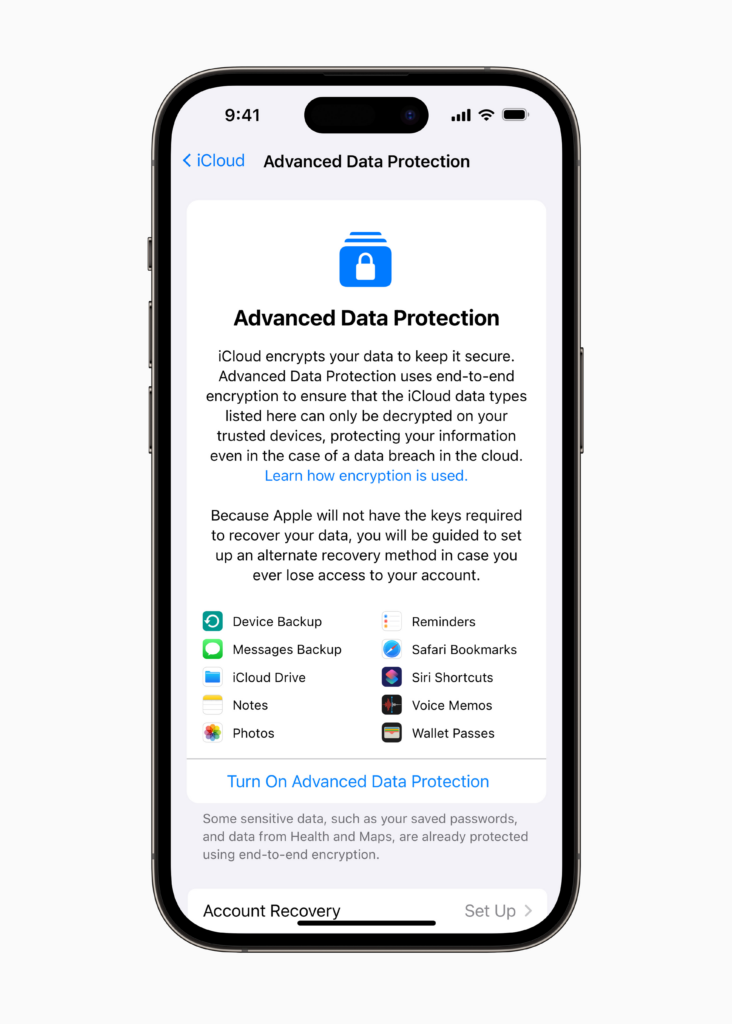
The dispute centres on Apple’s Advanced Data Protection program, which applies end-to-end encryption to iCloud backups, photos, and messages. Because Apple never holds the encryption keys, the company itself cannot access ADP-protected data, even under a court order. That design is what makes the feature valuable to privacy-conscious users and what makes it a target for law enforcement agencies pursuing serious crime, terrorism, and child sexual abuse investigations.
Rather than build the backdoor the Home Office demanded, Apple disabled Advanced Data Protection for new UK users while the legal fight continues. Existing UK users who already enabled the feature will need to deactivate it too, according to a company statement from September. That response reveals Apple’s actual negotiating position: the company would rather remove a security feature from an entire country than compromise the encryption architecture protecting users everywhere else.
Civil Liberties Groups Weigh the Stakes
Ruth Ehrlich, director of external relations at the civil liberties group Liberty, warned the case carries consequences well beyond UK borders. “Opening a backdoor risks personal data,” she said, describing the dispute as having “far-reaching implications for the public’s privacy rights.” Liberty and Privacy International are challenging the UK government’s use of similar surveillance powers, and the court order notifying Privacy International of Apple’s filing is how the complaint became public in the first place, since neither Apple nor the Home Office can comment on the case.

That secrecy requirement is itself part of the controversy. Technical Capability Notices are classified by design, meaning the public learns about them only through leaks, court filings, or reporting like the Financial Times’ original disclosure. Critics argue that opacity makes meaningful public oversight of surveillance demands nearly impossible, regardless of how narrowly or how any individual notice is scoped.
TF Summary: What’s Next
The Investigatory Powers Tribunal has not scheduled a hearing date for Apple’s new complaint. Neither Apple nor the UK Home Office can comment on case specifics, given the classified nature of Technical Capability Notices. Existing UK users with Advanced Data Protection enabled will need to turn off the feature, though Apple hasn’t specified a deadline. The legal challenges from Liberty and Privacy International against UK surveillance powers continue separately.
MY FORECAST: Expect the second challenge to follow a similar trajectory to the first, ending in either a narrowed order or another UK retreat under renewed pressure from Washington, given how the Trump administration intervened last time and how little political appetite exists for reopening that fight. The more durable outcome is architectural, not legal. Apple’s decision to disable Advanced Data Protection for UK users rather than build any backdoor establishes a template the company will repeat with any future government demanding similar access, whether in the EU, Australia, or elsewhere. Watch whether other governments cite the UK’s approach as a model worth copying, or whether Apple’s consistent refusal instead discourages similar demands from being made at all.
Related Stories
- Russia Issues Arrest Warrant for Durov, Telegram Founder
- A CSAM Lawsuit Against Apple Over iCloud Was Just Dismissed
- EU Makes AI Labels Mandatory for Realistic Synthetic Content